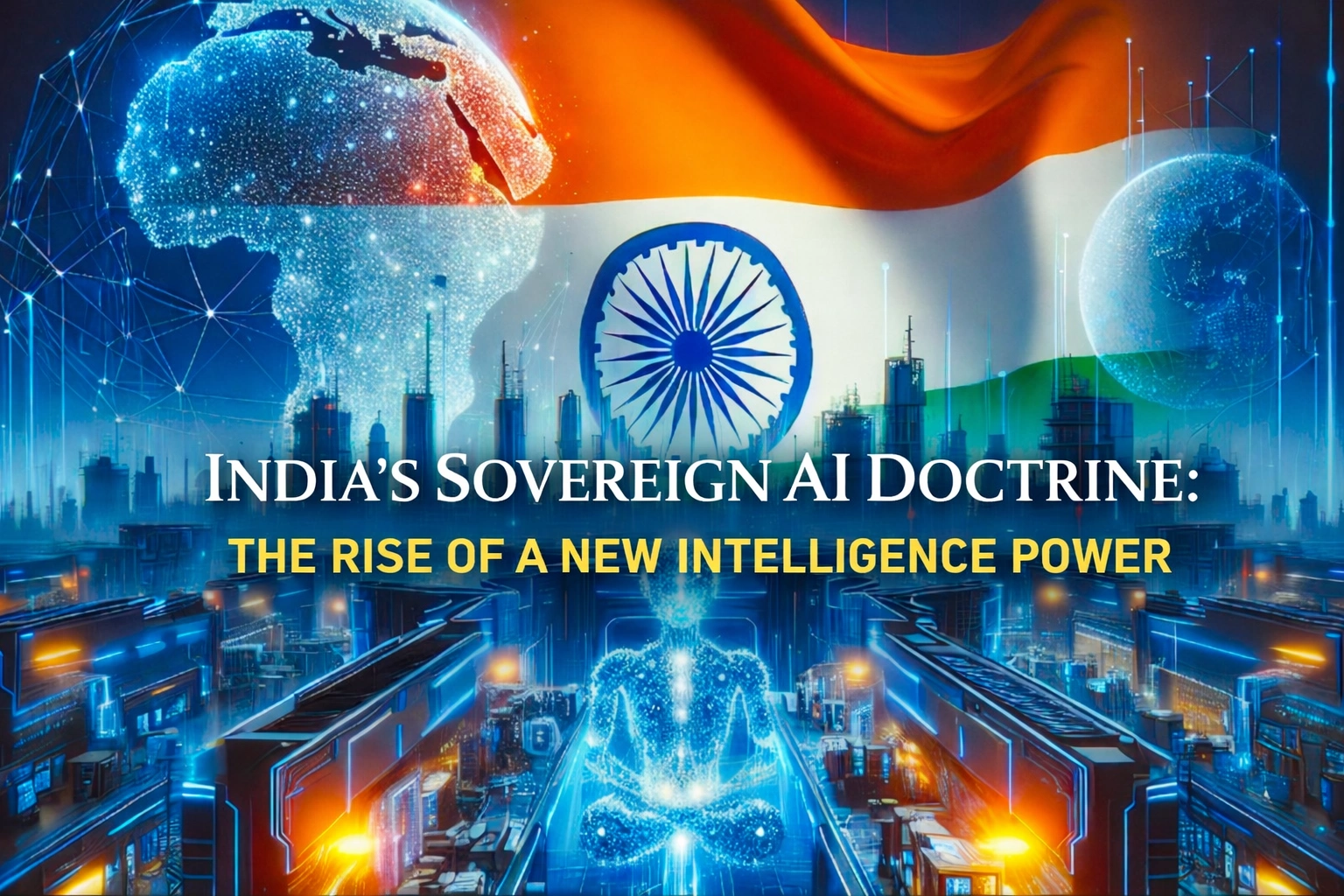
India’s sovereign AI infrastructure forms the foundation of its rise as a global intelligence power
India AI Impact Summit 2026: India’s Sovereign AI Doctrine and the Geopolitics of Intelligence
The India AI Impact Summit 2026 represents a decisive inflection point in India’s technological evolution. More than a global technology gathering, it marks India’s formal transition from an adopter of artificial intelligence to a sovereign architect of AI systems, infrastructure, and governance.
At the heart of the summit lies a strategic doctrine increasingly referred to as “Sovereign AI”—the principle that true digital independence requires ownership of the models, infrastructure, and data that power national intelligence systems.
The End of Digital Dependency
For years, India’s digital ecosystem relied heavily on foreign-developed AI platforms. While these tools accelerated innovation, they also introduced structural vulnerabilities. Control over AI systems determines how information is processed, how decisions are made, and ultimately, who holds technological power.
India’s sovereign AI strategy seeks to eliminate this dependency by building indigenous capability across the entire AI stack—from hardware and cloud infrastructure to foundational models and applications.
This transition mirrors India’s earlier successes with Aadhaar and UPI, where sovereign infrastructure enabled both innovation and strategic autonomy.
The $200 Billion Strategic Bet
The summit revealed one of the most ambitious technology investment plans in modern history: India expects over $200 billion in AI-related investments over the next two years.
This investment will support expansion across five key layers:
- Compute and semiconductor infrastructure
- Cloud and sovereign data hosting
- Foundational AI models
- Enterprise and government applications
- AI-driven services and innovation ecosystems
Infrastructure is the backbone of AI power. Without sovereign compute capacity, nations remain dependent on external actors for access to intelligence systems.
Param-2 and Control of the Cognitive Layer
The unveiling of Param-2, India’s indigenous multilingual foundation model, marks a critical milestone in sovereign AI capability. Supporting 22 Indian languages and optimized for reasoning and analytical tasks, Param-2 represents India’s entry into the global race to control the cognitive layer of artificial intelligence.
Foundational models determine how machines understand language, interpret reality, and assist decision-making. Control over these models translates directly into strategic and economic influence.
Economic Transformation and Productivity Revolution
Artificial intelligence is poised to transform India’s core economic sectors:
- Agriculture: AI-driven satellite analytics improving crop yields and climate resilience.
- Healthcare: Multilingual diagnostics expanding access to quality healthcare.
- Manufacturing: Robotics and automation increasing productivity and efficiency.
- Financial Inclusion: AI systems enabling access to banking and credit for underserved populations.
Together, these advancements could significantly increase India’s economic productivity and accelerate its transition into a developed economy.
The Startup Battlefield: Opportunity and Strategic Risk
India’s sovereign AI infrastructure aims to empower domestic startups. However, summit discussions highlighted a critical risk: global technology giants may underprice AI services to dominate emerging markets and suppress local innovation.
India’s response is to build shared public infrastructure—compute, datasets, and models—allowing startups to compete on innovation rather than capital alone.
AI, National Security, and Strategic Sovereignty
Artificial intelligence has emerged as a strategic asset comparable to nuclear technology or satellite systems. AI increasingly powers defense intelligence, cyber operations, surveillance systems, and national infrastructure.
Dependence on foreign AI systems in such domains presents unacceptable strategic risks.
India’s sovereign AI initiative ensures that critical national systems remain under domestic control, enhancing resilience against geopolitical disruptions.
The Emerging Global AI Power Structure
The global AI landscape is increasingly shaped by three competing models:
- United States: Corporate-driven AI leadership
- China: State-controlled centralized AI development
- India: Hybrid public-private sovereign AI ecosystem
India’s approach emphasizes open infrastructure combined with private innovation, positioning it as a technological leader among emerging economies.
Conclusion: India’s AI Independence Moment
The India AI Impact Summit 2026 marks the beginning of a new era. By investing in infrastructure, building indigenous models, and fostering research ecosystems, India is laying the foundation for long-term technological independence.
The implications extend far beyond economics. AI sovereignty will shape India’s geopolitical influence, national security, and global technological standing.
If successful, India will not merely participate in the global AI revolution—it will help define its architecture.
This article is intended for strategic analysis and editorial publication.