The 18% Gambit: How India Escaped the BRICS Tariff Trap
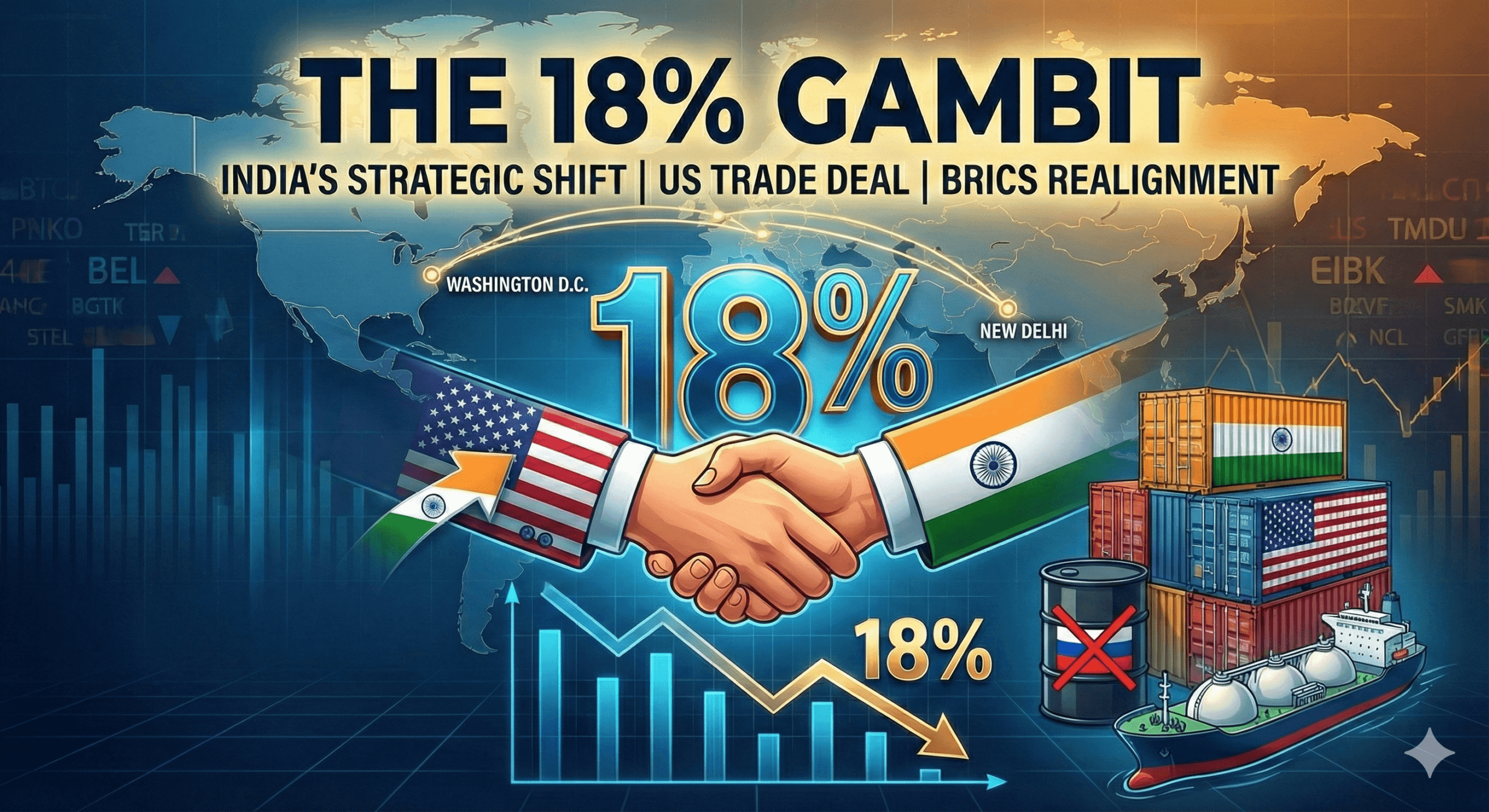
The India US tariff deal signed February 7, 2026 marks the most consequential trade realignment of the decade. India has secured preferential tariff treatment from Washington that fundamentally separates it from its BRICS partners. The updated Executive Order 14329 doesn’t just cut rates—it redefines India’s position in the global economic order.
Executive Summary
Three numbers tell the story:
- 18%: India’s new strategic tariff rate
- ₹40,000 crore: Immediate refund to Indian exporters
- $500 billion: India’s five-year U.S. procurement commitment
The ₹40,000 Crore Lifeline
The tariff reduction is only half the story. In an unprecedented move, U.S. Customs and Border Protection has been directed to reverse six months of punitive “Russian Oil” duties—a ₹40,000 crore ($4.8 billion) refund that will inject immediate liquidity into India’s export sector.

Who benefits most:
- MSMEs in textiles and engineering that absorbed costs to stay competitive.
- Pharmaceutical exporters who maintained market share despite margin compression.
- Auto components manufacturers squeezed between U.S. tariffs and Chinese competition.
This isn’t relief—it’s rescue capital. For thousands of mid-sized exporters operating on thin margins, this refund represents 6-9 months of working capital arriving exactly when credit conditions are tightening.
The New BRICS Hierarchy: India Stands Apart
Washington has created a four-tier system that demolishes the fiction of BRICS unity. India now occupies a category of one.
| Country | U.S. Tariff Rate | Strategic Classification | Delta from India |
|---|---|---|---|
| India | 18% | Strategic Ally | — |
| South Africa | 30% | Non-Aligned Friction | +67% |
| China | 37% | Strategic Rival | +106% |
| Brazil | 50% | Reciprocal Conflict | +178% |
| Russia | Sanctioned | Total Embargo | N/A |
What this means: An Indian textile exporter now has a 32-percentage-point advantage over a Chinese competitor. In commodity categories where price sensitivity is absolute, this isn’t just competitive—it’s determinative.
The 300-Day War: A Chronicle of Pressure and Pivot
April 2, 2025: The Opening Salvo
Washington announces a baseline 25% reciprocal tariff on Indian goods. New Delhi responds with calibrated counter-tariffs but maintains diplomatic channels.
August 6, 2025: Maximum Pressure
The “darkest hour.” An additional 25% penalty linked to Russian oil imports drives total duties to 50%. Indian export growth crashes to -8.4% month-over-month. Emergency Cabinet meetings convene in New Delhi.
February 2, 2026: The Breakthrough
A 90-minute phone call between PM Modi and President Trump produces an “Interim Framework.” Sources describe the conversation as “direct, transactional, conclusive.”
February 7, 2026: The Reset
Executive Order 14329 is amended. The 25% oil penalty is rescinded. Base rate drops to 18%. Refunds are authorized. The tariff war ends—with conditions.
The Strategic Bargain: Energy Independence for Market Access
This is not a trade concession. It’s a procurement swap with geopolitical implications.
India’s Commitment:
- Purchase $500 billion in U.S. goods over five years.
- Shift energy imports from Russian Urals to U.S. LNG and shale.
- Cap Russian oil imports at ~800,000 barrels/day (down from 2.1 million at peak).
- Phase-out of the 2% Digital Services Tax affecting U.S. tech giants.
What India Gains:
- Immediate tariff relief to 18%.
- Defense technology transfer acceleration.
- Zero-tariff pathway for aircraft components and defense electronics by Q4 2026.
- Preferential treatment in U.S. government procurement.
Sector Impact Analysis
1. Defense: The Real Prize
A new 10-year defense framework aims to eliminate tariffs on aircraft parts, avionics, semiconductor components for military applications, and communication systems.
Winners: HAL, Bharat Electronics, Zen Technologies, and the emerging private defense sector.
2. Technology: The Digital Détente
India’s agreement to phase out the Digital Services Tax removes the single biggest irritant in U.S.-India tech relations. Expect accelerated cloud infrastructure investment, renewed momentum in semiconductor fab negotiations, and deeper integration into U.S. tech supply chains.
3. Energy: The Pivot Point
This is where compliance risk lives. The U.S. Commerce Department has installed a “snapback” clause. If India’s Russian oil imports exceed agreed levels by March 2026, the 25% penalty can be reimposed within 48 hours—no negotiation, no grace period.
Current trajectory: India imported 1.63 million barrels/day of Russian oil in January 2026. The target is 800,000 by month-end. That is a 51% reduction in 60 days. Ambitious doesn’t begin to describe it.
The Compliance Era: What Comes Next
For Exporters:
- Immediate action: Verify eligibility for refunds with customs brokers.
- Medium-term: Recalibrate pricing strategies with the 18% rate embedded.
- Strategic: Diversify beyond U.S. markets—this preferential access creates dependency.
For Investors:
- Defense stocks: Strong buy signal—the tariff pathway to zero is now codified.
- Energy importers: Watch compliance metrics monthly—snapback risk is real.
- Tech sector: The DST phase-out removes a major valuation discount for India-focused platforms.
For Policymakers:
This deal required India to accept terms that would have been unthinkable 18 months ago. The calculation was simple: economic survival trumps strategic autonomy. But compliance monitoring will be intrusive, and the geopolitical cost—distancing from Russia, accepting U.S. oversight of energy policy—is only beginning to be calculated.
The Strategist’s Verdict
India has secured breathing room, not victory. The 18% rate is a floor, not a ceiling—compliance failures or geopolitical missteps could reverse these gains within weeks. The BRICS narrative of multipolarity has taken a decisive hit; New Delhi has chosen sides, at least in the economic arena.
Three scenarios for 2027:
- Best case: India meets compliance targets, tariffs drop further to 12-15%, and it becomes the primary Asia-Pacific manufacturing alternative to China.
- Base case: India hovers around compliance thresholds, rate stays at 18%, and the relationship remains transactional.
- Worst case: Compliance failure triggers snapback, energy crisis forces return to Russian oil, and tariffs revert to 43-50%.
The next 90 days will determine which scenario unfolds.
About The Eastern Strategist
The Eastern Strategist provides actionable geopolitical and economic analysis for decision-makers navigating India’s evolving position in the global order.
Editor’s Note: This analysis incorporates the latest data as of February 10, 2026. U.S.-India trade policy remains fluid. For real-time updates, subscribe to our daily brief.