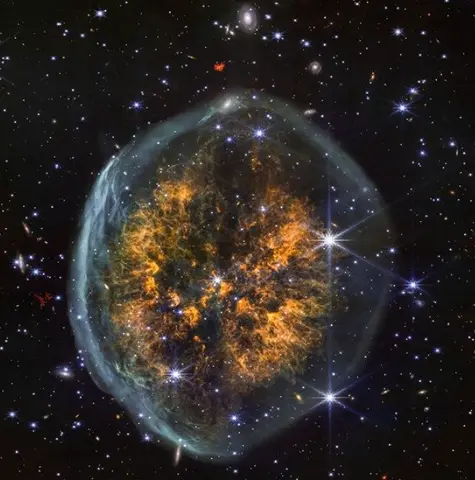
NASA’s Webb Peels Back the ‘Cosmic Skull’: The Forensic Truth of the Cranium Nebula
Cosmic Skull-like nebula in space?
Five thousand light-years from Earth, nestled in the southern constellation Vela, something extraordinary is happening. A dying star—one that spent eons quietly fusing elements in its core—has violently shed its outer layers to leave behind a ghostly shell known as the Exposed Cranium Nebula (PMR 1). But here is what makes this cosmic death mask different: NASA’s James Webb Space Telescope (JWST) has just peeled back its outer veil to reveal an interior so intricate it is rewriting our understanding of how stars die—and what they leave behind for the next generation of worlds.
The nebula earned its macabre nickname honestly. In previous views, most notably from the Spitzer Space Telescope in 2013, it appeared as a faint, glowing skull floating in the void. But Webb’s infrared vision, which pierces through the cosmic dust that blinds optical telescopes, has revealed the “brain” within the skull: a labyrinth of filaments and chemical shells that map the final convulsions of a star’s death throes with unprecedented clarity.
The Forensic Lens
Think of Webb’s instruments—MIRI and NIRCam—not as cameras but as forensic tools at a crime scene. Together, they have produced an image that challenges the textbook narrative of planetary nebulae as simple, spherical bubbles. Instead, the Cranium shows a complex, nested structure: a large outer shell of hydrogen (the “skull”) and a highly structured inner cloud of ionized gas (the “brain”), separated by a distinctive, dark vertical lane.
The chemical stratification reads like an autopsy report. By mapping the glow of molecules and dust grains heated by the central star’s radiation, Webb has identified specific zones where the star ejected different materials at different speeds. The Cranium Nebula is not merely a grave—it is a maternity ward, seeding the galaxy with the raw materials for rocky planets and, potentially, life itself.
The Mystery at the Core
At the center of this expanding shell sits the stellar remnant, a pinpoint of intense energy that powers the entire display. While earlier models often assumed such remnants were standard white dwarfs, the Webb data has sparked a new debate among astrophysicists. The exact mass and nature of this star remain TBD; some suspect it may be a more massive and unstable Wolf-Rayet star.
If it is a high-mass remnant, its ultimate fate is not a slow cooling into an ember, but perhaps a more violent conclusion. Currently, it is blasting the surrounding gas with radiation equivalent to thousands of suns, ionizing atoms and creating the eerie glow visible across the galaxy. This star hasn’t just died; it has transformed into a high-energy engine of chemical synthesis.
Why This Matters for Earth
Our Sun will one day share a similar fate. In approximately five billion years, it will exhaust its fuel and eject its atmosphere into space, creating a planetary nebula that future civilizations might observe from distant worlds. But the Cranium Nebula is more than a preview of our cosmic end. It is a factory. Every atom of oxygen in the water you drank this morning, and every molecule of iron in your blood, was forged in the core of a dying star and scattered through nebulae like this one.
Webb has given us the sharpest image yet of stellar alchemy in action—the process that makes rocky worlds and organic molecules possible.
The Technical Breakthrough
The leap from the 2013 Spitzer observations to today’s Webb imagery is the difference between a blurry charcoal sketch and a high-definition MRI. Because Webb operates at the L2 Lagrange point, 1.5 million kilometers from Earth, it is free from the infrared “noise” of our planet’s atmosphere. This allowed MIRI (Mid-Infrared Instrument) to capture wavelengths between 5 and 28 microns—the precise range where warm dust and complex molecules reveal their secrets.
While we now see the structure, the “why” remains. Why did the star eject material in such specific, asymmetrical pulses? To find out, NASA is planning follow-up spectroscopy to measure the velocities of individual gas clouds, tracing their trajectories back to the exact moment of ejection.
The Ghost in the Machine
There is something haunting about staring at the Cranium Nebula and knowing you are looking at a star’s last breath—frozen in time by the speed of light, arriving at our telescopes 5,000 years after the event itself. The light Webb captures today left the nebula as the first civilizations were rising in the Indus Valley and Mesopotamia.
The Cranium Nebula reminds us that endings are generative. The oxygen we breathe today was likely expelled from a similar nebula billions of years ago. In that sense, the star inside the Cranium never truly died. It simply traded fusion for chemistry, and light for legacy. And somewhere, five millennia from now, another observer might look toward our Sun’s remnant and wonder what kind of world once orbited that distant, dying light.