WWIII at Sub-Zero: Why the Arctic Is the World’s Most Dangerous New Battlefield
Arctic geopolitics is no longer a distant climate story — it is a high-risk power struggle unfolding in real time at the top of the world.
For decades, the Arctic was seen as frozen, remote, and strategically irrelevant.
In 2026, that illusion is gone.
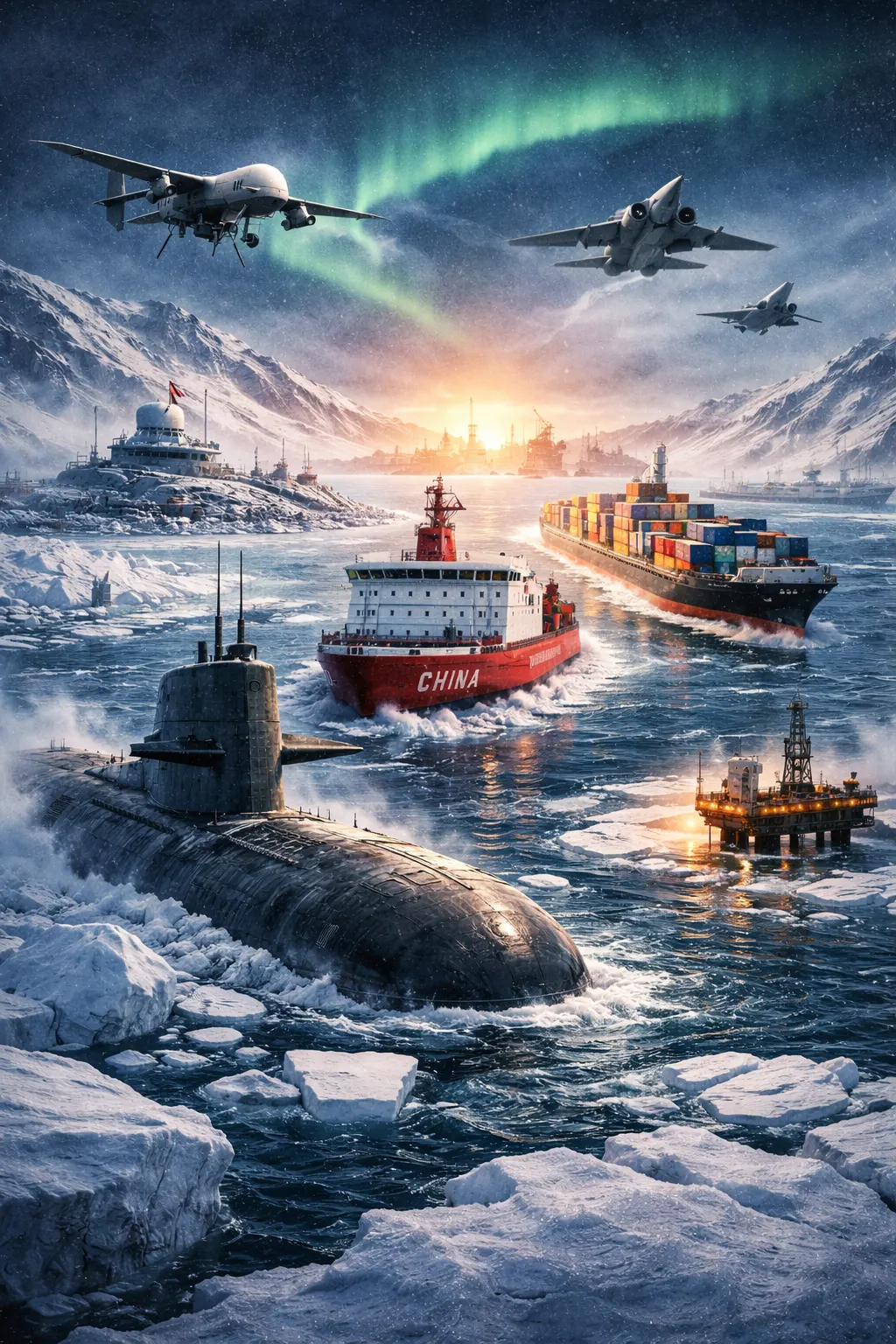
Nuclear submarines move beneath thinning ice. Long-range drones test radar envelopes. Cargo ships are mapping trade corridors that didn’t exist a decade ago. The world’s most overlooked region is becoming its most volatile.
Arctic Geopolitics and the $1 Trillion Northern Sea Route Shift
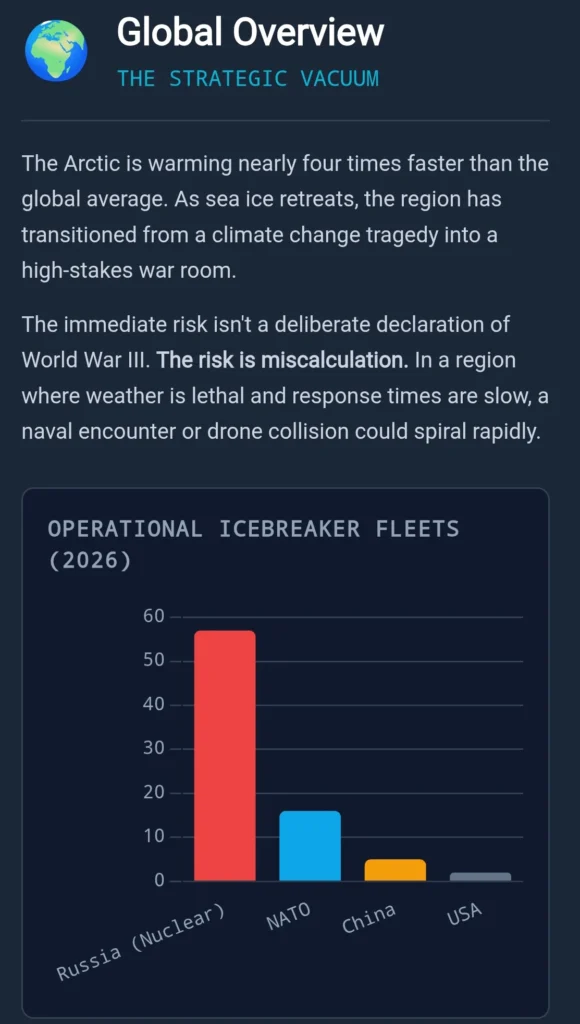
The Arctic is warming nearly four times faster than the global average. But while scientists track degrees Celsius, military planners track nautical miles.
The Northern Sea Route can now reduce Asia–Europe transit time by nearly 40%. That means faster logistics, lower fuel costs, and reduced dependence on traditional chokepoints like the Suez Canal.
For global trade, this is an efficiency breakthrough.
For Arctic geopolitics, this is a structural power shift.
Control the route. Influence the trade. Shape the century.
Russia’s Arctic Fortress: Preparation, Not Provocation
Moscow never treated the Arctic as symbolic territory.
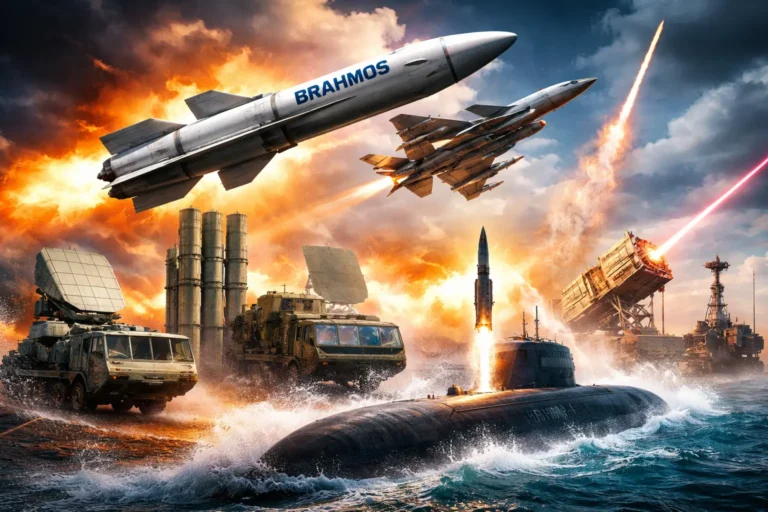
Over the past decade, Russia rebuilt Soviet-era bases, expanded Arctic radar systems, and deployed the world’s most advanced fleet of nuclear-powered icebreakers.
By 2026, its Arctic posture includes:
- Layered air-defense systems
- Extended-range maritime drones
- Year-round naval logistics support
This was not sudden escalation.
It was long-term positioning.
China’s Silent Expansion in Arctic Geopolitics
China has no Arctic coastline.
Yet Beijing officially labels itself a “near-Arctic state.”
Through infrastructure funding, research partnerships, and energy investments, China has embedded itself in Arctic supply chains.
The strategy mirrors previous global expansions: capital first, influence second, leverage later.
In Arctic geopolitics, presence does not require proximity.
Arctic Geopolitics and NATO’s 2026 Military Awakening
In February 2026, NATO launched Operation Arctic Sentry — a coordinated Arctic deployment stretching from Norway to Greenland.
The message was firm but calculated: deterrence, not declaration.
However, alliance cohesion faces strain. Strategic disagreements over Greenland’s rare-earth reserves have exposed internal tensions within the West.
The Arctic is no longer a diplomatic afterthought.
It is an alliance stress test.
The Most Dangerous Risk: Miscalculation
No analyst expects a formal war announcement over the Arctic.
The real threat is simpler — and more dangerous.
A drone collision in a snowstorm. A submarine surfacing in contested waters. A radar misread at 2 AM.
In extreme cold, systems fail. Communications degrade. Reaction windows shrink.
History shows major conflicts rarely begin intentionally.
They begin accidentally.
Why Arctic Geopolitics Directly Impacts India
The Arctic may seem geographically distant from India.
Strategically, it is not.
Energy Markets: Arctic disruption could send immediate shockwaves through global oil pricing.
Trade Routes: A dominant Northern Sea Route would reshape Eurasian commerce.
Defence Procurement: As great powers pivot north, global arms markets will shift accordingly.
India’s presence in Svalbard through the Himadri Research Station signals strategic awareness in a region that could define future leverage.
The Arctic is no longer frozen geopolitically.
Shipping lanes are opening. Military assets are deploying. Alliances are recalibrating.
The shift north is already underway.
The only remaining question is whether global powers can manage Arctic geopolitics without triggering a crisis that reshapes the international order.
Further Strategic Reading on Arctic Geopolitics
As Arctic geopolitics reshapes global power equations, readers tracking long-term strategic shifts should also explore TES Intel’s deeper analysis on India’s evolving Middle East power recalibration, the global rare-earth mineral supply chain battle, and our detailed Northern Sea Route trade impact assessment.For primary-source context, refer to official material from NATO, the Arctic Council, and NOAA’s Arctic climate research division, all of which provide institutional data and operational insight into the region’s evolving security and environmental landscape.
Arctic geopolitics is not an isolated theater — it intersects with trade, energy, climate science, and great-power rivalry. Understanding the full picture requires following both the strategic signals and the structural shifts now underway.
Related Strategic Analysis
The Arctic power shift is not unfolding in isolation. Similar strategic recalibrations are visible across other geopolitical flashpoints. Read our analysis on Modi’s strategic deal with Israel amid regional war pressures, examine how India’s Middle East recalibration is reshaping regional power equations, and explore why the escalating Israel–Iran tensions could destabilize global markets. Together, these emerging theaters — from the Arctic to West Asia — reveal a larger pattern: strategic competition is intensifying across multiple fronts, and the balance of power is being rewritten in real time.