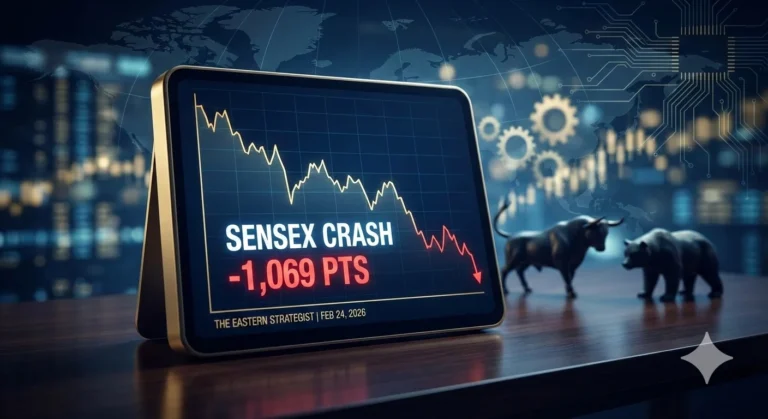
The Bullion Rollercoaster 2026: Gold and Silver Enter the ‘Great Shake-Out’
Gold and silver price outlook 2026 — Domestic bullion markets are attempting a technical recovery after a brutal “Flash Friday” liquidation.
Current Market Price (CMP)
- Gold – MCX Feb/April futures: around ₹1,56,600 per 10 grams, recovering from the ₹1.52 lakh zone
- Silver – MCX March futures: near ₹2,85,000 per kg, trying to stabilise after a sharp collapse.
- (Prices refer to the Indian futures market at Multi Commodity Exchange of India.)
The Rally — and the Sudden Crash
The last few months have been extraordinary for global bullion traders.
What powered the rally?
- Escalating US tariff rhetoric and rising talk of global de-dollarisation pushed safe-haven demand sharply higher.
- Gold surged to a record $5,594 per ounce (nearly ₹1.80 lakh+ on MCX at the peak).
- Silver went into a speculative melt-up, briefly touching ₹4.20 lakh per kg
What triggered the collapse?
The sharp reversal was driven by two developments:
- The so-called “Kevin Warsh effect” — following the nomination of Kevin Warsh as a distinctly hawkish Federal Reserve chair candidate.
- A sudden cooling of trade-war headlines.
This combination triggered heavy unwinding of leveraged positions.
Silver witnessed its largest single-day percentage fall on record, plunging nearly 35–40% in just a few sessions, as over-leveraged FOMO traders were forced out.
One-Year Outlook (2026–27): Do Institutions Still Believe?
Despite the violence in recent price action, major institutional houses remain structurally bullish.
Gold
Analysts at J.P. Morgan and Goldman Sachs continue to project a re-test — and possible break — of previous highs, with a broad target range of $5,400–$6,000 per ounce by late-2026.
For Indian investors, this implies a possible MCX range of ₹1.90–₹2.10 lakh per 10 grams (subject to USD-INR)
Silver
Supported by persistent industrial deficits driven by solar and electric-vehicle demand, silver is widely projected to revisit the $85–$100 per ounce band — equivalent to roughly ₹3.8–₹4.2 lakh per kg in domestic terms, once volatility settles.
Is the 2026 Crash a Buying Opportunity?
Short answer: yes — for patient investors.
- Gold has corrected more than 10% from its peak.
- Silver has corrected over 30% in an extremely short span.
This pullback is increasingly being viewed by institutional “conviction buyers” as an opportunity.
Practical strategy for Indian investors

Avoid lump-sum buying in the current environment.A staggered accumulation (SIP-style buying) over the next 3–4 months offers a far better risk-reward profile and protects against another volatility spike.
ETF vs Physical Gold & Silver — What Works Better in 2026?
Your choice should depend entirely on your exit strategy.
✔ ETFs
- Best suited for tactical and trading allocations.
- High liquidity.
- No storage or purity concerns.
- Zero making charges
- During the recent crash, ETFs allowed investors to exit and re-enter instantly.
✔ Physical coins and bars
Still important for long-term family holdings and contingency scenarios.
However, buyers immediately lose value due to
- 3% GST
- local dealer premiums
In practice, physical purchases are typically 5–7% costlier than the prevailing market price on day one.
Safe-Haven FOMO: Why Bullion Has Replaced Crypto in 2026
The global “fear of missing out” has shifted decisively from digital assets to bullion.
With US public debt now exceeding $34 trillion, gold is no longer just a hedge for retail investors. It is increasingly being used as institutional insurance.
When investors stop trusting bank deposits and bond yields to beat inflation, capital rushes into gold — creating the sharp V-shaped recoveries that now define this market.
How Is Gold Price Determined for Indian Investors?
ndian gold prices are driven by a four-layer structure:
- Global benchmark fixing by theLondon Bullion Market Association (LBMA).
- Price discovery and intraday volatility in US futures markets such asCOMEX.
- The hidden lever — USD-INR.Even if global prices remain flat, a weaker rupee directly pushes domestic gold higher.
- Central-bank demand — especially from India and China — which increasingly sets the global floor price.
The Trade-Deal Twist: Will a US–EU Accord Slow Central-Bank Gold Buying?
whether a US-EU trade deal could reverse the global shift from bonds to gold.
The short answer: very unlikely.
Why the gold pivot remains intact?
- Trust in paper assets has fractured.Many central banks — especially across the Global South — have learned that sovereign bonds and reserves can be frozen or weaponised.
- Debt sustainability remains unresolved.Even with trade stability, debt levels in both the US and Europe continue to rise sharply.
The verdict
A trade deal may slow the pace of gold accumulation — but it will not reverse it.Central banks are no longer merely diversifying into gold.They are increasingly replacing sovereign bonds with bullion as a strategic reserve asset.
Bottom line for Indian investors
The 2026 bullion crash looks less like the end of the cycle — and more like a classic shake-out inside a long-term structural bull market.
For disciplined investors, the opportunity lies not in predicting the next spike — but in building exposure gradually while volatility remains elevated.