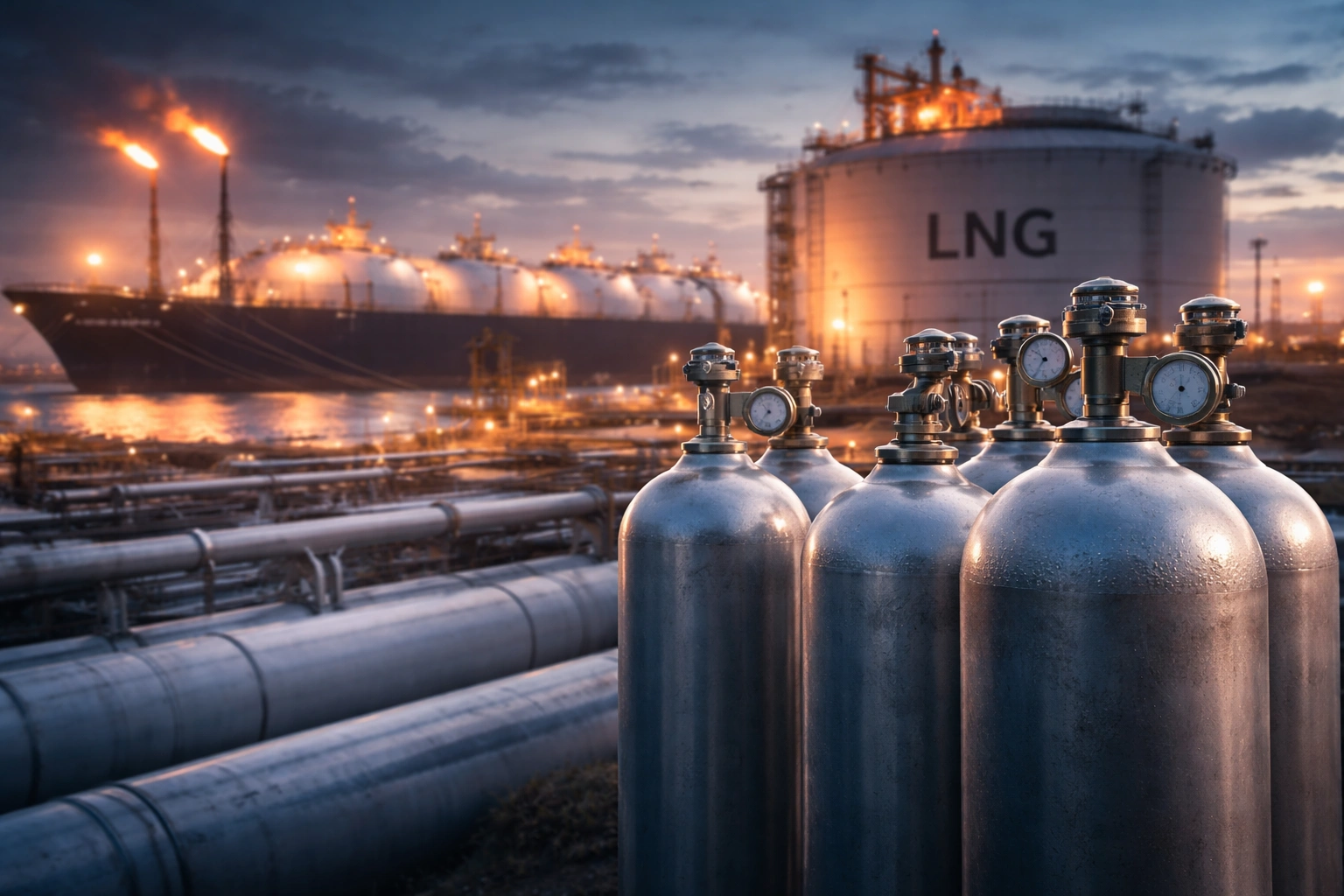
Helium prices surged after Qatar halted liquefied natural gas production this week, removing an estimated 5 million cubic meters of monthly helium output from the global market and exposing a fragile industrial supply chain that supports semiconductors, hospitals and aerospace manufacturing.
Helium Supply Shock Hits Global Markets
The disruption is already rippling beyond energy trading desks. Industrial gas distributors are warning that chip manufacturers, research facilities and medical systems could face tighter allocations if the shutdown persists, because helium is extracted as a by-product of natural gas processing.
Qatar is one of the world’s largest helium suppliers, accounting for roughly a quarter of global production. When LNG facilities stop operating, helium output falls almost immediately, turning a regional energy interruption into a wider industrial problem.
That is why this development matters now. The market is not reacting to a theoretical shortage but to a sudden loss of real supply from a core producer at a time when high-tech manufacturing demand remains firm.
Why Helium Matters Far Beyond Balloons
Helium is rarely discussed with the same urgency as oil or natural gas, yet it is one of the most important quiet inputs in the modern industrial economy. The gas is chemically inert and highly efficient at transferring heat, which makes it essential in environments where precision and stability matter.
Those properties give helium extraordinary strategic value. It is used in semiconductor fabrication, MRI systems, fiber-optic production, advanced laboratory research and aerospace engineering, sectors where even short disruptions can produce outsized downstream costs.
Unlike many industrial materials, helium cannot be manufactured at scale through a simple industrial process. It is naturally generated over long geological periods and recovered only from select natural gas fields with the right concentration levels.
Semiconductors and AI Infrastructure Face New Pressure
The most powerful consequence may be inside the semiconductor industry. Helium helps regulate temperature and maintain controlled conditions during wafer processing, plasma etching and leak detection, making it an important support gas in advanced chip fabrication plants.
That raises the stakes for the technology sector. Semiconductor demand has been strengthened by heavy investment in artificial intelligence infrastructure, high-performance computing and data-center expansion, all of which depend on highly specialized chips produced through complex manufacturing processes.
If helium prices remain elevated, the immediate risk is not a complete shutdown of chip output but a rise in manufacturing costs and tighter operating margins. Fabrication plants have recycling systems to reduce helium consumption, but those systems do not eliminate the need for steady fresh supply.
For a broader technology angle, readers can also explore our analysis of how Gulf instability is creating new strategic risks across global industrial and energy systems.
Qatar’s Critical Role in the Helium Market
Qatar’s importance in helium is a direct extension of its strength in natural gas. Because helium is separated during gas processing, large LNG producers with helium-rich fields become essential suppliers to the global market.
This makes the helium trade unusually concentrated. Major production centers include the United States, Qatar, Algeria and Russia, with only limited capacity elsewhere to absorb a major supply shock quickly.
That concentration is what makes the current disruption so dangerous. A single geopolitical event tied to Gulf energy infrastructure can suddenly tighten availability for industries thousands of miles away, even when those industries have no obvious connection to the Middle East.
For official background on industrial gas and mineral supply chains, readers can review external data from the U.S. Geological Survey and broader energy market reporting from Reuters Energy.
Hospitals and Aerospace Also Feel the Strain
The pressure is not limited to semiconductors. Hospitals rely on liquid helium to cool superconducting magnets inside MRI machines, while aerospace and defense applications use helium in pressurization, testing and propulsion-related systems.
That creates a difficult balance for suppliers. Industrial gas companies often prioritize customers with long-term contracts or critical infrastructure needs, but prolonged disruption can still raise costs across healthcare, research and aerospace production lines.
In practical terms, the positive side of the market response is limited to producers and distributors with secure access to non-Qatari supply. The negative side is broader: higher costs, tighter allocation and renewed vulnerability for industries that depend on precise, uninterrupted operations.
A Strategic Warning for Global Supply Chains
The current helium squeeze is a sharp reminder that the global technology economy depends on a narrow group of critical materials, many of them sourced from geopolitically sensitive regions. What began as an LNG disruption now looks more like a strategic supply-chain stress test.
That matters for investors and policymakers alike. When specialized materials such as helium are disrupted, the effect can spread quietly but forcefully through chip fabrication, medical technology and industrial production long before consumers understand the source of the pressure.
If Qatar restores LNG operations quickly, the helium market may stabilize before the shortage deepens. If the disruption lasts longer, helium prices could become another powerful signal that energy conflict in the Gulf no longer stops at oil and gas, but now reaches directly into the high-value sectors driving the global economy.