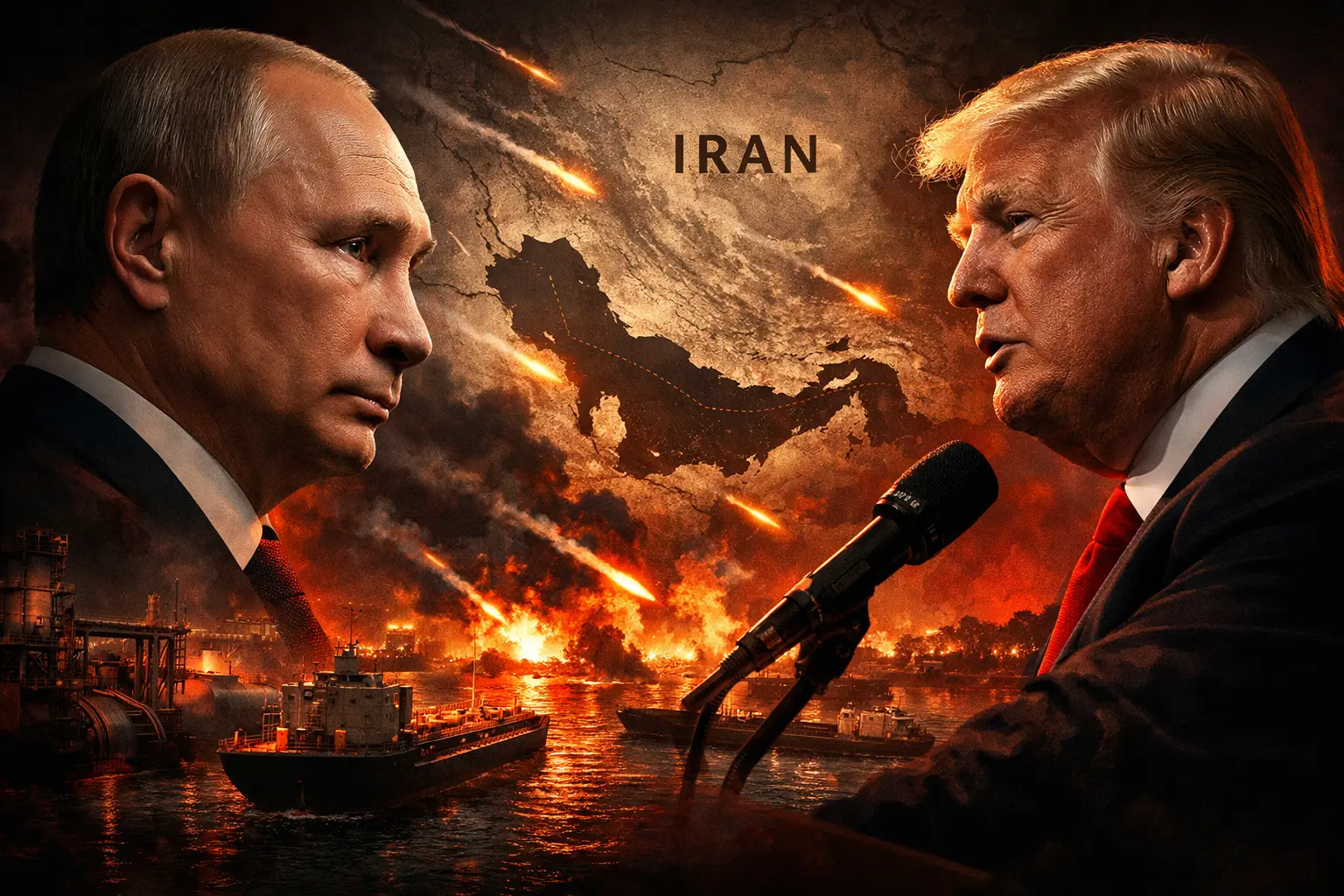
Iran war helping Russia is no longer a theoretical argument. The widening U.S.-Iran conflict has lifted oil prices, revived Moscow’s export earnings, strained Western weapons supply, and shifted diplomatic attention away from Ukraine.
- Higher oil prices from the Iran war are strengthening Russia’s energy revenues.
- Washington’s 30-day waiver on stranded Russian oil cargoes has intensified criticism in Kyiv and Europe.
- Western air-defense stocks are under pressure as the Middle East and Ukraine compete for the same systems.
- The wider the Gulf crisis becomes, the more time Moscow gains in Ukraine.
There is a brutal logic to interconnected wars. A conflict in one theater can quietly reshape the balance in another, not through ideology but through energy prices, industrial bottlenecks, and diplomatic distraction. That is what is happening now. Iran war helping Russia has become one of the clearest strategic side effects of the current Middle East escalation.
The immediate headlines are in the Gulf: U.S. strikes on military targets on Kharg Island, threats around the Strait of Hormuz, and emergency efforts to prevent a broader regional war. But the secondary effects are now rippling into Europe’s largest battlefield. As oil markets tighten and Western attention fragments, Russia is finding room to breathe.
€510M/day Russia fossil-fuel revenue in early March ·
$10B possible gain estimated by Kyiv
■ Iran war helping Russia: The core argument
The case rests on three developments. First, the threat to shipping through Hormuz has pushed oil higher, directly improving Russia’s pricing power. Second, the U.S. decision to allow a 30-day waiver for sanctioned Russian oil cargoes already at sea has softened the immediate pressure on Moscow’s exports. Third, the Middle East crisis is consuming missile inventories, military planning time, and diplomatic focus that might otherwise have been directed toward Ukraine.
None of this means Russia has suddenly solved its structural problems. But wars of attrition are not won only through battlefield breakthroughs. They are also shaped by who can keep financing the war, who can replenish weapons faster, and who can wait for the opposing coalition to lose concentration.
■ The oil windfall
The first and most obvious benefit for Moscow is oil. Reuters reported that the Strait of Hormuz typically carries about one-fifth of global oil and LNG flows, while Kharg Island handles about 90% of Iran’s crude exports. Even limited disruption in that system is enough to jolt traders and lift prices. As a result, Russia’s oil revenues, which had fallen in February to their lowest level since the Ukraine war began, have started rising again with the Gulf shock.
According to the Centre for Research on Energy and Clean Air, Russia’s fossil-fuel export revenues in February averaged about €492 million a day. By the first 12 days of March, that figure had climbed to roughly €510 million a day, a gain that fits with the wider surge in energy prices after the Iran conflict intensified. For a state running a prolonged war economy, that kind of move matters. It restores fiscal space at exactly the moment Moscow needs it most.
“The wider the energy shock becomes, the more durable Russia’s war financing looks.”
■ The sanctions waiver and market shock
The second factor is political as much as economic. Reuters reported that the U.S. Treasury issued a 30-day waiver allowing countries to buy sanctioned Russian oil and petroleum products already stranded at sea, describing the move as a step to stabilize energy markets roiled by the Iran war. That decision immediately drew sharp criticism from Kyiv.
President Volodymyr Zelenskyy said the waiver was “not the right decision” and argued it could funnel as much as $10 billion into Russia’s war effort. Whether that figure proves exact or not, the strategic point is hard to dismiss: when global energy panic rises, sanctions discipline weakens. Governments begin prioritizing price stability over coercive pressure, and Moscow benefits from that shift.
Sanctions are most effective when markets are calm. They become harder to enforce when policymakers fear an inflation shock, an energy crunch, or a broader recession. The Iran war has revived exactly those pressures.
■ The three-war problem
The deeper problem for the West is strategic overload. Washington is now managing three major theaters at once: support for Ukraine, confrontation with Iran, and long-term deterrence against China in the Indo-Pacific. The political bandwidth, industrial capacity, and weapons inventories needed to sustain all three are not unlimited.
That is why Iran war helping Russia is more than an oil story. It is also an overstretch story. Every emergency meeting focused on the Gulf is a meeting not focused on Ukraine. Every Patriot interceptor or naval asset redirected toward the Middle East changes the distribution of pressure across the broader system. Moscow does not need a dramatic battlefield breakthrough if the West gradually disperses its attention on its own.
■ The missile arithmetic
Zelenskyy said Gulf Arab states had used more advanced air-defense missiles in recent days than Ukraine had received from the United States in four years. The exact comparison will be debated, but the basic arithmetic is hard to avoid. Ukraine depends on high-end Western air defense to protect its cities, grid, and logistics. So do U.S. forces and partners in the Middle East when Iranian missiles and drones are in the air.
When two wars start pulling from the same inventory, priorities harden quickly. Treaty allies and forward-deployed U.S. forces come first. Ukraine slips down the queue. That does not mean support ends. It means the timetable changes, and in attritional warfare even delays can alter outcomes.
“A widening Gulf war does not have to defeat Ukraine outright to help Russia. It only has to stretch the West.”
■ The strategic dividend for Moscow
The final benefit is time. Russia’s strategy in Ukraine has increasingly relied on endurance, not speed. It needs revenue, ammunition, and patience. The Iran crisis assists all three. Oil prices refill the war chest. Sanctions discipline weakens under market stress. Western military and diplomatic focus becomes more fragmented.
This does not guarantee a Russian victory. Moscow still faces sanctions, manpower losses, and an expensive war economy. But the current direction is unmistakable. Iran war helping Russia has become one of the most important hidden dynamics of the broader conflict system now taking shape across Europe and the Middle East.
In the end, the most damaging effect of the Iran war for Ukraine may not be a single strike, waiver, or speech. It may be the slow accumulation of advantages handed to Moscow by a world whose strategic focus is no longer fixed on one front.
About the Author:
Shiwangi Priya is Co-Founder and Managing Editor of The Eastern Strategist, focusing on geopolitics, defence strategy and global power shifts.
Internal:
Strait of Hormuz crisis analysis ·
Russia’s oil revenues and the Ukraine war ·
Indian Ocean geopolitics
External:
Reuters on Kharg Island and Hormuz ·
Reuters on the U.S. oil waiver ·
AP on Zelenskyy’s criticism ·
CREA export revenue data