The countdown to NATO’s disintegration is live. Trump made massive claims about securing the Strait of Hormuz, banking entirely on European firepower to back his play.
That firepower never showed up. Not a single ally answered the call.
Europe is sprinting away from an uninvited war. Trump is completely blindsided. His fury is palpable, and his revenge on the alliance is now a geopolitical certainty. He is already lashing out at NATO partners. The deeper question is whether NATO members simply ignored his threats out of arrogance, or if they are quietly sitting in the dark, fully prepared for the violent unraveling of the post-1945 order.
The Arsonist and the Empty Hose
Trump is operating with a burning torch in one hand and a fire extinguisher in the other.
He does not consult Brussels before imposing crippling tariffs. He does not call London before launching kinetic strikes in the Middle East. He single-handedly sets the geopolitical map on fire. Then, he turns around and demands his allies hold the hose.
Europe is done playing the fireman. The mutiny is total. The sheer arrogance of assuming foreign navies would act as meat shields for American electoral posturing has shattered whatever trust remained in European capitals. They see the trap. Entering the Gulf means signing a death warrant for their own economies.
The $100 Barrel Nightmare
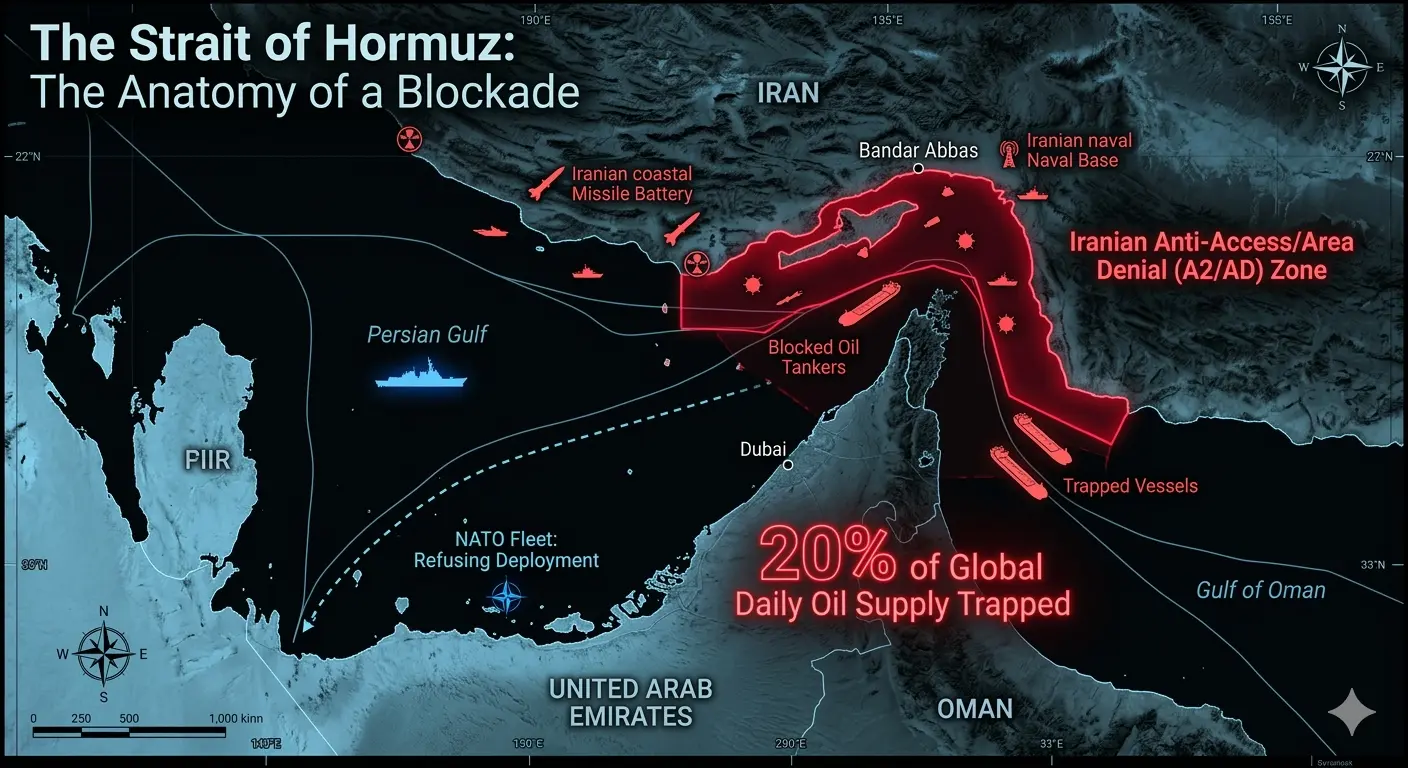
Look at the commodities board. Fractures in global alliances always show up in crude prices first.
Oil is now a weapon of mass economic destruction. Brent crude is stalking the $100 mark. Tehran choked off the Strait of Hormuz with a crude but brutally effective web of mines and attack drones. Twenty percent of the global oil supply is trapped behind a wall of high-explosives. Maritime insurance premiums are detonating.
Washington wants NATO to clear the minefield. Berlin and Paris told Washington to clear it themselves.
“Not our war.” That is the whisper echoing through European defense ministries. They are entirely correct. The United States blew up the diplomatic off-ramps in this US–Iran conflict. America has vast domestic shale reserves and two oceans isolating it from the fallout. Europe faces an immediate energy freeze and skyrocketing inflation. They will not subsidize Washington’s military adventurism with their own economic suicide.
The Domestic Rebellion in Europe
European leaders are trapped in a geopolitical vice. Even if Britain’s Keir Starmer or Germany’s Friedrich Merz wanted to appease Washington, their domestic populations would riot.
The European working class is already buckling under the weight of inflation, green energy mandates, and a stagnant industrial base. Pitching a new, open-ended war in the Middle East to voters who cannot afford their winter heating bills is political suicide. The streets of London, Paris, and Berlin would paralyze within 48 hours. The political elites know that blindly following Trump into the Strait of Hormuz will trigger populist uprisings that will wipe out incumbent governments.
This is not just a military refusal. It is a desperate act of domestic political survival. Washington fundamentally failed to read the room.
Preparing for the Post-American Reality
Trump’s shock stems from a fundamental miscalculation of leverage. He thought extortion bred loyalty.
He threatened allies with a “very bad future” if they refuse to police the strait. Extortion only works if the target has no alternative. European capitals are making a cold, calculated bet. They value their immediate energy security over an outdated transatlantic security umbrella that only opens when Washington decides it should.
Are they ignoring the risk of American abandonment? No. They are pricing it in. They know Trump’s wrath is coming. They are choosing the slow decay of NATO over the immediate devastation of a Middle Eastern ground war. The US Navy is massive. The Pentagon expects a handful of European ships to join the fray merely for the optics of a unified Western front.
The West is not unified. The optics are dead.
Asian Spectators and the Great De-Risking
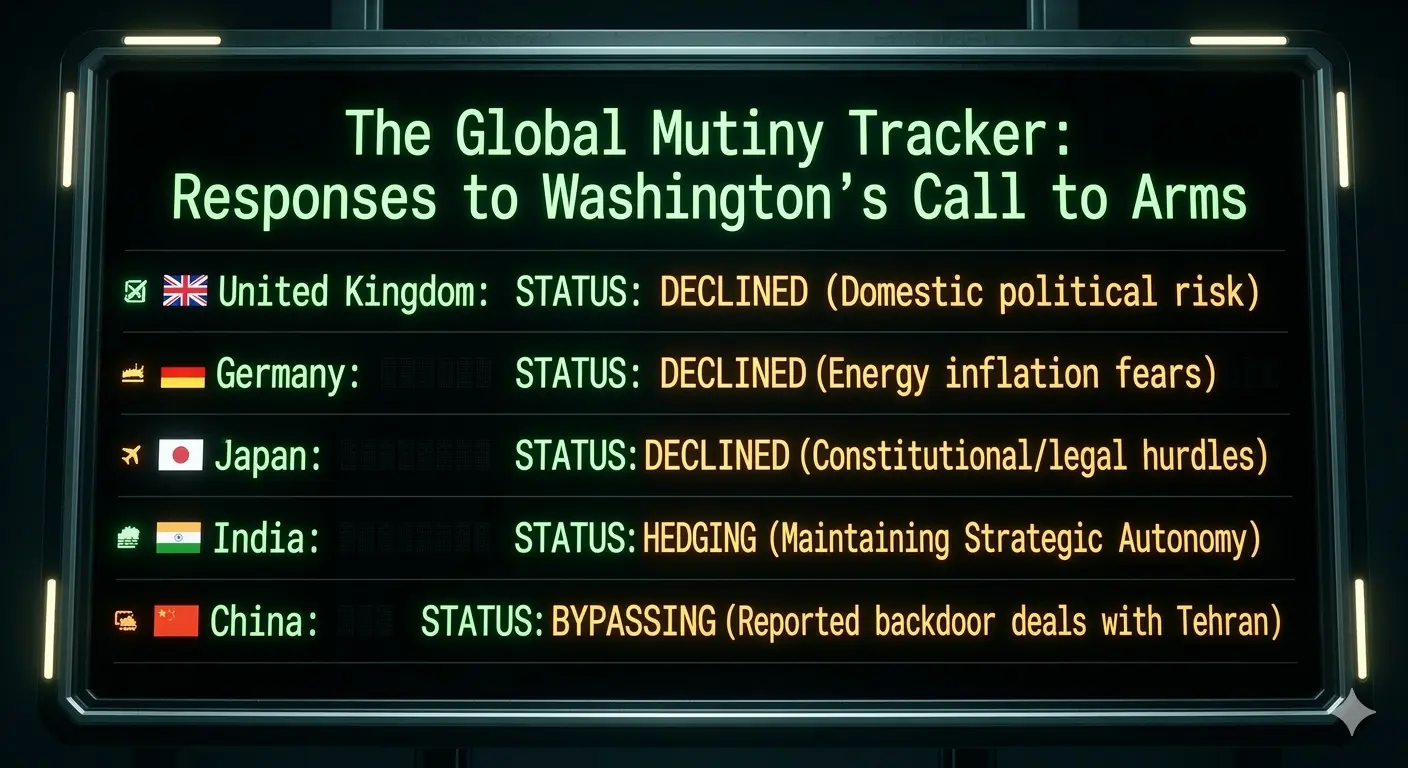
Look east. The panic is not contained to the Atlantic.
Trump demanded naval assets from Japan, South Korea, and India. He got dial tones. Tokyo is hiding behind domestic legal hurdles to avoid deploying escort ships. Beijing is bypassing the chaos entirely, reportedly negotiating backdoor deals with the Iranian regime to sneak Chinese tankers through the blockade unharmed. New Delhi is watching the NATO meltdown with cold detachment, vindicated in its long-standing policy of strategic autonomy.
Nobody is riding to America’s rescue. They are hedging. The global south and the eastern powers realize Washington’s bite no longer matches its bark unless it acts entirely alone. Central banks in Asia are quietly hoarding physical gold and accelerating de-dollarization. Trump wanted a grand coalition to legitimize a messy, escalating war. He got a front-row seat to his own isolation.
The Strategist’s Verdict:
The mutiny is complete. Trump threw a war and his closest allies simply hung up the phone. NATO is no longer a mutual defense pact; it is a hollowed-out shell held together by weapons contracts and fear. Sell the transatlantic illusion.