Sometimes, a single moment captures the spirit of a nation.
For India, one such moment came in the spring of 2025. On 22 April 2025, a brutal terrorist attack in Pahalgam, Jammu and Kashmir, killed 26 civilians, shocking the country and triggering national outrage.
In response, India launched Operation Sindoor on 7 May 2025, a coordinated military operation aimed at terrorist infrastructure linked to groups operating across the Line of Control. According to official briefings by the Government of India, the strikes targeted terror facilities in Pakistan and Pakistan-occupied Kashmir (PoK) connected to organizations responsible for cross-border terrorism.
The operation demonstrated India’s growing emphasis on precision strikes, intelligence coordination, and joint operations between the Army, Air Force, and Navy.
But the moment that truly captured global attention came not on the battlefield, but the following morning in New Delhi.
When India Sent Its Daughters to Speak for the Nation
In modern geopolitics, military action is only one part of the story. The other battle is fought in the realm of information and global perception.
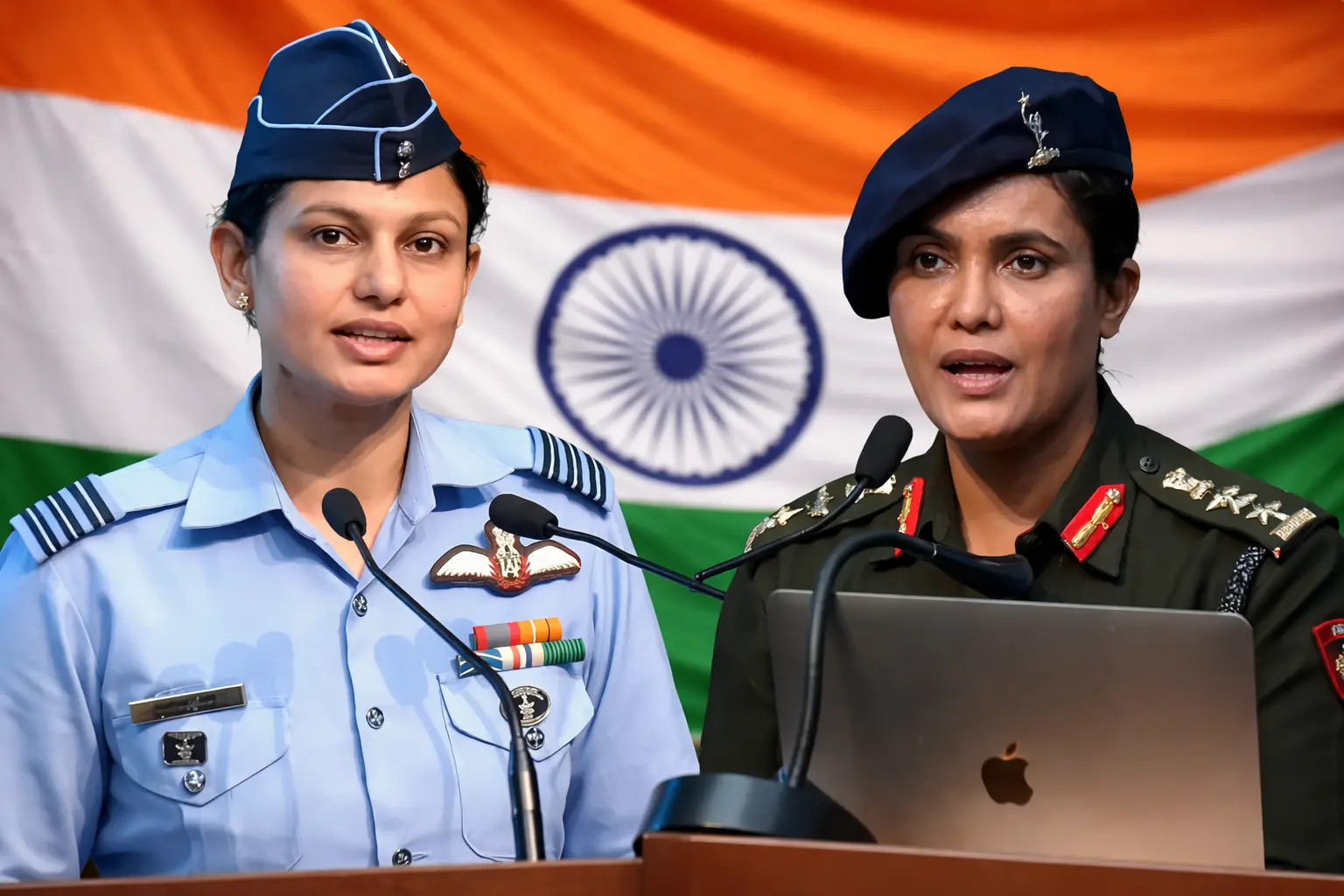
On 8 May 2025, the Ministry of External Affairs held a special press briefing at the National Media Centre in New Delhi to explain the details of Operation Sindoor to the international media.
Standing beside Foreign Secretary Vikram Misri were two distinguished officers representing India’s armed forces:
- Colonel Sofiya Qureshi of the Indian Army
- Wing Commander Vyomika Singh of the Indian Air Force
Their presence carried powerful symbolism.
Colonel Qureshi, a respected officer known for her role in international military exercises and United Nations peacekeeping missions, presented satellite imagery and operational information related to the targets struck during the operation.
Alongside her, Wing Commander Vyomika Singh explained the aerial component of the operation and the technological systems used to verify the success of the strikes.
Through imagery, data, and operational details, the briefing aimed to demonstrate that India’s response was measured, targeted, and focused on terrorist infrastructure rather than civilian or military facilities of Pakistan.
A Strategic Message Beyond the Battlefield
The decision to place two women officers at the forefront of the briefing was widely seen as a powerful signal of the changing character of India’s armed forces.
For decades, the military had been perceived as a male-dominated institution. But over the past three decades, India has steadily expanded opportunities for women across all three services.
Women were first inducted as officers in the Indian Army, Navy, and Air Force in 1992 through the Short Service Commission system. Since then, their roles have expanded significantly, from support branches to operational positions including aviation, intelligence, logistics, and command appointments.
A major milestone came in 2020, when the Supreme Court of India ruled that women officers in the Army must be eligible for permanent commission, enabling long-term careers and leadership opportunities.
Another landmark reform followed when women were allowed to enter the National Defence Academy (NDA), with the first batch of female cadets beginning training in 2022.
Today, women serve as fighter pilots in the Indian Air Force, officers on Indian Navy warships, and leaders across multiple operational branches of the armed forces.
The Meaning of Nari Shakti in Modern India
Against this broader backdrop, the image of Colonel Sofiya Qureshi and Wing Commander Vyomika Singh briefing the world on Operation Sindoor carried a deeper meaning.
It reflected a transformation within India’s security institutions, one in which professional merit, capability, and leadership increasingly define military roles rather than traditional barriers.
For international audiences watching the briefing, the message was clear: India’s armed forces are evolving alongside the country itself.
The moment became a powerful illustration of Nari Shakti, not as a slogan, but as a reality within the institutions responsible for defending the nation.
And on that morning in New Delhi, the world witnessed an image of modern India: two officers, two uniforms, and a nation speaking with confidence to the global stage.
Timeline: Women in India’s Armed Forces
- 1992: Women inducted as officers in the Army, Navy, and Air Force through Short Service Commission.
- 2008: Permanent Commission granted in limited branches.
- 2020: Supreme Court rules in favour of Permanent Commission for women officers in the Army.
- 2022: First batch of women cadets begins training at the National Defence Academy.
Also read: More strategic analysis from The Eastern Strategist.
Operation Sindoor and the powerful briefing that followed also reflected a broader transformation within India’s defence institutions. Over the past decade, reforms have steadily expanded opportunities for women across the armed forces—from fighter pilots in the Indian Air Force to officers deployed on Indian Navy warships and the first batches of female cadets entering the National Defence Academy. As noted in official government releases, these changes highlight a deliberate effort to build a modern, professional military where talent and capability define leadership. For official details on the operation and the evolving role of women in India’s defence forces, readers can refer to the Government of India releases available on the Press Information Bureau and the Ministry of Defence updates on women in the National Defence Academy.