The Great De-Rating: Why February 24 is the “Death of the Defensive” for Indian IT
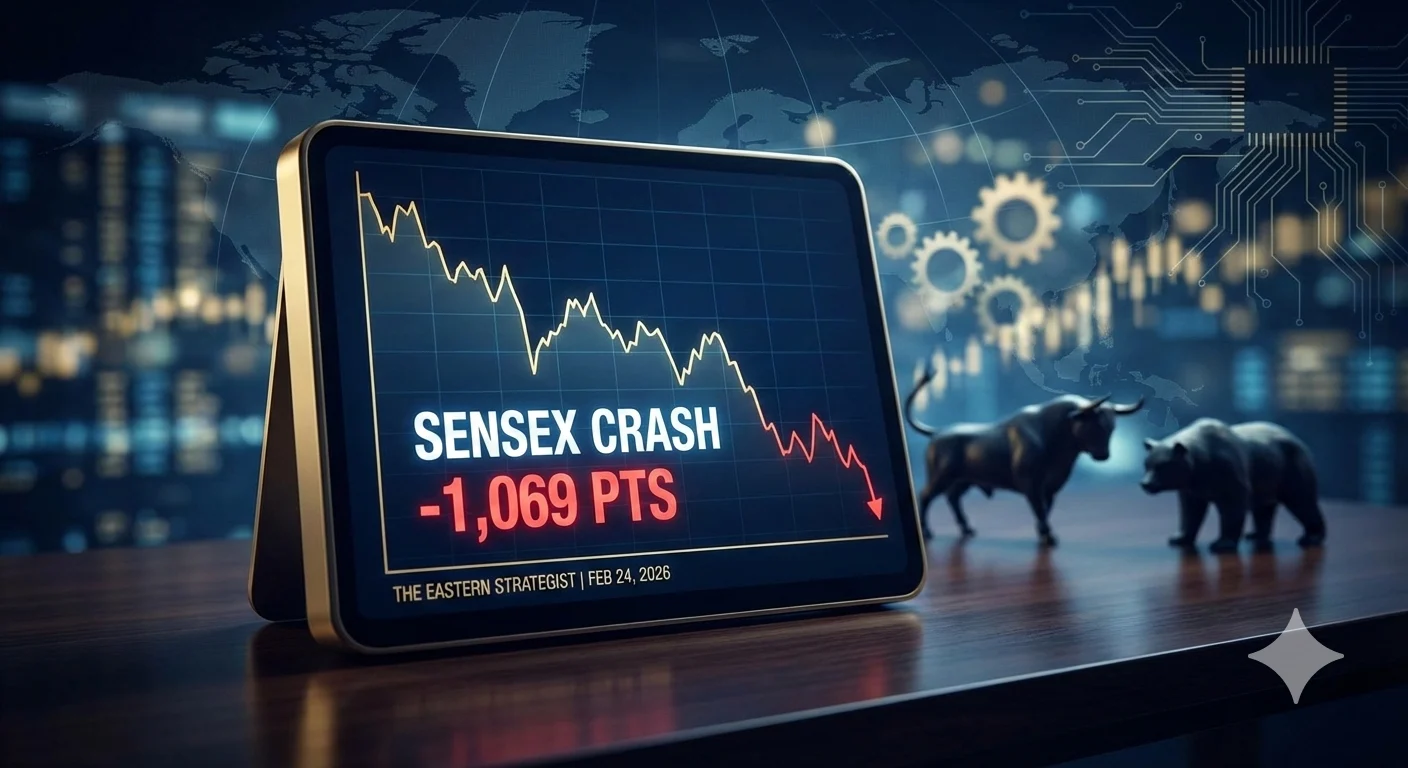
The massive Sensex crash today saw the index plummet 1,069 points, proving it wasn’t just another volatile Tuesday; it was a fundamental re-pricing of India’s economic “moats.” As the Nifty 50 slipped below the critical 25,450 support level, the market signaled that the two pillars of the Indian bull run—Software Exports and Global Trade Stability—are under direct assault.
1. The “Claude Code” Shock and Today’s Sensex Crash
The catalyst for today’s IT rout was Anthropic’s unveiling of Claude Code. This AI agent is now capable of modernizing legacy COBOL systems, which power roughly 95% of global ATM transactions. For the uninitiated, COBOL modernization is the high-margin “annuity revenue” that sustains firms like TCS and Infosys. By automating what previously required thousands of human engineers, AI is attacking the core unit economics of the Indian IT sector.
2. Section 122: Trump’s Emergency Trade Wall
Simultaneously, the Trump administration has pivoted to Section 122 of the Trade Act of 1974 to impose a 15% universal surcharge. By declaring a “balance-of-payments” emergency, the administration effectively bypassed earlier judicial roadblocks. This move transforms trade from a negotiation into a mandate, putting immediate pressure on India’s export margins as the Dollar strengthens against a struggling Rupee.
3. The FII Exodus and Energy Volatility
Foreign Institutional Investors (FIIs) have accelerated their sell-off, with today’s net outflows estimated at over ₹4,500 crore. This liquidity drain is being exacerbated by rising Brent Crude prices, which surpassed $72/barrel today amid US-Iran military buildups. For a net-importing economy like India, the combination of a weakening currency and rising energy costs creates a “Twin Deficit” pressure that traditionally precedes a deeper market correction.
🛡️ Strategic Safe Harbor:
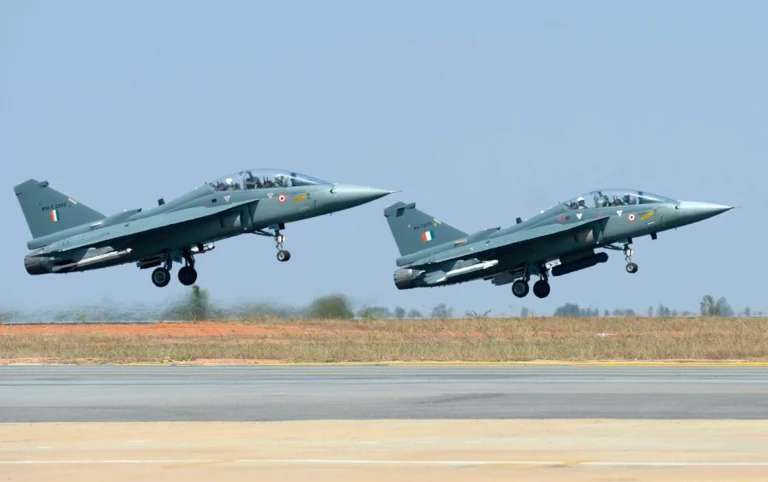
While global trade faces 15% surcharge walls, India’s domestic defense sector remains a bastion of resilience. Our deep-dive into the Atmanirbhar moat explains why companies like HAL are structurally protected from US-centric trade wars.
Market Intelligence Scorecard (Feb 24)
| Sector Status | Sentiment | Strategic Rationale |
|---|---|---|
| Nifty IT | 🔴 CRITICAL | Worst fall since 2008; Structural AI threat to legacy code. |
| Nifty Bank | 🟡 STABLE | Last bastion of domestic safety; credit demand remains high. |
| Defense (HAL) | 🟢 STRATEGIC | Protected by captive order book and indigenous supply chains. |
Technical Roadmap: The 25,450 Line in the Sand
Technically, the Nifty has breached its 50-day Exponential Moving Average (EMA). The next major support lies at 24,800. Until the index reclaims the 25,450 mark on a weekly closing basis, the “Sell on Rise” sentiment will likely dominate Dalal Street. Retail investors should avoid averaging down in high-beta IT stocks until we see concrete management guidance on AI integration costs in the next quarterly earnings cycle.
The “Contagion” Risk in Midcaps
Beyond the heavyweights of the Nifty 50, the midcap and smallcap space today faced a ‘liquidity vacuum.’ As retail investors panicked over the Sensex crash today, midcap valuations—which were already trading at a premium—saw significant erosion. Unlike the blue-chip IT firms, many mid-tier companies lack the R&D budget to pivot toward the AI-first model demanded by the ‘Claude Code’ era. This creates a dangerous ‘valuation trap’ for retail investors who traditionally buy the dip in smaller stocks. Until we see a stabilization in the Midcap 100 index, the risk of a cascading sell-off remains high, as margin calls on leveraged positions could trigger another wave of forced liquidation in the coming sessions.
The Dollar-Rupee Conflict
The currency market is the silent witness to this market rout. As the Trump administration invokes Section 122, the U.S. Dollar Index (DXY) has surged, putting the Indian Rupee under immense pressure. A weakening Rupee is a double-edged sword: while it theoretically helps IT exporters, it simultaneously inflates the cost of critical imports like crude oil and electronic components. This ‘imported inflation’ limits the RBI’s room for maneuver regarding interest rate cuts. For the Indian stock market to find a definitive floor, we need to see the Rupee stabilize against the Greenback. Investors should closely monitor the ₹84.50 level on the USD/INR pair; a breach there could lead to further FII outflows from domestic equities.