
By Abhishek Kumar
Published: March 29, 2026
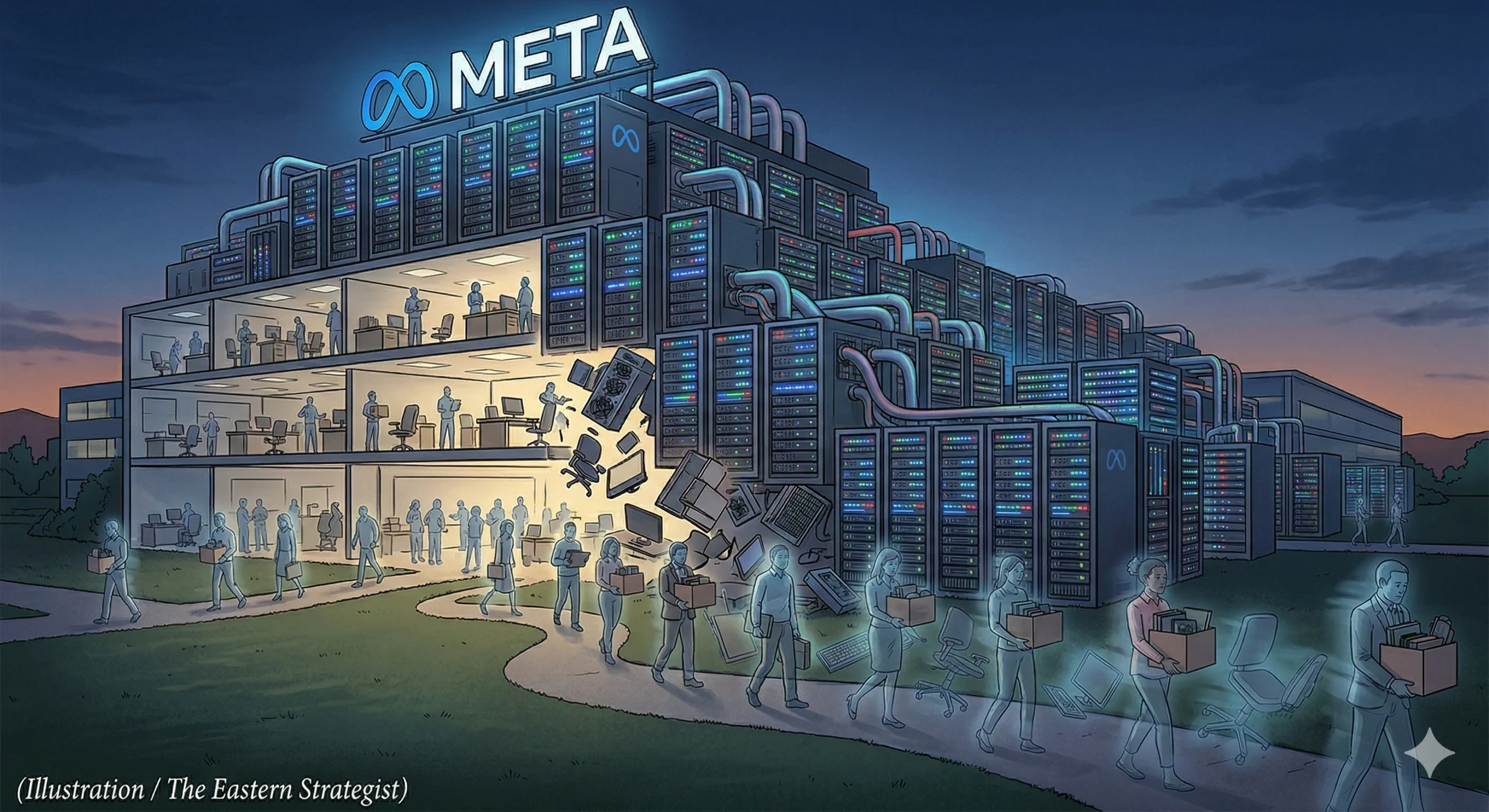
In March 2026, Meta—the parent company of Facebook, Instagram, WhatsApp, and Reality Labs—initiated one of its most consequential workforce restructurings to date. While the company has conducted multiple rounds of layoffs since 2023, the latest cuts mark a decisive turning point: Meta is no longer positioning itself as a social media giant experimenting with AI, but as a full‑scale AI infrastructure powerhouse reshaping its global priorities.
Reports from multiple outlets confirm that Meta is eliminating several hundred positions, with the total number expected to remain under 1,000 employees. These cuts span across Reality Labs, Facebook operations, global sales, recruiting, and advertising, and affect both U.S. and international teams.
A Strategic Pivot: From Social Media to “Meta Compute”
The most striking interpretation of these layoffs comes from industry analysts who argue that Meta is undergoing a fundamental identity shift. The company is reallocating capital from traditional social‑media‑centric divisions—such as community management, recruiting, and wearables—into massive Nvidia GPU clusters, custom CPUs, and liquid‑cooled data centers.
This signals a transition toward what some insiders call “Meta Compute”, an AI‑first operational model designed to compete with the likes of OpenAI, Google DeepMind, and Microsoft.
“This pivot is not merely a technological upgrade; it represents a redefinition of Meta’s long‑term mission. The company aims to build the infrastructure that powers the next generation of global AI systems.”
Why These Layoffs Matter
1. AI Is Core Business
Meta’s leadership has made it clear that the future lies in generative AI. Billions are being funneled into data-center expansion, driving this massive capital reallocation.
2. Reality Labs Hit
Reality Labs is hit hard, but not abandoned. Meta is streamlining to focus strictly on AI‑enhanced immersive technologies rather than broad hardware projects.
3. Global Consolidation
Sales, recruiting, and legacy teams are facing reductions to support a leaner, more automated, AI‑driven corporate structure worldwide.
The Human Cost & The Tech Shake-Up
While the number of affected employees is relatively small compared to Meta’s nearly 79,000‑strong workforce, the symbolic impact is enormous. These cuts are not about cost‑saving; they are about strategic realignment. Meta is offering some employees internal transfers or roles within AI-focused teams, proving that the company is not shrinking—it is reshaping.
Meta is not alone. The first quarter of 2026 has seen widespread layoffs across major tech companies including Amazon and Epic Games. The social media era that dominated the 2010s is officially giving way to a new epoch defined by AI ecosystems, data‑center supremacy, and compute‑driven innovation.
The Ripple Effect: Impact on the Indian Tech Diaspora
Meta’s job cuts are affecting Indian professionals in multiple, profound ways—from emotional stress for laid‑off workers in the US to surprising new opportunities in India’s booming domestic AI ecosystem.
📉 1. The H-1B Visa Crisis & Emotional Toll
Indian professionals in the US on H‑1B and L‑1 visas are among the most vulnerable. With only 60 days to find a new sponsor amidst industry-wide hiring freezes, many face sudden deportation threats. Furthermore, former employees describe the emotional toll as “paralyzing,” noting that even top-tier performers were not spared.
🤖 2. The AI Upskilling Mandate
Meta is now requiring engineers to use AI tools like Metamate and Google Gemini for up to 75% of their coding work. For Indian IT professionals—both at Meta India and abroad—traditional coding roles are shrinking rapidly. Survival now dictates immediate upskilling in AI‑assisted development workflows.
✨ 3. The Silver Lining: India’s AI Sovereignty
Surprisingly, Big Tech’s loss is proving to be a massive gain for India. Indian AI startups like Sarvam AI, Smallest AI, and giants like Reliance Jio are aggressively recruiting displaced Meta AI professionals. This brain drain reversal is actively accelerating India’s push for AI sovereignty, absorbing world-class talent to build domestic foundation models.
Conclusion: The Compute Wars Have Begun
Is Meta still a social media company? Based on this restructuring, the answer appears to be: not primarily. Meta still owns the world’s largest social platforms, but they are increasingly becoming mere data engines for training AI, and distribution channels for AI-powered features.
Meta’s 2026 layoffs represent a historic strategic shift—signaling the end of the social media-first era. The next decade will not be defined by social media wars, but by compute wars. For the global tech landscape, and specifically for the Indian workforce, this restructuring is a stark preview of the future: a world where AI infrastructure dictates survival.
Conclusion: The Compute Wars Have Begun
Is Meta still a social media company? Based on this restructuring, the answer appears to be: not primarily. Meta still owns the world’s largest social platforms, but they are increasingly becoming mere data engines for training AI, and distribution channels for AI-powered features.
Meta’s 2026 layoffs represent a historic strategic shift—signaling the end of the social media-first era. The next decade will not be defined by social media wars, but by compute wars—a reality already echoing across the broader tech sector, as seen in the recent Oracle layoffs driven by the same aggressive AI race.
For the global tech landscape, and specifically for the Indian workforce navigating new macroeconomic realities like the 2026 India-US trade deal and tariff resets, this restructuring is a stark preview of the future: a world where AI infrastructure and strategic adaptability dictate survival.