E2E Networks Jumps 20% After Nvidia Deal—A Major Signal for India’s AI Future
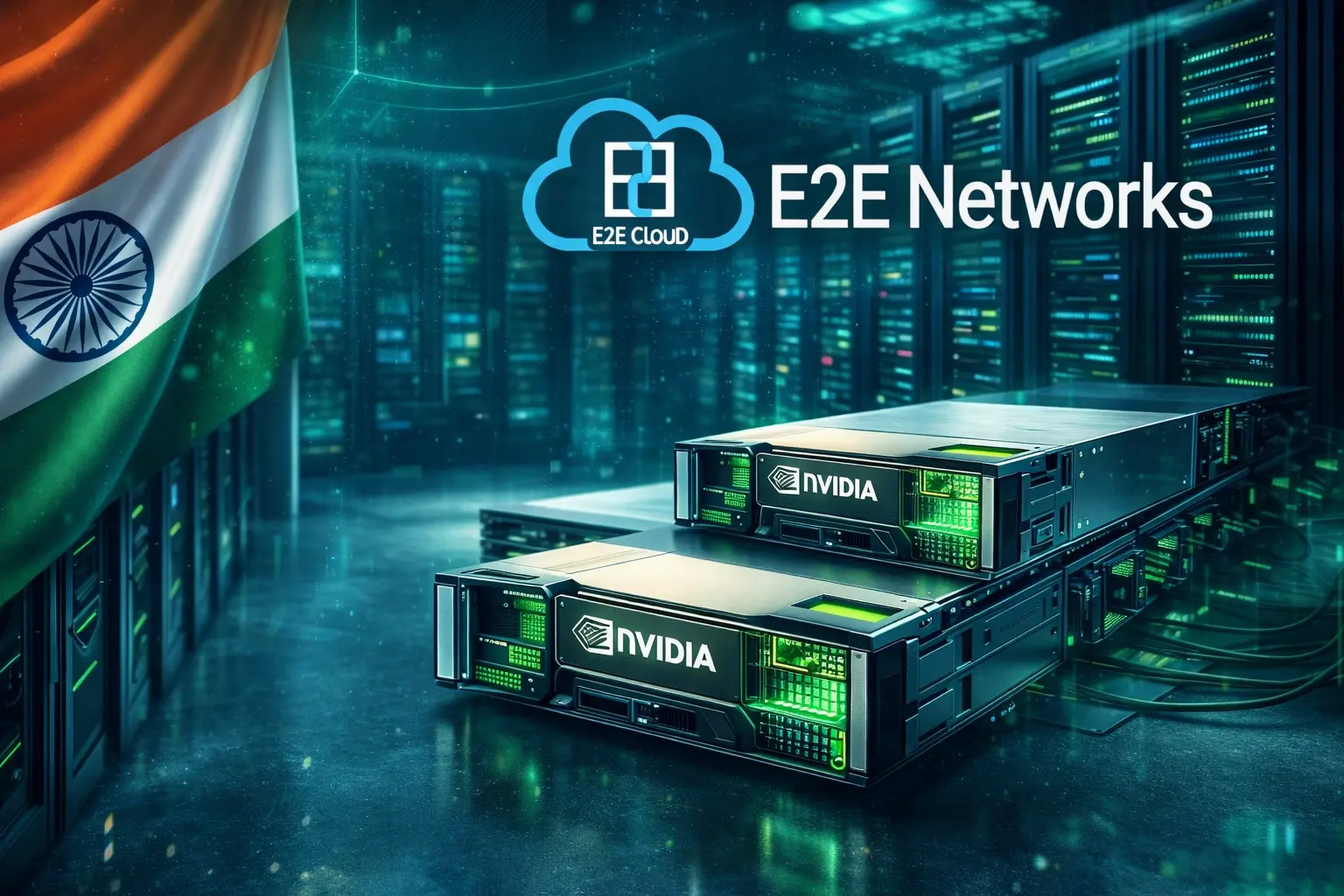
E2E share price skyrocketed on February 18, 2026, surging up to 17-20% intraday following news of a collaboration with Nvidia for AI compute infrastructure in India. This continues a pattern of high volatility and strong, AI-driven growth for the NSE-listed GPU cloud provider, which previously surged on L&T stake acquisitions.
E2E Networks Surges on Nvidia Blackwell Partnership: A Milestone for India’s Sovereign AI Infrastructure
India’s artificial intelligence landscape reached a decisive breakthrough today as E2E Networks shares surged nearly 20%, hitting an intraday high of ₹3,068.
The rally followed the formalization of its strategic Nvidia Blackwell partnership—a defining milestone in India’s sovereign AI infrastructure evolution.
Strategic Financial Moat
- Low Financial Leverage Reducing systemic risk compared to global GPU infrastructure competitors.
- High Utilization Rates Maximizing revenue efficiency across deployed AI compute infrastructure.
- Defensible Infrastructure Position Focused sovereign AI infrastructure capability within India’s domestic market.
Strategist Outlook
The Nvidia Blackwell partnership positions E2E Networks at the center of India’s sovereign AI infrastructure transformation, strengthening domestic compute independence and long-term strategic technological capability.
IndiaAI Mission Accelerates Sovereign AI Infrastructure Expansion
The rise of E2E Networks is directly linked to India’s ambitious sovereign AI infrastructure strategy under the IndiaAI Mission. With over ₹10,000 crore allocated toward artificial intelligence development, the government is prioritizing domestic compute capacity as a core pillar of technological sovereignty.
Historically, India’s AI ecosystem depended heavily on foreign cloud providers such as Amazon Web Services, Microsoft Azure, and Google Cloud. While these platforms enabled rapid adoption, they also created structural vulnerabilities related to data sovereignty, cost control, and geopolitical dependency.
The deployment of Nvidia Blackwell infrastructure through E2E Networks represents a decisive shift toward domestic compute independence. This transition enables Indian companies, startups, and government institutions to build and deploy AI systems entirely within national infrastructure.
Positive Structural Impacts of India Sovereign AI Infrastructure
- Positive: Strengthened national technological independence
- Positive: Reduced strategic dependence on foreign hyperscalers
- Positive: Accelerated domestic AI innovation and startup growth
- Positive: Improved national security and data sovereignty
- Positive: Long-term economic value creation through infrastructure ownership
This infrastructure transition positions India to become not just an AI consumer, but an AI infrastructure producer, fundamentally altering its role in the global technology hierarchy.
Competitive Risks and Strategic Challenges Remain
Despite its strong momentum, E2E Networks faces significant strategic risks that could influence its long-term trajectory. The global cloud infrastructure market is dominated by trillion-dollar hyperscalers with vast financial and technological advantages.
Companies such as Amazon, Microsoft, and Google possess massive infrastructure capacity, deep capital reserves, and established enterprise relationships. Their ability to rapidly deploy competing infrastructure in India remains a key competitive threat.
Negative Risk Factors Investors Must Monitor
- Negative: High capital expenditure requirements for GPU infrastructure expansion
- Negative: Potential aggressive competition from global hyperscalers
- Negative: Infrastructure deployment and execution risks
- Negative: Valuation sensitivity to growth expectations
- Negative: Rapid technological evolution requiring continuous upgrades
Additionally, GPU infrastructure investments involve long-term capital commitments, making operational efficiency and utilization rates critical determinants of financial performance.
Failure to maintain high utilization or successfully scale operations could create financial pressure, despite strong structural demand.
E2E Networks Positioned at Center of India AI Power Shift
The global artificial intelligence race is increasingly defined by infrastructure ownership. Nations and companies that control AI compute capacity gain structural advantages in innovation, economic growth, and technological influence.
Through its Nvidia Blackwell partnership, E2E Networks has positioned itself at the center of India’s sovereign AI infrastructure expansion. This gives the company strategic importance beyond traditional financial metrics.
The company’s ability to deploy advanced GPU infrastructure domestically strengthens India’s technological independence while supporting the rapid growth of domestic AI startups, enterprises, and government initiatives.
This transformation reflects a broader global shift toward sovereign AI infrastructure, as countries prioritize domestic control over critical technological systems.
Strategic Outlook: Infrastructure Will Define AI Winners
E2E Networks represents one of the most strategically important emerging players in India’s artificial intelligence infrastructure ecosystem. Its partnership with Nvidia Blackwell signals a transition from dependence to domestic capability in AI compute.
The company’s strong growth momentum, expanding infrastructure base, and strategic positioning within the IndiaAI Mission create powerful long-term structural advantages.
However, investors must balance optimism with caution. Infrastructure expansion requires sustained execution, operational efficiency, and financial discipline.
The global AI infrastructure race remains highly competitive, and long-term winners will be determined by execution, scalability, and technological adaptability.
E2E Networks’ current trajectory places it among the most important infrastructure players shaping India’s sovereign AI future.