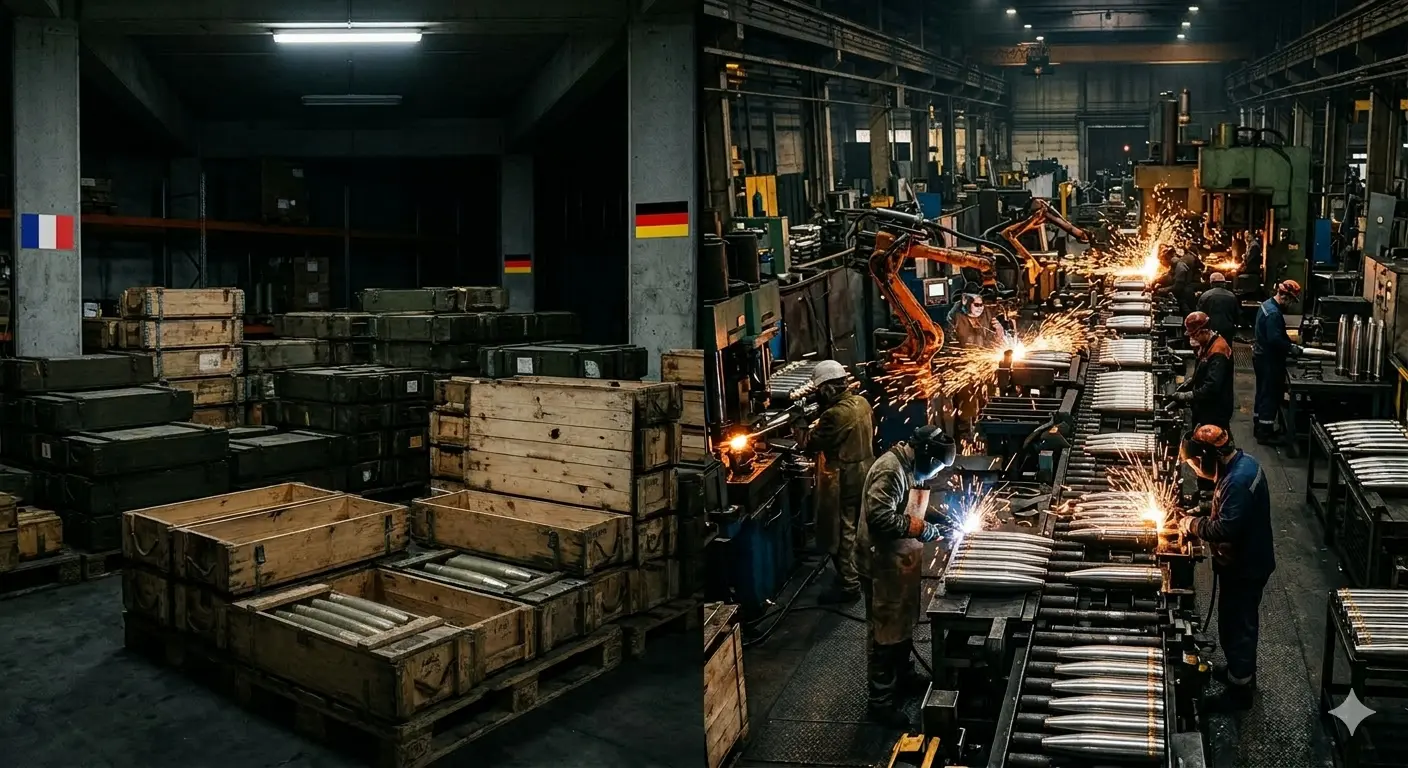
Indian defense stocks are moving into a powerful new spotlight as Europe scrambles to rebuild depleted ammunition reserves and expand military production capacity. The continent’s shell shortage is no longer a temporary battlefield problem. It is becoming a strategic industrial crisis with enormous implications for exporters, suppliers, and investors.
That shift matters because Europe is now under pressure to replenish stockpiles, accelerate procurement, and widen its defense manufacturing base. The old model of relying only on domestic output looks increasingly strained. A brutal supply gap is opening, and markets are starting to ask who can fill it at speed and scale.
The answer may not sit in Europe alone.
Europe Needs Millions of Shells
European governments are facing a hard reality: modern conflict burns through ammunition at a pace their factories were never built to sustain. Years of underinvestment, peacetime production models, and battlefield demand have exposed a dangerous weakness inside the continent’s military-industrial base. What looked manageable on paper now looks deeply inadequate under pressure.
The urgency is intensifying because the broader European rearmament push is no longer rhetorical. Brussels has put defense readiness at the center of its strategic agenda, and that means more money, faster procurement, and more pressure on supply chains. For investors, this is where the story turns explosive.
This is not just a military issue. It is an industrial repricing event.
That is also why this trend deserves close attention alongside our broader defense sector analysis and geopolitical risk coverage. Europe’s ammunition crunch is feeding directly into a larger reset in military sourcing, export partnerships, and strategic manufacturing geography. The winners are unlikely to be chosen by sentiment alone. They will be chosen by capacity.
Why Europe Cannot Scale Fast Enough
Europe still has world-class defense technology. What it lacks is manufacturing speed.
Building new ammunition lines is slow, capital-intensive, and politically difficult. Factories need equipment, raw materials, skilled labor, regulatory clearances, and long-term order visibility. None of that appears overnight. The result is a severe mismatch between urgent military demand and painfully slow industrial response.
That mismatch is exactly what creates opportunity for external partners. When domestic output cannot rise fast enough, procurement logic changes. Governments start looking beyond traditional suppliers and toward countries that can combine lower costs with scalable production.
The problem is scale.
For European buyers, cost also matters. Rebuilding reserves with premium-cost supply chains is expensive, especially when ammunition volumes run into the millions. That makes high-capacity, lower-cost manufacturing ecosystems far more attractive than they looked a few years ago.
Why India Fits the Supply Gap
India fits this gap because it offers an increasingly credible mix of industrial depth, cost competitiveness, and export ambition. The country’s defense sector is no longer just a domestic procurement story. It is steadily evolving into a strategic manufacturing platform with global relevance.
That transition is becoming more important as Europe and India deepen defense ties. The new security and defense partnership framework opens political space for stronger industrial cooperation, and that matters because supply relationships usually follow diplomatic alignment. Once the framework changes, capital and contracts often follow.
That is where India enters the equation.
Indian manufacturers also bring a practical advantage that markets often underestimate: they can operate in volume-sensitive categories where Western producers struggle to stay price competitive. In a cycle driven by shells, explosives, electronics, components, and repeat orders, that edge becomes extremely valuable.
Readers following this theme may also want to revisit our coverage of defense exports and Indian defense stocks, because the European angle strengthens the long-term export case. This is not only about one crisis. It is about a structural opening.
Indian Defense Stocks to Watch
Solar Industries
Solar Industries stands out because explosives and propellant-linked capacity sit close to the heart of any ammunition expansion cycle. If Europe needs more shells and related inputs, companies with scale in explosives manufacturing move into a very strong position. That is where the market starts paying attention to operating leverage, export optionality, and margin expansion.
Bharat Dynamics (BDL)
BDL matters because the defense opportunity extends beyond basic shells into propulsion systems, missile-linked manufacturing, and wider weapons supply chains. If export orders deepen over time, companies already embedded in strategic production categories could see stronger revenue visibility. That makes the stock more than a domestic order-book story.
Bharat Electronics (BEL)
BEL fits the theme from the electronics side. Modern warfare is not only about munitions volume. It also depends on radars, sensors, communication systems, targeting support, and electronic warfare architecture. As Europe upgrades capability and replenishes inventories, the electronics layer becomes highly profitable.
Investors are beginning to notice.
Over time, the secondary beneficiaries could include companies tied to precision engineering, aerospace components, naval systems, and advanced manufacturing. That creates a broader basket effect inside the sector. The market usually starts with a few obvious names, then widens once the export thesis gains credibility.
Strategic Outlook for Indian Defense Stocks
The bullish case is strong, but it is not risk-free. Defense deals move slowly, export approvals can delay momentum, and political signaling does not always convert into immediate contracts. Investors should avoid treating every geopolitical headline as instant revenue.
Still, the underlying direction looks powerful. Europe needs more shells, more capacity, and more flexible partners. India wants larger defense exports, deeper technology access, and a stronger place in global military supply chains. Those interests are starting to align in a serious way.
This is the real catalyst.
If Europe’s rearmament drive keeps accelerating, Indian defense stocks could move from being viewed as domestic policy beneficiaries to being priced as global strategic suppliers. That would be a major rerating. And if that rerating begins, it may not stay limited to one or two names.
For more context, readers can track the official EU-India Security and Defence Partnership announcement and the European Commission’s Readiness 2030 / ReArm Europe framework. Those documents help explain why this defense shift is no longer theoretical. It is already taking shape.