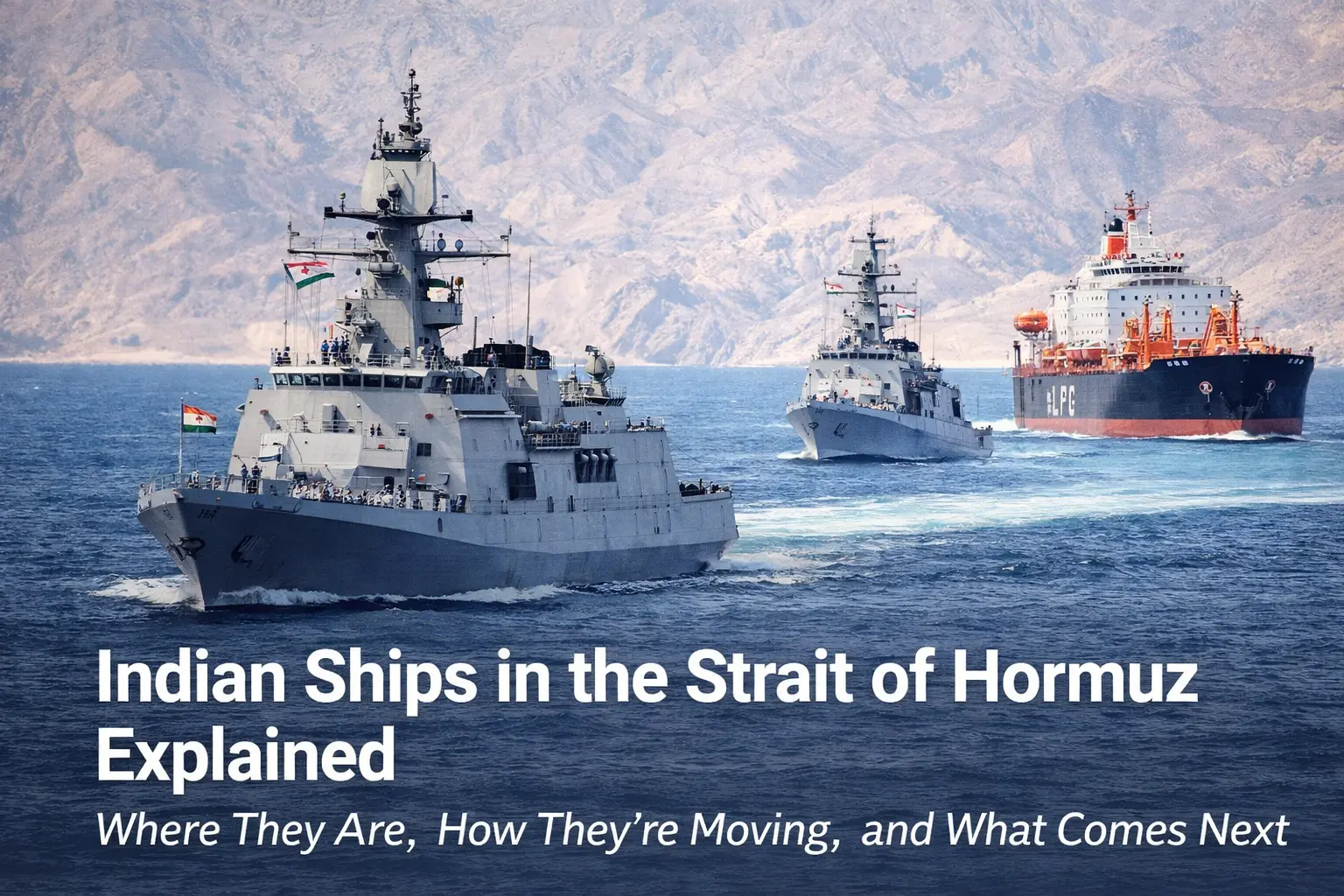
Indian ships in the Strait of Hormuz are caught in a narrow and dangerous passage system shaped by war, diplomacy, and naval caution. The Strait of Hormuz is not fully open, but it is not fully shut in the old sense either. What exists now is a selective wartime passage system in which a few Indian-flagged ships are being allowed through under special coordination while most traffic remains trapped, delayed, or too risky to move normally.
- Some Indian LPG carriers have moved through Hormuz, but most commercial traffic is still severely disrupted.
- Indian ships are not simply sailing through on routine commercial schedules; the passages that have happened appear tightly coordinated.
- The vessels still waiting are believed to be in Gulf waters west of the strait, holding for safer movement windows or diplomatic clearance.
- India has won a narrow operational exception, not a durable reopening of the sea lane.
- The biggest risk now is not just higher oil prices, but a prolonged supply and shipping shock if the conflict worsens.
For many readers, the confusion begins with a simple question: if a few Indian ships have already made it through, does that mean the crisis is easing? The answer is no. The successful movement of a handful of India-bound tankers does not mean normal traffic has resumed. It means only that India has managed to secure limited relief inside a maritime zone that is still operating under extraordinary pressure.
That is the key to understanding the current moment. The story is not that Hormuz has reopened. The story is that access to one of the world’s most important energy chokepoints is now being filtered by war, military risk, and political calculation. For a broader look at why the Strait of Hormuz matters to global oil supply, the wider strategic context is just as important as the immediate ship movements.
What is happening in the Strait of Hormuz right now?
The strait is functioning in a highly distorted way. A few ships are moving, but most maritime traffic remains constrained. Indian-flagged LPG carriers such as Pine Gas and Jag Vasant have recently transited with fuel bound for India, offering badly needed relief to a tightening LPG supply situation. But that movement should not be mistaken for a return to normal navigation.
The broader pattern is still one of disruption. Ships, crews, insurers, charterers, and governments are all operating under the shadow of a conflict that has transformed commercial passage into a strategic calculation. The traffic that once moved through Hormuz on routine schedules is now facing a system shaped by risk alerts, diplomatic signalling, military escort planning, and the possibility of sudden escalation, as reported by Reuters.
Where are the Indian ships stuck?
The available picture suggests that many of the affected Indian-linked vessels are waiting in Gulf waters to the west of the Strait of Hormuz, rather than moving freely through the chokepoint. In plain terms, they are in the broader danger zone around the approach to the strait, not safely back in Indian waters and not part of any normal sailing rhythm.
Public reporting does not provide a full live vessel-by-vessel map for all Indian ships, and that is not surprising. In a conflict environment, governments and operators are often careful about disclosing exact positions. But the broad operational reality is clear enough: these ships are effectively in a waiting pattern, held back by a mix of political uncertainty, route risk, and the need for safe passage arrangements.
Are the ships in ports or out at sea?
The most accurate answer is that the situation appears mixed, but the main problem is not a neat line of ships quietly berthed in ports. It is a maritime holding pattern. Some vessels may be near terminals, anchorages, or protected waiting areas, but the core crisis involves ships that are delayed in regional waters because commercial movement through Hormuz no longer works like an ordinary shipping lane.
That distinction matters. A ship waiting inside a stable port environment faces one kind of risk. A ship waiting in tense regional waters while insurers, navies, and governments assess passage options faces another. For readers trying to understand the real stress on Indian shipping, the second image is much closer to reality.
How are some Indian ships still moving through Hormuz?
They are moving through special coordination, not through routine freedom of navigation. The passages that have happened appear to be closely managed, with Indian Navy involvement in guidance and protection, and with routes that seem designed to reduce the odds of a confrontation or miscalculation.
Reports have indicated that the recent Indian LPG tankers followed a route close to the Iranian coastline. That matters because it suggests the ships were not simply challenging the situation head-on. Instead, they were likely moving under a negotiated or tolerated pathway that minimized risk. In other words, this is less a story of defiance than of careful choreography.
This also explains why only a few ships have moved. If passage depends on coordination, timing, and political approval rather than on open commercial rules, then every transit becomes an exception instead of a norm. Reuters’ wider reporting on the same crisis also shows how energy, diplomacy, and maritime security are now tightly linked in the Gulf.
What are the stuck ships doing right now?
In practical terms, they are waiting. They are waiting for the next clearance, the next safer weather and threat window, the next diplomatic arrangement, or the next escort plan that makes movement possible. This is not idle delay. It is risk management in a sea lane where a wrong move could trigger military, political, or economic consequences.
Behind that waiting lies a dense layer of coordination. Ship operators are assessing route conditions. The Indian government is in touch with relevant regional actors. Maritime agencies are exploring safer movement corridors. Naval planners are evaluating what support can be offered without turning a protection mission into a direct confrontation. All of this means that “waiting” is not inactivity. It is the operational form of survival in a crisis zone.
Will Iran attack Indian ships if they try to pass?
There is no clear sign at the moment that Iran wants to deliberately target Indian ships in the same way it is pressuring broader traffic. In fact, the limited passage granted to some Indian vessels points in the opposite direction: Tehran appears willing to make selective exceptions for India. But that does not mean Indian ships are automatically safe.
The danger lies in the difference between not being a preferred target and being fully protected. An Indian ship moving without coordination could still face interception, misidentification, maritime harassment, or exposure to spillover from a wider escalation. If Iran were to conclude that a particular movement violated the rules it is now informally imposing, the risk would rise sharply.
That is why the better question is not whether Iran “wants” to attack Indian ships. The real question is whether India can keep ensuring that its ships move only through pathways that Iran has decided not to contest. At the moment, that seems to be the logic guiding recent transits. The wider geopolitical logic of this war is visible well beyond shipping too, including in how Iran’s strike near Dimona shook Israel’s “Little India”.
Is the Indian Navy there?
Yes — but in a careful, calibrated way. India is not absent from this crisis. The Indian Navy has been involved in guiding and protecting recent movements, and India’s wider maritime posture in the Arabian Sea and nearby waters is clearly part of the response architecture around Hormuz.
That involvement matters for two reasons. First, it reassures ship operators and cargo planners that India is not leaving its vessels entirely to chance. Second, it gives New Delhi a practical tool to back up its diplomacy. In a crisis like this, diplomacy without visible maritime capability can look weak. Maritime capability without diplomatic restraint can look reckless. India is trying to balance both.
Will the Indian Navy enter the Strait of Hormuz itself?
That remains the most sensitive question. There is no clear public indication that India wants to turn this into an open naval challenge inside the strait. Everything about the current approach suggests caution. India wants to protect its ships, but it also wants to avoid a direct military faceoff with Iran.
The likely Indian approach is therefore narrow and practical: go as far as necessary to guide, protect, and manage passage, but avoid actions that would make India look like an active participant in a coercive campaign against Tehran. That caution is not weakness. It is strategic discipline. India’s goal is to get ships through, not to start a naval theatre of its own.
Why is Iran allowing some Indian ships through?
Because this is a political filter, not a neutral commercial system. Iran appears to be distinguishing between traffic it sees as hostile, traffic it wants to pressure, and traffic it is willing to tolerate for strategic reasons. India occupies an unusual space in that calculation: it is an important energy buyer, a major Asian power, and not part of the U.S.-Israel military campaign against Iran.
That makes selective permission useful to Tehran. By allowing some India-bound ships through, Iran shows that it can still shape access on its own terms. It also avoids needlessly alienating a country it may want to keep engaged diplomatically. This is not sentimental friendship. It is wartime pragmatism.
What happens next?
Three possibilities now matter most. The first is controlled continuation: a few more Indian ships get through under similar arrangements, easing immediate pressure but leaving the broader crisis unresolved. The second is prolonged gridlock: movement stays selective, delays persist, and the economic strain deepens across fuel markets, freight, and inflation. The third is escalation: the conflict worsens, maritime threats rise, and the narrow exceptions India has secured begin to disappear.
That last scenario cannot be dismissed. If the war intensifies further, even carefully negotiated passages could become much harder to sustain. A sea lane already operating under exceptional risk can deteriorate very quickly once military messaging turns into hard action.
Why this matters for India
This is not only a shipping story. It is an energy security story, an inflation story, and a strategic credibility story. India depends heavily on energy flows that can be disrupted by instability in the Gulf. Even when substitute supply exists, shipping risk changes the economics of getting fuel where it needs to go. LPG shortages hit households quickly. Crude disruptions ripple through transport, industry, and prices.
For India, the danger is not limited to delayed cargoes. Shipping stress in the Gulf is already feeding directly into global oil pricing, a trend explored in our analysis of the Brent crude price spike. The same dynamic is also visible in broader international coverage of oil-market disruption, including Reuters’ reporting on how the Iran war is redirecting fuel flows toward Asia.
The conflict also matters to India in more personal ways than many readers realize. Beyond oil routes and freight risk, the wider war has already touched communities with deep Indian roots in the region, as seen in how Iran’s strike near Dimona shook Israel’s “Little India”.
There is also a geopolitical lesson here. India’s ability to protect its interests in a crisis zone now depends on a mix of naval presence, diplomatic flexibility, and its reputation for not being an automatic extension of any one power bloc. That balancing act is one of India’s great strengths — but Hormuz is showing how fragile that space can become when the region around it turns violent.
FAQ: Indian Ships in the Strait of Hormuz
Most are believed to be in Gulf waters west of the Strait of Hormuz, waiting for safer movement or diplomatic clearance rather than sailing normally through the chokepoint.
The situation appears mixed, but the core problem is ships waiting in regional waters and holding areas rather than operating on normal port-to-port schedules.
Through special coordination, careful routing, and Indian Navy-guided movement rather than ordinary commercial passage.
They are waiting for clearance, safer transit windows, escort arrangements, and route conditions that reduce the risk of confrontation or disruption.
There is no sign that Iran currently wants to deliberately target Indian ships that are moving under coordinated arrangements, but any uncoordinated passage would carry serious risk.
Yes. India is involved in guiding and protecting recent movements and is clearly part of the broader maritime response around the crisis.
India appears to be acting cautiously. The current strategy looks focused on protection and coordination, not on turning Hormuz into a direct India-Iran naval confrontation.
The cleanest way to understand the current situation is this: Hormuz is not open in any normal sense, but it is not sealed shut for India either. A few Indian ships are moving through under special arrangements. Most are still waiting. And until the wider war cools or a safer corridor emerges, every successful transit will remain an exception, not a return to normal.