
The Titan Rises: PFC–REC Merger and Why New Delhi Merged Its Power Wallets
PFC–REC Merger Ratio Explained: The PFC–REC merger marks a turning point in India’s power financing strategy. On February 6, the boards of Power Finance Corporation (PFC) and REC Limited approved a merger that rewrites the blueprint of India’s power sector.
Here is the strategic analysis of why this merger happened, what it means for the Indian grid, and the cold, hard math for the shareholders holding the paper.
PFC–REC Merger Ratio (Swap Ratio): What investors should know
The Swap Ratio (What to Expect)
The official swap ratio has not yet been finalized. It will be determined by an independent valuation in the coming months.
However, leading brokerages like UBS have provided an indicative swap ratio of roughly 8:9 based on current market prices.
- This means that for every 9 shares of REC, shareholders could receive 8 shares of PFC
- Until the official announcement is made, the swap ratio remains the most important near-term price trigger for both stocks.
The Strategic Imperative: Why the Government Did This
To understand this merger, you must look past the balance sheets and into the government’s energy roadmap. New Delhi didn’t just want a “bigger company”; it needed a Sovereign Financial Fortress.
- The “Global Scale” Gambit: India needs approximately $300-400 billion in power investments to meet its renewable targets by 2030. Separate, PFC and REC were large Indian lenders. Combined, they become a global financial giant with a loan book exceeding ₹11 Trillion ($130B+). This size allows them to tap into international bond markets (dollar bonds) at rates comparable to sovereign debt, drastically lowering the cost of funds.
- Ending the “Left Hand vs. Right Hand” War: For years, PFC and REC—both government-owned—competed for the same clients (State Electricity Boards). They undercut each other on interest rates, eroding public value. This merger forces a monopoly of efficiency: one lender, one policy, one underwriting standard.
- Capital Adequacy Management: By merging, the government can manage the Capital Adequacy Ratio (CAR) of one entity rather than juggling two. It creates a “Too Big To Fail” institution that can leverage its equity far more aggressively to fund mega-projects like Offshore Wind and Green Hydrogen hubs.
The Shareholder’s Playbook: What This Means for You
If you hold PFC or REC, you are currently riding a wave of uncertainty. Here is the breakdown:
The “Swap Ratio” Risk: This is the only number that matters right now.
- If you hold REC: You are the “target.” You will receive shares of the new combined entity (likely PFC). If the independent valuers set a ratio that values REC lower than its current market price relative to PFC, you effectively take a “haircut” in the short term.
- If you hold PFC: You are the “acquirer.” You face the risk of equity dilution (more shares being issued to buy REC). However, you end up owning the cash-cow subsidiary (REC) directly on your books, which is “Book Value Accretive” in the long run.
- The Dividend Narrative: Both companies were high-dividend payers (often 9-10% yield). A merged entity might rationalize payouts to retain cash for growth. Expect dividend yields to moderate slightly but become more consistent.
- The “Index Effect”: A combined entity will have a higher weight in the MSCI and FTSE Indices. This triggers automatic buying by foreign passive funds (ETFs), which can act as a floor for the stock price post-merger.
3. The Infrastructure Impact: Fueling the Grid
- Faster Financial Close: Mega-projects (like the 30GW solar parks in Khavda) often faced delays because they had to secure consortium lending. A combined PFC-REC can underwrite massive loans solo, speeding up the “Financial Close” of projects by months.
- Resolving the DISCOM Mess: The combined entity will hold virtually all the debt of India’s State DISCOMs. This gives it unprecedented leverage to force reforms, ensuring that state electricity boards pay power generators on time, which improves the health of the entire sector.
The Verdict: The “Eastern” View
The merger of PFC and REC is not just a corporate restructuring; it is the creation of India’s “Energy World Bank.”
For the investor, the advice is patience. The next few weeks will be volatile as the arbitrage traders play the spread between the two stock prices. But for the long-term holder, the new entity represents the safest way to play India’s energy transition story—a government-backed monopoly with the financial muscle to power the world’s most populous nation.
The Strategy: Watch the PFC/REC Price Ratio. If the spread widens irrationally due to panic, it may be the buying opportunity of the year.
The Arbitrage Monitor: PFC vs. REC Price Ratio
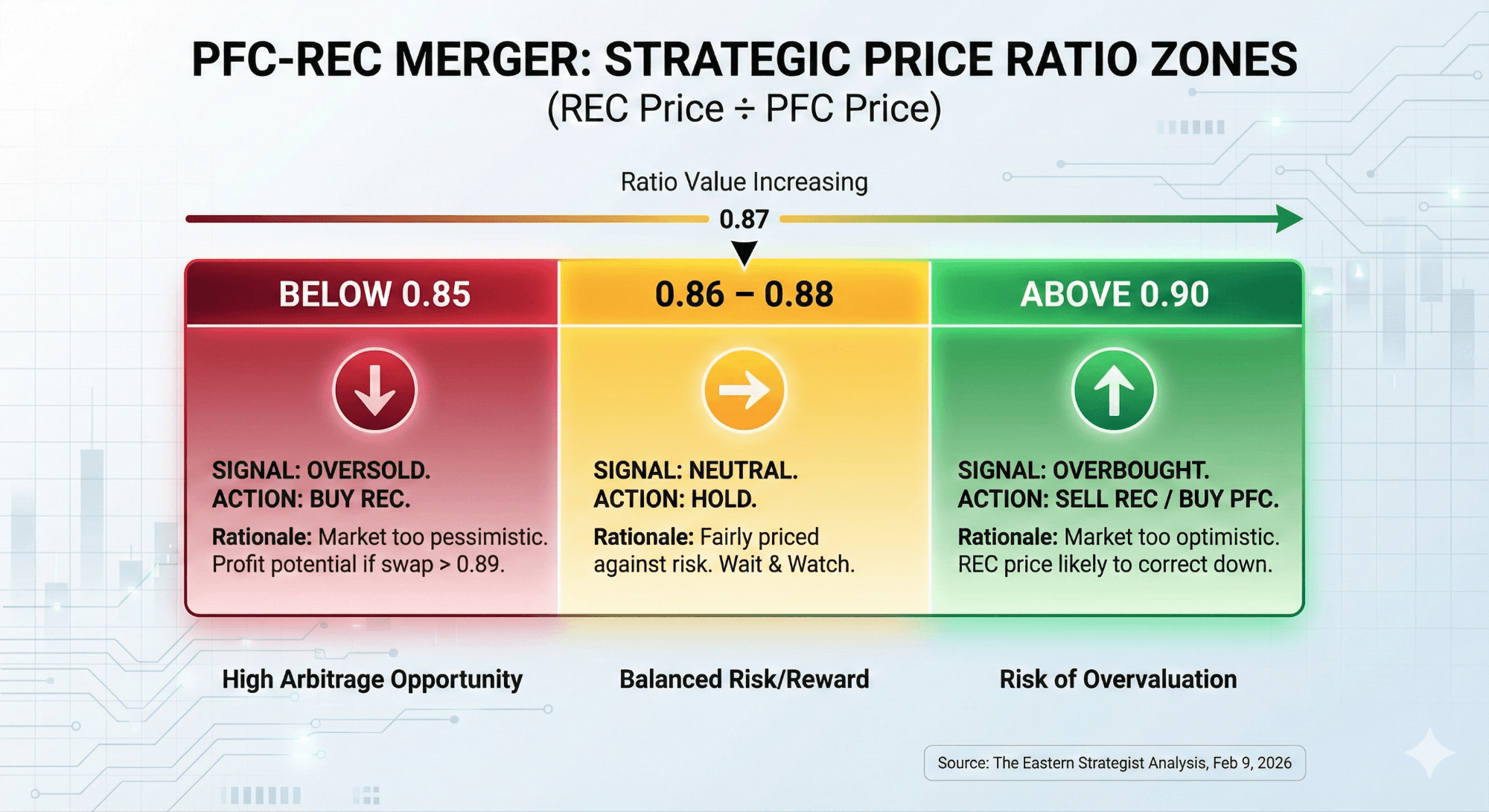
The Chart: The most important chart for the next 12 months is not the PFC or REC price individually, but the Price Ratio (REC Price ÷ PFC Price).
Technical Analysis of the Ratio (As of Feb 9, 2026)
- Current Ratio: 0.87 (REC @ ₹361 / PFC @ ₹414)
- The “Fair Value” Zone: Analysts (like UBS) are projecting a swap ratio close to 0.89 (8 shares of PFC for every 9 shares of REC).
- The Opportunity Gap: Currently, the market is trading at 0.87, which is a discount to the expected 0.89. This “spread” exists because of the uncertainty risk (what if the government sets a lower ratio?).
Strategic Zones to Watch:
Frequently Asked Questions
What is the PFC–REC merger?
It is the consolidation of India’s two largest government-owned power sector lenders to create a single large financing institution for grid, renewable and infrastructure projects.
Why did the government approve the PFC–REC merger?
To lower funding costs, reduce duplication between state lenders and create a globally scalable financing platform for India’s energy transition.
How will the PFC–REC merger affect shareholders?
Short-term volatility will depend on the final swap ratio, while long-term returns will depend on balance-sheet scale, dividends and index inclusion.