
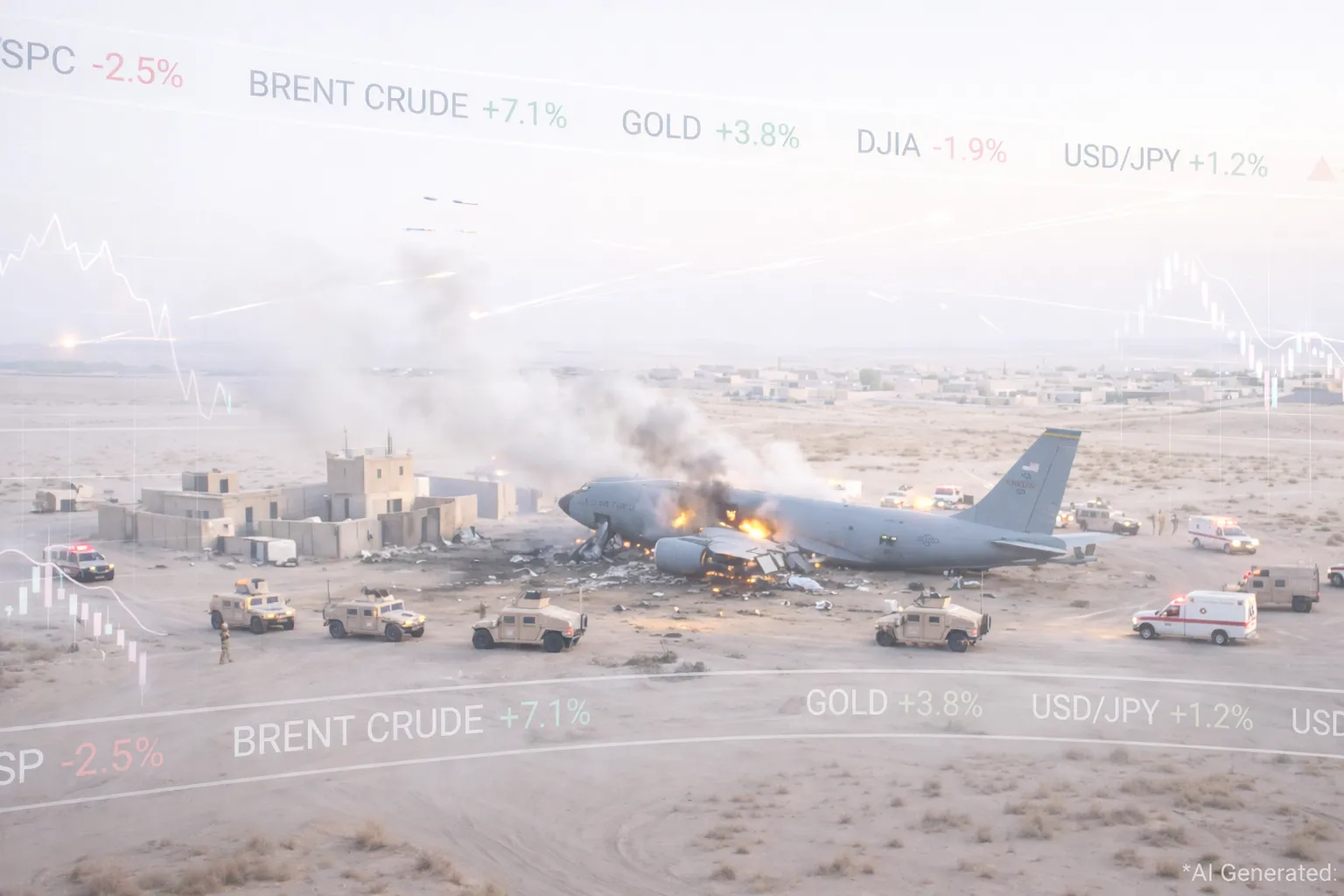
U.S. Military Plane Crash: A critical incident in the Middle East has just sent global markets into a defensive scramble. The crash of a U.S. aerial refueling plane in Iraq—set against a backdrop of escalating drone and missile strikes by Iran-backed militias—has investors bracing for a massive regional conflict.
Whether the Pentagon ultimately rules this a mechanical failure or the result of hostile fire, the damage to market confidence is already done. Wall Street is flashing red, oil prices are surging, and the threat of direct state-on-state confrontation between Washington and Tehran has never been higher.
Here is what you need to know about the escalating crisis and how it could hit your wallet in the coming weeks.
The Geopolitical Powder Keg
The timing of this crash could not be worse. The U.S. military has been operating in a hyper-militarized environment, fending off asymmetric proxy skirmishes for months. Now, the stakes have officially changed.
If intelligence attributes this crash to an Iranian-aligned militia, the White House will face overwhelming domestic and allied pressure to retaliate with overwhelming force. This attribution dilemma places the U.S. on the precipice of a direct conflict.
Furthermore, this puts Iraq’s fragile government in an impossible position—caught in a tug-of-war between its U.S. security partnerships and powerful, Tehran-backed factions operating within its own borders. Even if the crash is definitively proven to be an accident, the pervasive “fog of war” greatly increases the risk of a deadly miscalculation by either side.
The Human Cost: A Growing Regional Toll
Behind the market volatility lies a rapidly mounting human cost. As the conflict nears the two-week mark, casualty figures across the region have escalated dramatically, driving further geopolitical instability.
Below is the current breakdown of the human toll as of March 13:
📊 INFOGRAPHIC: Regional Fatalities at a Glance
| Region | Reported Fatalities | |
|---|---|---|
| Iran | ~1,300+ | 🟥🟥🟥🟥🟥🟥🟥🟥🟥🟥🟥🟥🟥 |
| Lebanon | 687 | 🟧🟧🟧🟧🟧🟧 |
| Other Regional | 20+ | 🟨 |
| Israel | 12–15 | 🟦 |
| U.S. Forces | 13 | 🇺🇸 |
- United States: 13 U.S. service members have been killed, including the 6 crew members lost in the recent KC-135 refueling plane crash in Iraq, 6 in a prior drone strike in Kuwait, and 1 in Saudi Arabia. Approximately 140 troops have been wounded, 8 of them severely.
- Iran: More than 1,300 people have been killed, including civilian casualties from widespread airstrikes, with thousands more injured.
- Lebanon & The Broader Region: Over 680 people have died in Lebanon amid extensive bombing, displacing over 800,000 residents. Scattered casualties have also been reported in neighboring Gulf states and Israel, which has sustained over a dozen fatalities and hundreds of injuries from missile barrages.
Strategic Blows: Military and Naval Asset Losses
Beyond the tragic human toll, the conflict has seen massive destruction of high-value military hardware, particularly naval assets.
📊 INFOGRAPHIC: Major Equipment & Naval Losses
| Nation | Key Asset Losses | Est. Financial Impact | Visual Status |
|---|---|---|---|
| Iran | 50+ Naval Vessels, Submarines, Air Defenses | Severe Degradation | 🚢💥💥💥💥💥 |
| U.S. | 4 Aircraft, 2 Major Radar Systems, Base Damage | ~$2 Billion | ✈️💥 |
| Israel | Interceptor Stockpiles, Civilian Infrastructure | High (Defensive) | 🛡️📉 |
- United States: The U.S. has lost approximately $2 billion in strategic hardware. This includes the KC-135 refueling plane in Iraq, three F-15E Strike Eagles, an AN/FPS-132 early warning radar in Qatar ($1.1 billion), and a THAAD radar component in the UAE ($500 million).
- Iran: U.S. and Israeli strikes have devastated Iran’s maritime capabilities. Over 50 vessels have been destroyed or crippled, including the entire Soleimani-class fleet, the IRIS Dena corvette, and the Shahid Bagheri drone carrier. Coastal submarines and underground “missile cities” have also sustained heavy damage.
- Israel: While Israel has not reported major losses of heavy offensive platforms like fighter jets or ships, the ongoing barrage of thousands of drones and ballistic missiles has severely depleted its multi-tiered interceptor stockpiles and damaged regional infrastructure.
The Market Impact: Gas Prices, Portfolios, and Safe Havens
For the American consumer and investor, the geopolitical shockwaves are already hitting home. The market reaction has been swift, brutal, and focused entirely on asset protection.
- Pain at the Pump: Crude oil (both Brent and WTI) surged immediately on the news. Traders are aggressively pricing in a “risk premium” around the Strait of Hormuz—the vital chokepoint where roughly 20% of global oil consumption passes. If maritime war-risk insurance premiums skyrocket as expected, those costs will be passed down directly to U.S. gas stations.
- Flight to Safety: Investors are dumping riskier assets and fleeing to traditional safe havens. Gold experienced a massive intraday spike, while the U.S. Dollar (USD) and Swiss Franc (CHF) are strengthening as global capital seeks a secure harbor.
- Defense Stocks Surge: While the broader market bleeds, major defense and aerospace contractors—including Lockheed Martin, RTX, and General Dynamics—are seeing massive pre-market bids. Wall Street is betting on a prolonged, well-funded conflict.
- Travel and Logistics Chaos: Global airlines are selling off sharply. The dual threat of spiking jet fuel costs and the immediate closure of massive swathes of Middle Eastern airspace is forcing costly rerouting that will inevitably impact global supply chains and ticket prices.
What Happens Next? 3 Scenarios to Watch
Over the next 30 to 90 days, military and market analysts are tracking three potential paths forward:
1. The “Tit-for-Tat” Reality (Base Case – 50% Probability) The U.S. responds with targeted, heavy strikes against proxy infrastructure in Iraq and Syria, but carefully avoids striking sovereign Iranian territory to prevent World War III. Markets remain highly volatile but eventually digest the news, leaving gas and oil prices at a permanently higher baseline.
2. The Doomsday Contagion (Tail Risk – 35% Probability) U.S. retaliation targets Iranian assets directly. In response, Tehran attempts to blockade the Strait of Hormuz or launches direct missile strikes on U.S. bases in the Persian Gulf. This nightmare scenario would push oil well past multi-year highs, reignite U.S. inflation, and severely threaten global economic growth.
3. Rapid De-escalation (Low Probability – 15%) Back-channel diplomacy (likely via Oman or Qatar) succeeds in establishing a temporary pause in hostilities. The Pentagon confirms the plane crash was strictly mechanical, cooling immediate tensions. Markets breathe a sigh of relief, and oil prices retrace their immediate spike.
The Bottom Line: The era of isolated Middle Eastern proxy wars is fading. The global economy is deeply intertwined with the security of the Persian Gulf, and the coming days will be critical for U.S. troops, global markets, and the American consumer.