India-Flagged Ships Are Crossing Hormuz — But Not the Way You Think
Behind the headlines, India’s energy lifeline is being managed through a controlled wartime corridor — not a normal global shipping route
By Abhishek Kumar | The Eastern Strategist
Indian-flagged ships are still crossing the Strait of Hormuz. But they are not sailing freely. What appears to be normal commercial traffic is, in reality, tightly managed movement through a live conflict zone.
When reports say Indian vessels are crossing Hormuz, the natural assumption is that the sea lane remains open and global trade continues as usual. That assumption is misleading. The passage is functioning under stress, control, and selective access.
According to Indian government data, only seven India-flagged LPG tankers crossed the strait between early March and early April, while 17 vessels remained stranded in the western Persian Gulf waiting for safer transit. Over 460 Indian seafarers were under continuous monitoring.
This is not normal shipping
If Hormuz were operating normally, ships would not be queuing in a war-risk zone under government supervision. The limited number of crossings reflects not openness, but controlled movement through a dangerous bottleneck.
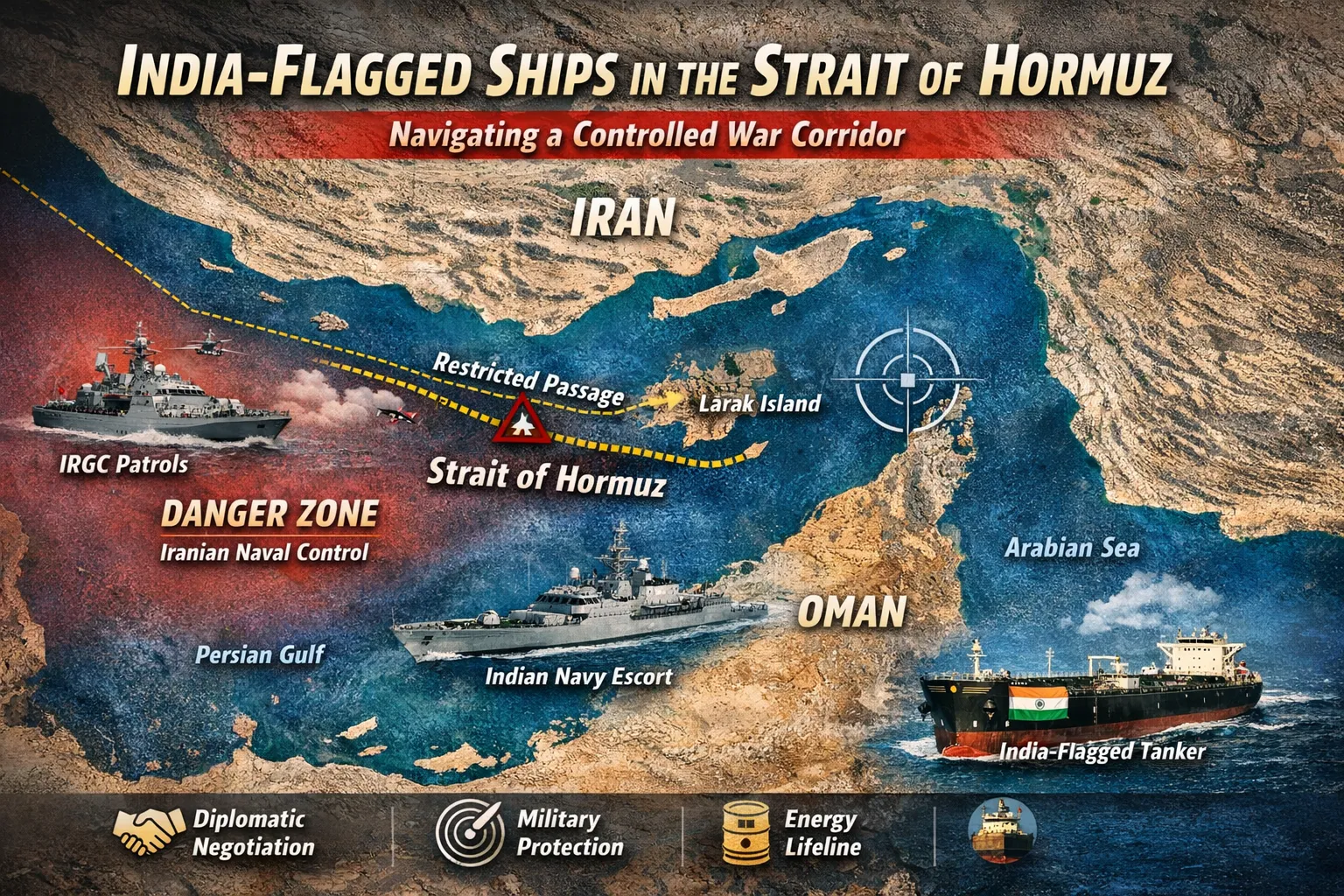
The clearest example came from the LPG tanker Pine Gas. After being delayed for nearly three weeks, the vessel was routed through a narrow channel near Iran’s coast instead of the standard commercial lane, which was considered unsafe.
That shift is critical. Hormuz is no longer functioning as a freely accessible maritime highway. It is operating more like a monitored corridor where routing decisions are influenced by security and political considerations.
A permission-based corridor
The perception is that ships are navigating normally. The reality is that passage increasingly depends on identity, signaling, and geopolitical positioning.
Reports indicate that Iran has allowed vessels from “non-hostile” countries to pass selectively. In at least one case, an Indian ship identified itself explicitly during transit — a signal that would be unnecessary in normal conditions.
This suggests that Hormuz is no longer a neutral global route in practice. It is becoming a controlled passage where access is filtered.
India is managing this like a live operation
New Delhi’s response reflects the seriousness of the situation. Authorities have imposed real-time tracking, increased reporting requirements, and round-the-clock monitoring of Indian vessels in the region.
This is not routine maritime oversight. It is a security-driven operational posture.
The Indian Navy has also played a role. The tanker Pine Gas was guided during its most vulnerable phase and later escorted by Indian warships after exiting the strait. Even its cargo was rerouted within India, highlighting how the crisis is affecting downstream logistics.
This is as much diplomacy as shipping
India’s continued movement through Hormuz is not just about navigation. It reflects political positioning. Tehran appears to be allowing selective passage, and India is currently outside the hostile bracket.
That makes this a diplomatic story as much as a maritime one.
TES Insight
The blunt reality is this: India-flagged ships are not navigating Hormuz the way many imagine. They are not simply sailing through an open international route. They are moving through a controlled chokepoint shaped by risk, politics, and state intervention.
The map still shows a sea lane. The reality looks closer to a checkpoint.
This matters far beyond shipping. Hormuz is no longer functioning as a normal artery of global trade. It is operating as a filtered passage — where access is selective, movement is managed, and survival depends on more than navigation.
For India, the fact that ships are getting through is not a sign of stability. It is a sign of how carefully its energy lifeline is being managed under pressure.
Further Reading
👉
Iran War Hub
👉
Strait of Hormuz: Full Geopolitical Guide
👉
Iran War Impact on India
Sources
Reuters report on Pine Gas route
Government of India data on vessels
TOI report on tanker movement