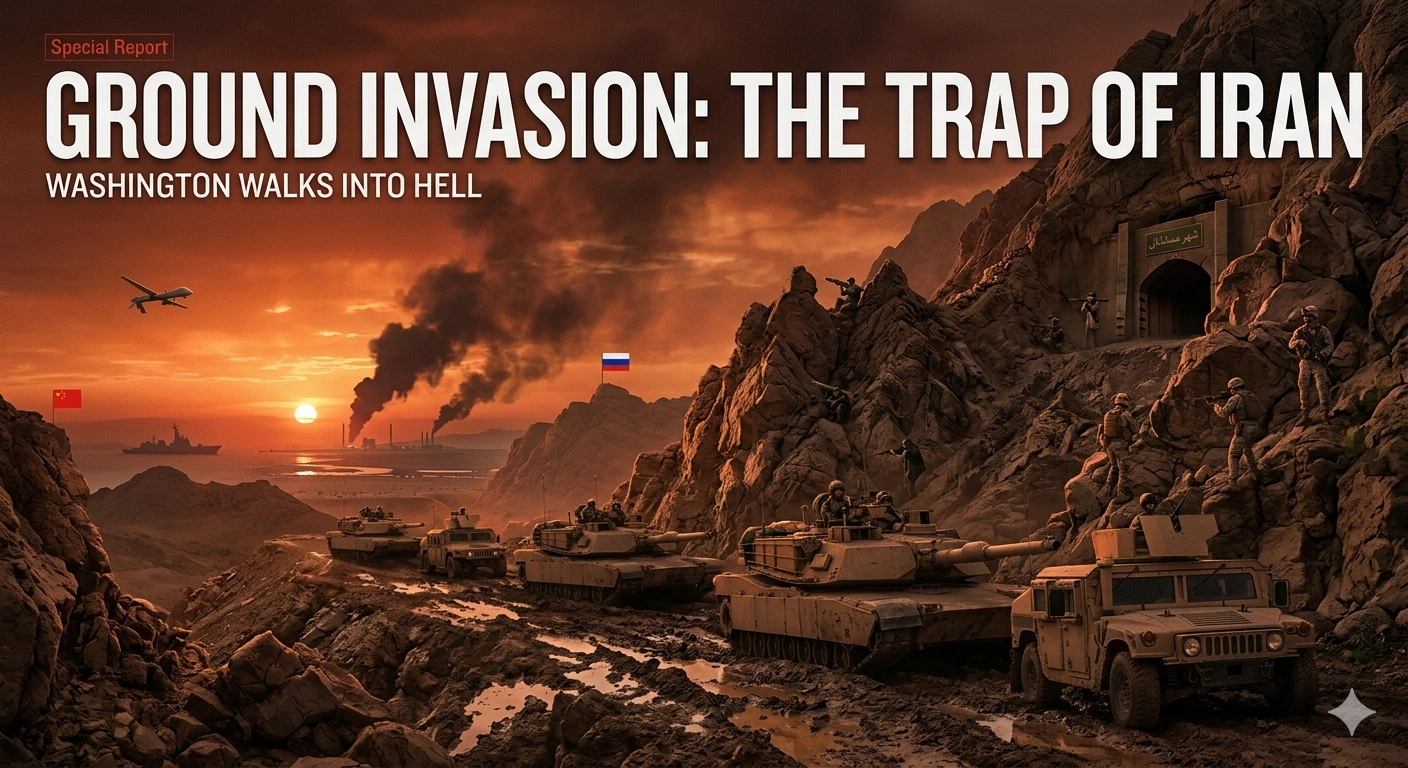
The US Ground Invasion of Iran: Why Washington is Walking into a Strategic Trap
Strategic Affairs
Thirty days into “Operation Epic Fury,” U.S. airstrikes have leveled over 10,000 targets across the Middle East. Yet, Brent crude sits stubbornly above $110 a barrel. The American air campaign has definitively failed to break Tehran’s grip on the Strait of Hormuz.
Now, Washington faces an impossible choice. The Pentagon is actively drafting contingency plans for a targeted US ground invasion of Iran. A full-scale occupation of the country is completely off the table.
But seizing Kharg Island—Tehran’s primary oil export hub—is a very real option being weighed by military planners. U.S. Central Command has already deployed elements of the 82nd Airborne Division to the region. Thousands of Marines recently arrived from California.
They are mapping out amphibious landing zones and planning operations to secure deeply buried nuclear facilities. Our ongoing coverage of regional defense shifts highlights the sheer scale of the logistical buildup currently underway.
The Casualty Math of a US Ground Invasion of Iran
Why consider this drastic step? The U.S. economy cannot sustain prolonged $110+ oil. If airpower cannot reopen global shipping lanes, boots on the ground remain the only physical way to force the issue.
Iran’s response has been pure psychological warfare. State media recently ran a front-page headline reading “Welcome to Hell,” promising U.S. troops would return in coffins. This is not domestic propaganda. It is a direct warning to the American electorate and Wall Street.
Tehran’s greatest weapon is its geography. Unlike the flat deserts of Iraq, Iran is a natural fortress guarded by the Zagros Mountains. The Islamic Revolutionary Guard Corps (IRGC) operates out of deeply buried “missile cities” immune to American bunker-busters.
This terrain guarantees catastrophic casualties. Military planners are comparing an amphibious assault on Kharg Island to the Gallipoli disaster of World War I. The southern shorelines are heavily mined and crawling with suicide drones.
The Domestic and Economic Breaking Point
American voters have zero appetite for another Middle East quagmire. Polls show nearly 70% of the public vehemently opposes a ground war. And with gasoline prices surging, domestic political anger is boiling over.
The economic shockwaves are already restructuring global markets. The war premium on oil is triggering massive fears of secondary inflation. But beneath the panic, institutional capital is flooding into global defense equities, anticipating a massive, multi-year supercycle.
Geopolitical Winners: Russia and China
While Washington bleeds resources, its geopolitical rivals are cashing in. Russia is selling sanctioned crude at massive premiums to fund its Ukraine offensive. China is quietly advancing its de-dollarization strategy by purchasing Iranian oil entirely in Yuan.
On the ground, Iran claims to have mobilized one million men. They are preparing a decentralized, guerrilla insurgency. If American Marines land, Tehran will immediately activate Hezbollah, the Houthis, and Iraqi militias to ignite a synchronized regional war.
The consensus in Western capitals is grim. A US ground invasion of Iran is a strategic trap. The administration is currently using the threat of boots on the ground as maximum leverage, desperately seeking a diplomatic off-ramp before the global economy fractures.
STRATEGIC BOTTOM LINE: Over the next 6 to 12 months, expect the U.S. to abandon the idea of an amphibious assault entirely. The casualty mathematics and domestic political costs are simply too high for the White House to absorb. Instead, Washington will double down on a prolonged, high-intensity containment strategy, forcing global markets to permanently adjust to a baseline of $100+ oil.