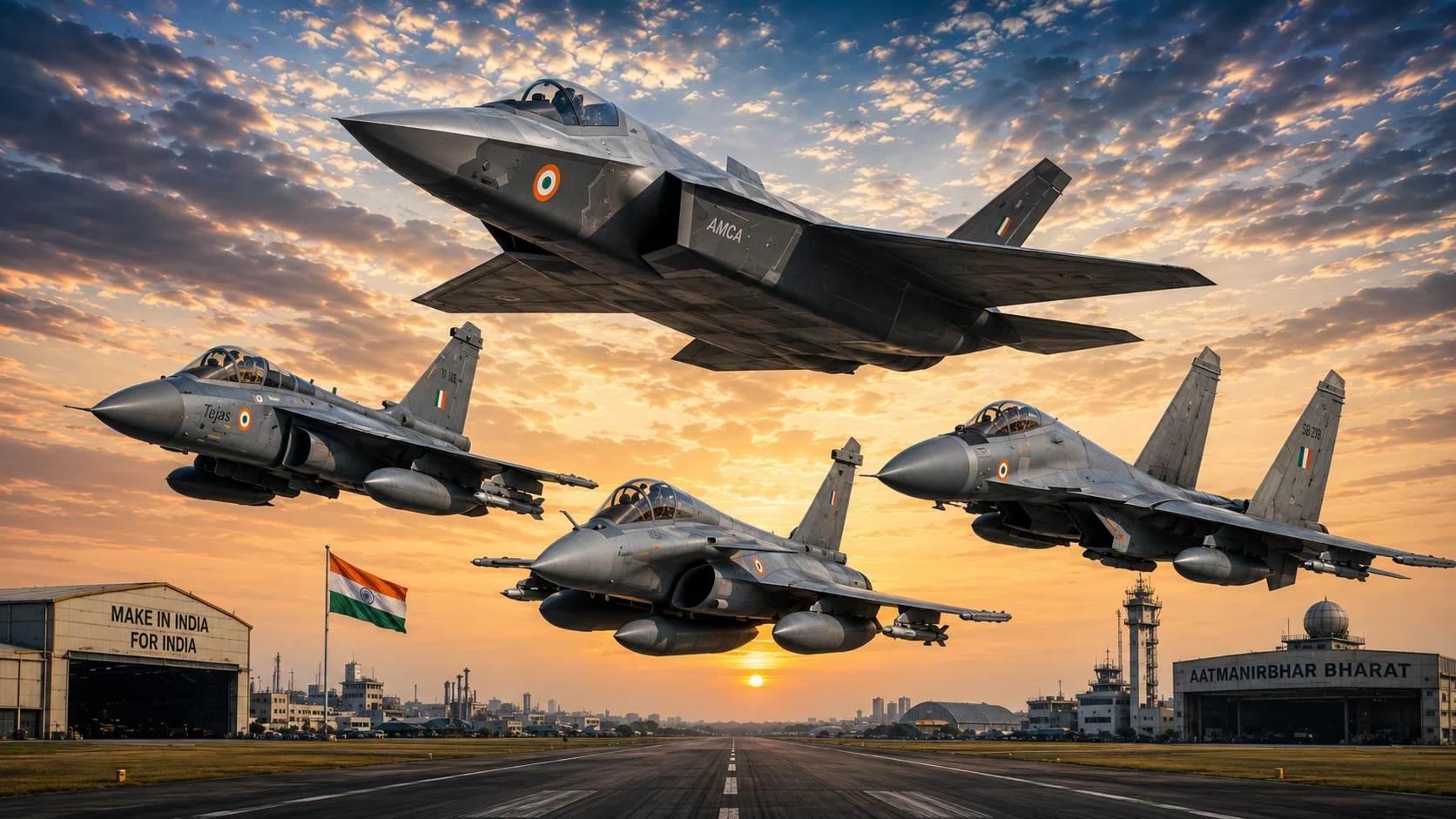
India Fighter Jet Programs and modernization effort spans indigenous development, foreign acquisitions, advanced propulsion technologies, and next-generation stealth programs that could shape the Indian Air Force through 2040.
India is attempting something few nations have achieved simultaneously. While many countries focus on either purchasing advanced fighters or developing indigenous aircraft, New Delhi is trying to do both.
The Indian Air Force is replacing aging fleets, modernizing existing aircraft, developing a fifth-generation stealth fighter, expanding domestic aerospace manufacturing, and pursuing advanced engine partnerships—all while managing one of the world’s most complex security environments.
The challenge extends far beyond acquiring new aircraft. It is about determining whether India can build a sustainable aerospace ecosystem capable of supporting national security requirements for decades to come.
The answer will shape not only the future of the Indian Air Force, but also India’s broader ambition to emerge as a leading aerospace and defence power.
Key Takeaways
- India is simultaneously pursuing Tejas, AMCA, Rafale, Super Sukhoi and advanced engine programs.
- The country seeks to balance immediate operational requirements with long-term technological self-reliance.
- AMCA is widely viewed as India’s most important future combat aviation project.
- Engine development remains one of the biggest challenges facing India’s aerospace ambitions.
- The ultimate test will be India’s ability to produce advanced aircraft at scale.
Strategic Snapshot
Core Question: Can India build a self-reliant fighter aircraft ecosystem before regional competitors widen the capability gap?
Key Programs: Tejas Mk1A, Tejas Mk2, AMCA, Rafale, Super Sukhoi, F414 Engine Program
Primary Challenge: Production scale, engine technology, and execution speed.
Time Horizon: 2025–2040
Contents
- Why India Needs New Fighter Aircraft
- Tejas: The Foundation of India’s Aerospace Ambition
- AMCA: India’s Most Important Defence Project?
- Rafale and the Search for Immediate Capability
- The Super Sukhoi Upgrade
- The Su-57 Debate
- The Engine Challenge
- Stealth and Counter-Stealth Competition
- India’s Fighter Fleet of 2040
- Timeline
- TES Intelligence Assessment
- Frequently Asked Questions
- TES Verdict
The Strategic Landscape of India Fighter Jet Programs
The debate surrounding India’s fighter aircraft programs is often framed around individual platforms—Tejas, Rafale, AMCA, or the Su-30MKI. Yet the real story is much larger. India’s fighter modernization effort is not simply about replacing aging aircraft. It is about maintaining military credibility in an increasingly contested strategic environment while simultaneously building the foundations of an indigenous aerospace ecosystem.
Few countries face the combination of challenges confronting New Delhi today. India must deter two nuclear-armed adversaries, protect a vast territorial expanse stretching from the Himalayas to the Indian Ocean, modernize legacy military systems, and reduce long-term dependence on foreign defence suppliers. The fighter aircraft decisions being made today will shape India’s security posture for decades.
The Squadron Crisis
For years, the Indian Air Force has warned about declining squadron strength. As older MiG-series aircraft approach retirement, the gap between desired and available combat squadrons has become a recurring concern within India’s defence establishment.
The issue is not simply numerical. Modern air warfare increasingly demands advanced sensors, network-centric operations, electronic warfare capabilities, and long-range precision weapons. Replacing retiring aircraft therefore requires more than maintaining squadron numbers—it requires ensuring that future fleets can operate effectively in highly contested environments.
This challenge explains why India is pursuing multiple aircraft programs simultaneously. Tejas Mk1A is intended to replace older platforms, Rafale provides advanced capability in the near term, while future programs such as Tejas Mk2 and AMCA are expected to strengthen long-term force structure.
The squadron issue has therefore become one of the primary drivers behind India’s fighter modernization roadmap.
The China Factor
Any discussion of Indian airpower inevitably leads to China.
Over the past two decades, China has invested heavily in military modernization, transforming the People’s Liberation Army Air Force into one of the world’s largest and most technologically sophisticated air forces. The induction of advanced fighters, growing aerospace manufacturing capacity, expanding surveillance networks, and investments in stealth technology have significantly altered the regional balance of power.
What makes China’s rise particularly significant is not merely technological progress but industrial scale. Chinese defence manufacturers possess the ability to design, produce, and field advanced military systems at a pace that few countries can match.
For India, this creates a strategic imperative. Maintaining credible deterrence requires not only acquiring capable aircraft but also building an industrial base capable of supporting future modernization efforts. This reality explains the increasing emphasis on indigenous programs such as Tejas and AMCA.
The challenge facing New Delhi is therefore not simply matching China’s current capabilities, but ensuring that India’s aerospace ecosystem remains competitive over the coming decades.
The Pakistan Factor
While China often dominates strategic discussions, Pakistan remains a central consideration in Indian military planning.
The history of military confrontation between the two countries ensures that airpower continues to play a critical role in deterrence and crisis management. Pakistan’s efforts to modernize its fighter fleet, strengthen missile capabilities, and deepen defence cooperation with external partners have reinforced the importance of maintaining a qualitative advantage.
For India, this means balancing long-term modernization against immediate operational requirements. Platforms such as Rafale provide near-term capability enhancements, while indigenous programs seek to ensure strategic flexibility in the future.
The challenge is not solely about maintaining superiority. It is about ensuring that India’s airpower remains credible across a wide spectrum of potential scenarios, from limited crises to prolonged competition.
The evolving military balance between India and Pakistan remains one of the most important factors influencing fighter aircraft procurement decisions.
Industrial Challenges Facing India Fighter Jet Programs
Perhaps the most important challenge facing India has little to do with aircraft specifications.
The real test is industrial capacity.
Modern fighter aircraft are among the most complex machines ever built. Their development requires advanced metallurgy, sophisticated electronics, precision manufacturing, software integration, propulsion technology, and highly specialized supply chains.
For decades, India relied heavily on foreign suppliers for critical technologies. While this approach helped address immediate operational requirements, it also exposed long-term vulnerabilities. Dependence on external partners can create procurement delays, technology restrictions, and supply-chain risks during periods of geopolitical tension.
Programs such as Tejas, AMCA, and the GE-HAL F414 partnership reflect a broader strategic objective: developing the industrial foundations necessary for aerospace self-reliance.
This is why India’s fighter aircraft story is ultimately about more than aircraft. It is about whether the country can build a sustainable ecosystem capable of designing, producing, upgrading, and supporting advanced combat platforms for decades to come.
The answer to that question will determine whether India emerges as a major aerospace power—or remains dependent on foreign technology for critical elements of national security.
Tejas: The Foundation of India’s Aerospace Ambition
Every aerospace power begins with a learning curve.
The United States had its early fighter programs. Europe built industrial capability through decades of collaboration and competition. China spent years absorbing foreign technology before developing increasingly sophisticated indigenous platforms.
For India, that foundation is Tejas.
The Light Combat Aircraft program represents far more than a single fighter aircraft. It is the culmination of decades of investment in aerospace engineering, flight testing, systems integration, materials science, and defence manufacturing. While critics often focus on delays or production challenges, the broader significance of Tejas lies in what it has enabled India to learn.
Without Tejas, there is no realistic pathway to AMCA. Without Tejas, India’s ambition to become a major aerospace power would remain largely theoretical.
More Than a Fighter Aircraft
The Tejas program was conceived during a period when India sought to reduce dependence on imported combat aircraft and develop a domestic aerospace ecosystem capable of supporting long-term national security requirements.
The challenge was enormous.
Building a modern fighter aircraft requires expertise across hundreds of disciplines—from aerodynamics and flight controls to radar integration, electronic warfare, advanced composites, and software engineering. Few countries have successfully mastered all of these capabilities.
Although progress was slower than many expected, the program ultimately produced something far more valuable than an aircraft alone: institutional knowledge.
Today, India possesses engineers, designers, test pilots, suppliers, and manufacturing infrastructure that simply did not exist when the project began.
That industrial experience is now feeding directly into future programs.
Tejas Mk1A: Addressing Immediate Requirements
The Tejas Mk1A represents the next phase in India’s indigenous fighter journey.
Designed as an improved version of the original aircraft, the platform incorporates upgrades intended to enhance operational effectiveness while supporting the Indian Air Force’s modernization goals.
The aircraft is expected to play a crucial role in replacing retiring legacy fighters and helping stabilize squadron strength over the coming years.
Just as importantly, large-scale production of the Tejas Mk1A serves as a test of India’s manufacturing ecosystem. Delivering aircraft consistently and at scale may prove as important as the aircraft’s technical specifications.
The success of Tejas Mk1A will therefore be measured not only by operational performance but also by production efficiency.
Tejas Mk2: Bridging the Gap
While Tejas Mk1A addresses immediate operational requirements, the proposed Tejas Mk2 is designed to occupy a different position within India’s future force structure.
Larger, more capable, and intended to carry a broader range of weapons and sensors, the aircraft is expected to bridge the gap between lightweight fighters and heavier multirole platforms.
In strategic terms, Tejas Mk2 represents a critical stepping stone.
The platform allows India to continue refining design and manufacturing capabilities before transitioning to even more ambitious projects such as the Advanced Medium Combat Aircraft.
Each generation of aircraft helps expand the technological and industrial base required for the next.
Viewed through this lens, Tejas Mk2 is not simply a fighter program—it is part of a larger aerospace development pathway.
HAL and the Manufacturing Question
No discussion of Tejas is complete without examining Hindustan Aeronautics Limited.
As India’s primary aerospace manufacturer, HAL sits at the center of the country’s fighter aircraft ecosystem. The company plays a key role in production, integration, maintenance, and future aerospace development efforts.
Yet the challenge facing HAL is not merely technological.
It is industrial.
Can India manufacture advanced combat aircraft rapidly enough to meet military requirements? Can production lines scale effectively? Can supply chains support sustained growth?
These questions are increasingly important as India seeks to accelerate modernization efforts across multiple programs simultaneously.
The future credibility of indigenous fighter development will depend as much on manufacturing performance as engineering achievement.
For a deeper look at the opportunities and challenges facing the company, readers can explore our analysis of HAL Stock Analysis: The Tejas Truth.
The Engine Problem
Even the most sophisticated aircraft remains dependent on one critical component: its engine.
For decades, propulsion technology has represented one of the most difficult barriers to aerospace self-reliance. While India has made substantial progress in aircraft design and systems integration, advanced engine development remains among the country’s most significant technological challenges.
This reality explains why discussions surrounding aerospace partnerships, technology transfer, and indigenous engine programs continue to receive so much attention.
The importance of propulsion technology extends far beyond Tejas itself. Future aircraft such as Tejas Mk2 and AMCA will depend heavily on India’s ability to secure reliable and advanced engine solutions.
As a result, the engine question remains central to India’s broader aerospace ambitions.
Readers interested in this issue can explore our detailed coverage of India’s Aero Engine Program and the GE-HAL F414 Engine Deal.
Why Tejas Matters Beyond the Air Force
The significance of Tejas extends beyond military capability.
The program represents an effort to build technological sovereignty in one of the world’s most demanding industries. Success would strengthen India’s manufacturing ecosystem, support high-skilled employment, expand domestic supply chains, and reduce long-term dependence on foreign suppliers.
In many ways, Tejas serves as a national industrial project as much as a military one.
This broader perspective helps explain why the aircraft occupies such an important place within India’s strategic planning.
The story of Tejas is ultimately not about replacing older fighters. It is about whether India can create the industrial foundation necessary to support future programs—including the most ambitious fighter project in the country’s history: the Advanced Medium Combat Aircraft.
AMCA: India’s Most Important Defence Project?
If Tejas represents India’s aerospace foundation, the Advanced Medium Combat Aircraft (AMCA) may determine whether the country can join the small group of nations capable of designing and producing fifth-generation combat aircraft.
Few defence projects carry greater strategic significance.
The aircraft is expected to incorporate stealth characteristics, internal weapons bays, advanced sensors, sensor fusion capabilities, artificial intelligence-assisted systems, and network-centric warfare architecture designed for future battlefields.
Yet AMCA is not merely another fighter aircraft program.
It is increasingly viewed as a national strategic project—one that could influence India’s defence industry, manufacturing ecosystem, technological sovereignty, and military posture for decades.
In many respects, AMCA is a test of whether India can transition from being a major importer of advanced military technology to becoming a producer of next-generation aerospace systems.
Why AMCA Matters
Modern air combat is evolving rapidly.
Stealth technology, sensor fusion, electronic warfare, artificial intelligence, and unmanned systems are transforming how air forces operate. Countries seeking long-term strategic relevance must adapt to these changes or risk falling behind.
For India, the challenge is particularly important.
China has already invested heavily in advanced aerospace capabilities and continues expanding production capacity. Meanwhile, several major powers are developing sixth-generation fighter concepts that may eventually redefine military aviation once again.
Against this backdrop, AMCA represents India’s attempt to secure a place within the next generation of aerospace powers.
The program is not simply about matching existing aircraft. It is about ensuring that India remains technologically relevant in future air combat environments.
Beyond Stealth
Public discussion often focuses on stealth features, but the significance of AMCA extends far beyond radar signatures.
Modern combat aircraft increasingly function as information platforms. Success in future conflicts will depend not only on speed or maneuverability but also on the ability to gather, process, share, and exploit information faster than opponents.
This is where sensor fusion, networking, electronic warfare, and advanced mission systems become critical.
The aircraft is expected to integrate these technologies into a single combat platform capable of operating within a highly connected battlespace.
In practical terms, AMCA is intended to become part of a broader ecosystem rather than function as a standalone fighter.
That shift reflects how air warfare is evolving globally.
A Test of India’s Industrial Ambition
The true importance of AMCA may not lie in the aircraft itself but in what it demands from India’s industrial ecosystem.
Developing a fifth-generation fighter requires expertise across multiple technological domains, including advanced materials, stealth engineering, avionics, propulsion systems, software integration, sensors, manufacturing processes, and systems testing.
Success therefore requires far more than a capable airframe.
It requires a mature aerospace ecosystem capable of supporting complex development programs over decades.
This is why AMCA has become a symbol of India’s broader industrial ambitions.
Every technological milestone achieved through the program has implications beyond military aviation. Advances in materials science, manufacturing techniques, software engineering, and systems integration can strengthen the wider defence-industrial base.
The Public Sector and Private Sector Question
One of the most significant debates surrounding AMCA involves industrial participation.
Historically, India’s defence sector relied heavily on public-sector organizations for major aerospace programs. However, growing recognition of the need for industrial scale, innovation, and manufacturing flexibility has encouraged greater discussion regarding private-sector participation.
Supporters argue that a broader industrial base could accelerate development timelines, strengthen supply chains, and increase production capacity.
Critics caution that managing a project of AMCA’s complexity will require careful coordination and strong institutional oversight.
Regardless of the final structure, the program is likely to shape how India approaches major defence manufacturing initiatives in the future.
Readers can explore this debate further in our analysis of AMCA Prototype: Private Sector vs HAL.
The Puttaparthi Aerospace Vision
AMCA is also connected to a larger vision for aerospace development.
As India seeks to expand manufacturing capacity and strengthen defence production capabilities, new industrial corridors and aerospace ecosystems are becoming increasingly important.
The proposed Puttaparthi Aerospace Corridor reflects this broader ambition.
Rather than viewing fighter aircraft production as an isolated activity, policymakers increasingly see aerospace manufacturing as part of a larger network involving suppliers, research institutions, technology firms, training centers, and advanced manufacturing facilities.
The long-term success of AMCA may depend as much on these supporting ecosystems as on the aircraft itself.
Our detailed examination of this vision can be found in AMCA Blueprint and the Puttaparthi Aerospace Corridor.
The Engine Challenge Returns
Every discussion about AMCA eventually leads back to propulsion.
While airframe design and stealth features often dominate headlines, advanced engines remain among the most difficult technologies to develop independently.
The aircraft’s long-term performance, range, payload capacity, and growth potential will depend heavily on propulsion solutions available to future variants.
This reality explains why engine partnerships, technology transfer arrangements, and indigenous development efforts continue to occupy such a central place in discussions surrounding India’s aerospace future.
For AMCA, propulsion technology is not a supporting issue—it is a strategic issue.
The Risks Facing the Program
Every ambitious defence project faces risks, and AMCA is no exception.
Development timelines, technological complexity, budget constraints, supply-chain challenges, and evolving military requirements all have the potential to influence the program’s trajectory.
The international aerospace industry offers numerous examples of advanced aircraft projects experiencing delays and cost increases due to the extraordinary complexity involved.
India’s challenge will be maintaining momentum while balancing ambition with realism.
The objective is not simply building an advanced aircraft. It is delivering a viable operational platform within a timeframe that remains strategically relevant.
Why AMCA Could Define India’s Aerospace Future
The significance of AMCA extends beyond military capability, industrial development, or technological achievement alone.
The program sits at the intersection of all three.
Success would demonstrate that India can design, develop, manufacture, and sustain one of the most complex military systems in the world. Failure would raise difficult questions about the country’s long-term aerospace ambitions.
This is why many analysts increasingly view AMCA as India’s most important defence project.
The aircraft is not merely intended to strengthen the Indian Air Force.
It is intended to strengthen the industrial, technological, and strategic foundations upon which future Indian airpower will depend.
And that may ultimately be its greatest significance.
Rafale, Super Sukhoi, Su-57 and the Future Airpower Balance
While Tejas and AMCA represent India’s long-term aerospace ambitions, national security cannot wait for future programs alone.
Air forces must prepare for current threats while simultaneously investing in future capabilities. This reality explains why India continues to modernize existing fleets, acquire advanced foreign platforms, and evaluate new partnerships even as indigenous programs move forward.
The challenge facing policymakers is balancing immediate operational requirements against long-term self-reliance.
Few countries have attempted both at the same time.
Rafale: Capability Today, Not Tomorrow
The Rafale acquisition marked one of the most significant upgrades to Indian airpower in recent decades.
At a time when squadron strength concerns were growing and regional competitors were modernizing rapidly, the aircraft provided immediate access to advanced sensors, electronic warfare systems, precision-strike capabilities, and modern air-to-air combat technology.
Unlike indigenous development programs, which often require years of testing and refinement, Rafale offered a near-term solution to pressing operational requirements.
This distinction is important.
The aircraft was never intended to replace India’s indigenous ambitions. Instead, it was designed to strengthen combat capability while domestic programs matured.
Viewed through this lens, Rafale represents a bridge between present requirements and future aspirations.
Its significance therefore extends beyond the aircraft itself. The platform demonstrates how India seeks to combine strategic autonomy with selective foreign partnerships when necessary.
Readers interested in the future of the Rafale program can explore our analysis of India’s 114 Rafale Deal: F4 and F5 Analysis and our coverage of Macron’s India Visit and Rafale Developments.
The MRFA Question
The Multi-Role Fighter Aircraft competition represents one of the most important procurement decisions facing India.
The outcome will influence force structure, industrial partnerships, technology transfer opportunities, and defence manufacturing priorities for decades.
Supporters argue that additional foreign acquisitions may be necessary to address squadron shortages and maintain operational readiness.
Others caution that excessive reliance on imports could undermine long-term efforts to strengthen domestic aerospace capabilities.
This debate reflects a recurring challenge within Indian defence planning.
How should the country balance immediate military requirements against the goal of achieving greater technological independence?
The answer remains one of the most important strategic questions confronting policymakers today.
Super Sukhoi: Maximizing Existing Strength
Not every modernization effort requires a new aircraft.
Sometimes the most effective solution involves improving existing platforms.
The Su-30MKI remains the backbone of Indian airpower and represents one of the largest fighter fleets in the country’s inventory. Replacing these aircraft would require enormous financial resources and many years of procurement.
The Super Sukhoi modernization program offers a different approach.
Rather than replacing the fleet, India plans to enhance it through upgraded radar systems, improved electronic warfare capabilities, advanced weapons integration, and modern avionics.
The objective is straightforward: extend operational relevance while maximizing value from an already substantial investment.
This strategy reflects an increasingly common trend in military aviation. Modernization programs often provide significant capability improvements without the cost and complexity associated with entirely new platforms.
For India, the Super Sukhoi initiative may prove particularly important because it strengthens existing combat power while Tejas Mk2 and AMCA continue development.
A detailed assessment can be found in our analysis of Why the Super Sukhoi Upgrade Could Be a Game Changer.
The Su-57 Debate
Few aircraft generate as much debate within India’s strategic community as Russia’s Su-57 Felon.
Supporters argue that the aircraft offers access to advanced technologies, operational experience with a fifth-generation platform, and opportunities for deeper defence cooperation.
Critics remain skeptical.
Questions regarding stealth performance, production scale, long-term support, and strategic compatibility continue to shape discussions surrounding the aircraft.
Yet the Su-57 debate is ultimately about more than a single fighter.
It reflects a broader question facing India.
Should the country prioritize rapid access to advanced foreign capabilities, or should resources be concentrated on indigenous programs such as AMCA even if progress takes longer?
This is not an easy choice.
One approach emphasizes immediate capability. The other emphasizes long-term sovereignty.
The reality is that policymakers must often balance both objectives simultaneously.
For a deeper examination of this debate, readers can explore our analysis of India and the Su-57 Felon as well as our review of Rostec’s Claims Regarding Su-57 Stealth Capabilities.
Stealth, Radar and the Next Airpower Competition
Future airpower competition will not be defined solely by fighter aircraft.
It will also be shaped by the technologies designed to detect, track, and counter them.
As stealth aircraft become more common, radar developers are investing heavily in counter-stealth capabilities. This dynamic is creating a technological competition that could influence military aviation for decades.
For India, the implications are significant.
Future platforms such as AMCA must operate in environments where adversaries increasingly possess sophisticated surveillance and tracking systems.
Success will therefore depend not only on stealth design but also on electronic warfare, sensor integration, networking, and information dominance.
Understanding this evolving competition is essential when evaluating the future relevance of modern fighter aircraft.
Readers can explore these issues further in our analysis of Can the YLC-8B Radar Detect Stealth Fighters?.
The Future Airpower Balance
India’s future fighter strategy is unlikely to revolve around a single aircraft.
Instead, the country appears to be pursuing a layered force structure.
Tejas will provide indigenous mass and manufacturing experience. Rafale delivers immediate high-end capability. Super Sukhoi extends the relevance of existing combat power. AMCA represents the future of stealth and technological sovereignty.
Each platform serves a different purpose.
Together, they form a broader modernization strategy designed to balance operational readiness, industrial development, and long-term strategic autonomy.
This approach may not be the fastest or simplest path, but it reflects the reality of India’s strategic environment.
The challenge is not choosing one aircraft over another.
The challenge is building an air force capable of meeting today’s threats while preparing for tomorrow’s battlefield.
Program Comparison: India’s Fighter Aircraft Roadmap
| Program | Status | Role | Strategic Importance |
|---|---|---|---|
| Tejas Mk1A | Production | Light Multirole Fighter | High |
| Tejas Mk2 | Development | Medium Fighter | Very High |
| Rafale | Operational | Advanced Multirole Fighter | High |
| Super Sukhoi | Upgrade Program | Air Dominance Platform | High |
| AMCA | Development | 5th Generation Fighter | Critical |
| F414 Engine Program | Technology Transfer | Propulsion Ecosystem | Critical |
Timeline: India’s Fighter Aircraft Roadmap
2025–2028: Tejas Mk1A production accelerates and squadron induction expands.
2028–2032: Tejas Mk2 enters advanced development and early operational integration.
2030–2035: Super Sukhoi modernization expands across the Su-30MKI fleet.
2032–2037: AMCA flight testing and limited induction phases begin.
2035–2040: India transitions toward a Tejas-Rafale-AMCA force structure.
What Could India’s Fighter Fleet Look Like by 2040?
If current modernization plans remain on track, the Indian Air Force of 2040 may be built around a layered force structure designed to balance affordability, capability, survivability, and industrial self-reliance.
| Aircraft | Role |
|---|---|
| Tejas Mk1A | Light Multirole Fighter |
| Tejas Mk2 | Medium Fighter |
| Rafale | Advanced Multirole Platform |
| Super Sukhoi | Air Dominance Platform |
| AMCA | Fifth-Generation Stealth Fighter |
TES Intelligence Assessment
The biggest misconception about India’s fighter aircraft modernization effort is that it revolves around individual aircraft.
In reality, the decisive factor is industrial capacity.
China’s primary advantage today is not merely technology but the ability to manufacture advanced military systems at scale. India faces a different challenge: transforming promising aerospace programs into a sustainable production ecosystem capable of delivering combat power consistently over time.
Viewed through this lens, Tejas, AMCA, the F414 engine partnership, and the Super Sukhoi modernization program are not isolated initiatives. They are interconnected components of a broader effort to build an aerospace-industrial foundation.
The future balance of airpower in Asia may therefore depend as much on factories, supply chains, engineering talent, and production capacity as on the fighter aircraft themselves.
Bottom Line: India’s long-term success will be determined not by prototypes unveiled, but by aircraft delivered to operational squadrons.
Frequently Asked Questions
What is India’s most important future fighter aircraft program?
Many analysts consider AMCA to be India’s most important future fighter program because it combines stealth technology, advanced sensors, indigenous development, and long-term aerospace self-reliance objectives.
Why does India need new fighter aircraft?
The Indian Air Force faces squadron shortages, aging aircraft retirements, and an increasingly competitive regional security environment. New fighter programs are intended to address both operational and industrial challenges.
What is the role of Tejas in India’s fighter strategy?
Tejas serves as the foundation of India’s indigenous aerospace ecosystem while helping replace older combat aircraft and strengthen domestic manufacturing capabilities.
Why is the F414 engine deal important?
The partnership is significant because propulsion technology remains one of the most difficult barriers to aerospace self-reliance and future fighter development.
Will AMCA replace Rafale or Su-30MKI?
Not directly. India’s future force structure is expected to include multiple aircraft types operating together, with AMCA serving as a fifth-generation stealth platform alongside upgraded and existing fleets.
TES Verdict
India’s fighter aircraft strategy is no longer centered on a single platform.
Instead, New Delhi is pursuing a layered force structure that combines indigenous innovation, foreign technology partnerships, advanced manufacturing, and long-term strategic planning.
Tejas is laying the industrial foundation. Rafale provides immediate capability. Super Sukhoi strengthens existing combat power. AMCA represents the future of technological sovereignty.
The defining challenge is no longer whether India can design sophisticated fighter aircraft.
The real challenge is whether India can build them at the scale and speed demanded by an increasingly competitive strategic environment.
That question—not any individual aircraft program—will determine the future of Indian air power.
Sources & Further Reading
- AMCA Blueprint and the Puttaparthi Aerospace Corridor
- AMCA Prototype: Private Sector vs HAL
- India’s 114 Rafale Deal: F4 and F5 Analysis
- Why the Super Sukhoi Upgrade Could Be a Game Changer
- India and the Su-57 Debate
- Rostec’s Claims About Su-57 Stealth Capabilities
- The GE-HAL F414 Engine Deal Explained
- India’s Aero Engine Program
- Can the YLC-8B Radar Detect Stealth Fighters?
- India-Pakistan Military Competition