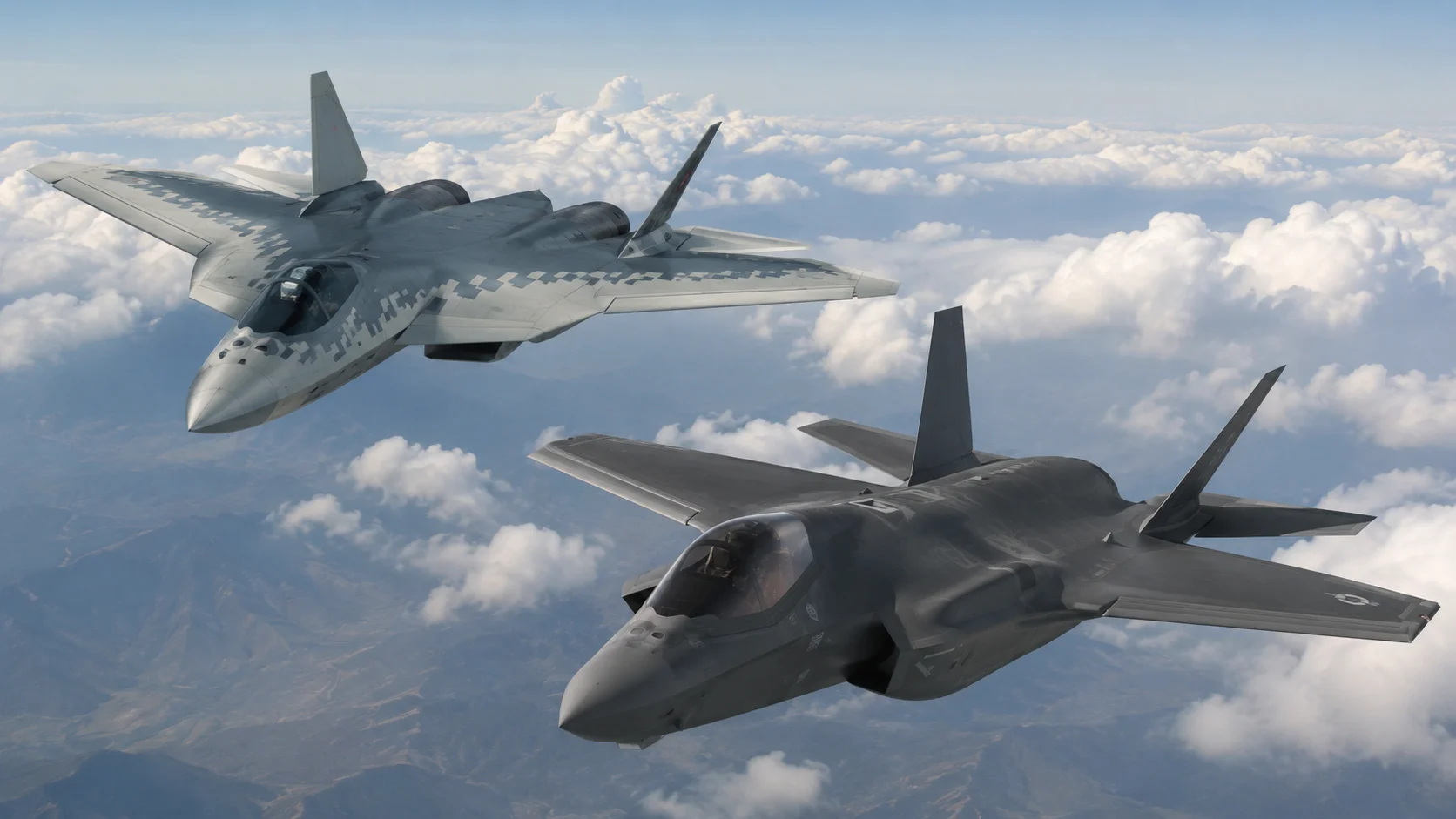
Rostec Su-57 Stealth Capabilities have become one of the most debated topics in modern military aviation. While Russia’s state defense conglomerate presents the Su-57 as a highly advanced fifth-generation fighter, analysts continue to question whether its low-observable characteristics can rival Western platforms such as the F-35. The answer lies not in marketing claims or geopolitical narratives, but in the aircraft’s engineering, radar signature reduction measures, sensors, and operational doctrine.
The debate surrounding Rostec Su-57 Stealth Capabilities ultimately centers on whether Russia’s fighter prioritizes stealth to the same degree as Western fifth-generation aircraft.
Why Rostec Su-57 Stealth Capabilities Matter for Modern Air Power
The Su-57 occupies a unique position in the global fighter landscape.
For more than a decade, discussions surrounding the aircraft have largely revolved around a single question: is it truly a stealth fighter? Yet that debate often overlooks a more important reality. Russia never designed the Su-57 to be a direct copy of the F-22 or F-35.
Instead, the aircraft reflects a distinctly Russian approach to air combat—one that balances stealth, maneuverability, speed, range, sensor performance, and weapons payload rather than maximizing a single characteristic.
As military powers across Asia accelerate fighter modernization programs, understanding the Su-57’s actual capabilities has become increasingly important for defense planners and policymakers alike.
Rostec’s Stealth Narrative vs Engineering Reality
Rostec frequently highlights the Su-57’s stealth features, including radar-absorbent materials, internal weapons bays, electronic warfare systems, and advanced airframe shaping.
Those claims are not without merit.
Compared with earlier Flanker-family aircraft, the Su-57 represents a substantial reduction in radar visibility. However, a close examination of the aircraft reveals several design choices that differ from the all-aspect stealth philosophy employed by American fifth-generation fighters.
The result is an aircraft optimized for reduced observability rather than extreme radar invisibility.
The Engine Intake Compromise
One of the most frequently discussed aspects of the Su-57 involves its air intake design.
Aircraft such as the F-22 utilize deeply curved serpentine ducts that completely conceal engine compressor blades from incoming radar waves. The compressor face is among the strongest radar reflectors on any fighter aircraft, making concealment a critical component of stealth design.
The Su-57 adopts a more direct intake configuration that prioritizes airflow efficiency and high-speed performance.
Russian engineers mitigated the resulting radar vulnerability through the use of radar-blocking structures within the intake system. While effective to a degree, this solution is generally considered less comprehensive than the approach used by Western stealth aircraft.
The design illustrates a recurring theme throughout the Su-57 program: stealth improvements balanced against aerodynamic performance.
The IRST Trade-Off
Another notable feature is the aircraft’s prominent 101KS-V Infrared Search and Track sensor mounted ahead of the cockpit.
The system allows pilots to detect targets passively without emitting radar signals, providing an important tactical advantage in contested environments.
Yet the sensor housing itself creates additional radar reflections.
For Russian designers, the operational value of passive detection appears to have outweighed the stealth penalty, highlighting a broader emphasis on sensor capability rather than pure signature reduction.
What Sukhoi’s Patent Data Reveals
One of the most objective sources of information regarding the aircraft’s signature reduction efforts comes from patent documentation associated with the Su-57 program.
The filings suggest efforts to reduce the aircraft’s frontal radar cross-section into a range of approximately 0.1 to 1.0 square meter.
Radar cross-section figures should always be treated cautiously, as signatures vary depending on angle, frequency, weather conditions, and aircraft configuration. Nevertheless, the available data indicates that the Su-57 is significantly stealthier than earlier Russian fighters while remaining more detectable than aircraft specifically designed around ultra-low observability.
Publicly available evidence regarding Rostec Su-57 Stealth Capabilities suggests the aircraft occupies a middle ground between conventional fighters and ultra-low-observable platforms.
Why It Matters
| Aircraft Platform | Estimated Frontal Radar Cross-Section |
|---|---|
| Su-27 Flanker | 10–15 m² |
| Su-57 Felon | 0.1–1.0 m² |
| F/A-18E/F Super Hornet | 0.1–0.5 m² |
| Rafale | 0.05–0.1 m² |
| F-35 Lightning II | 0.001–0.005 m² |
The comparison highlights the strategic reality behind the stealth debate.
The Su-57 represents a dramatic reduction in radar visibility compared with previous generations of Russian combat aircraft. However, publicly available evidence suggests it occupies a different category from the F-35, whose design was built around achieving the lowest possible radar signature.
For military planners, even modest reductions in radar cross-section can significantly complicate enemy targeting and engagement timelines. The question is therefore not whether the Su-57 is stealthy, but how much stealth is necessary within Russia’s broader operational doctrine.
Beyond Stealth: The Aircraft’s Real Strength
Focusing exclusively on radar signature risks overlooking what may be the aircraft’s most important advantage.
The Su-57 combines the N036 Byelka AESA radar with unique L-band radar arrays embedded in its wing leading edges. This creates a layered sensor architecture capable of tracking multiple targets across different frequencies.
The aircraft also carries long-range precision weapons internally, including the Kh-69 cruise missile, enabling engagements from outside heavily defended airspace.
Rather than relying solely on stealth penetration, the Su-57 appears designed to detect threats, launch standoff weapons, and operate as part of a broader networked battlespace.
In practical terms, survivability comes not only from avoiding detection but also from seeing and striking first.
The AL-51F1 Engine Could Reshape the Program
The future evolution of the Su-57 may depend heavily on the introduction of the AL-51F1 engine, previously known as Izdeliye 30.
For years, production aircraft relied on the AL-41F1, an upgraded derivative of engines already powering the Su-35.
The newer powerplant promises increased thrust, improved fuel efficiency, enhanced supercruise performance, and lower radar and infrared signatures.
If integrated across the fleet, the engine could significantly strengthen the aircraft’s overall combat effectiveness and address several limitations associated with earlier production models.
Strategic Implications for India and the Indo-Pacific
The significance of the Su-57 extends well beyond Russia.
Across Asia, air forces are investing heavily in next-generation combat aircraft. China continues expanding production of the J-20, while India advances its Advanced Medium Combat Aircraft (AMCA) program and modernizes existing fighter fleets.
The Su-57 demonstrates that fifth-generation air combat is no longer defined solely by stealth.
Future effectiveness will increasingly depend on how successfully countries integrate sensors, electronic warfare systems, networking, artificial intelligence, precision weapons, and low-observable technologies into a single operational framework.
For Indo-Pacific planners, the aircraft serves as an important reminder that survivability is becoming a system-wide characteristic rather than a single technological attribute.
For Asian defense planners, understanding Rostec Su-57 Stealth Capabilities is increasingly important as fifth-generation fighter programs expand across the Indo-Pacific.
Strategic Outlook
Assessing Rostec Su-57 Stealth Capabilities requires separating measurable engineering characteristics from political messaging and marketing narratives.
The available evidence suggests the aircraft is neither an invisible radar ghost nor an overhyped failure. Instead, it represents a uniquely Russian interpretation of fifth-generation fighter design—one that treats stealth as an important component of survivability rather than its defining feature.
Whether that philosophy ultimately proves successful will depend less on radar cross-section figures and more on how effectively the Su-57 integrates into Russia’s broader ecosystem of sensors, missiles, electronic warfare systems, and air-defense networks.
In an era increasingly defined by information dominance, the aircraft that survives may not be the one that is hardest to detect—but the one that can detect, decide, and strike first.
Ultimately, Rostec Su-57 Stealth Capabilities should be viewed within the broader context of Russia’s air combat doctrine, where sensors, weapons, and networking are considered as important as stealth itself.