
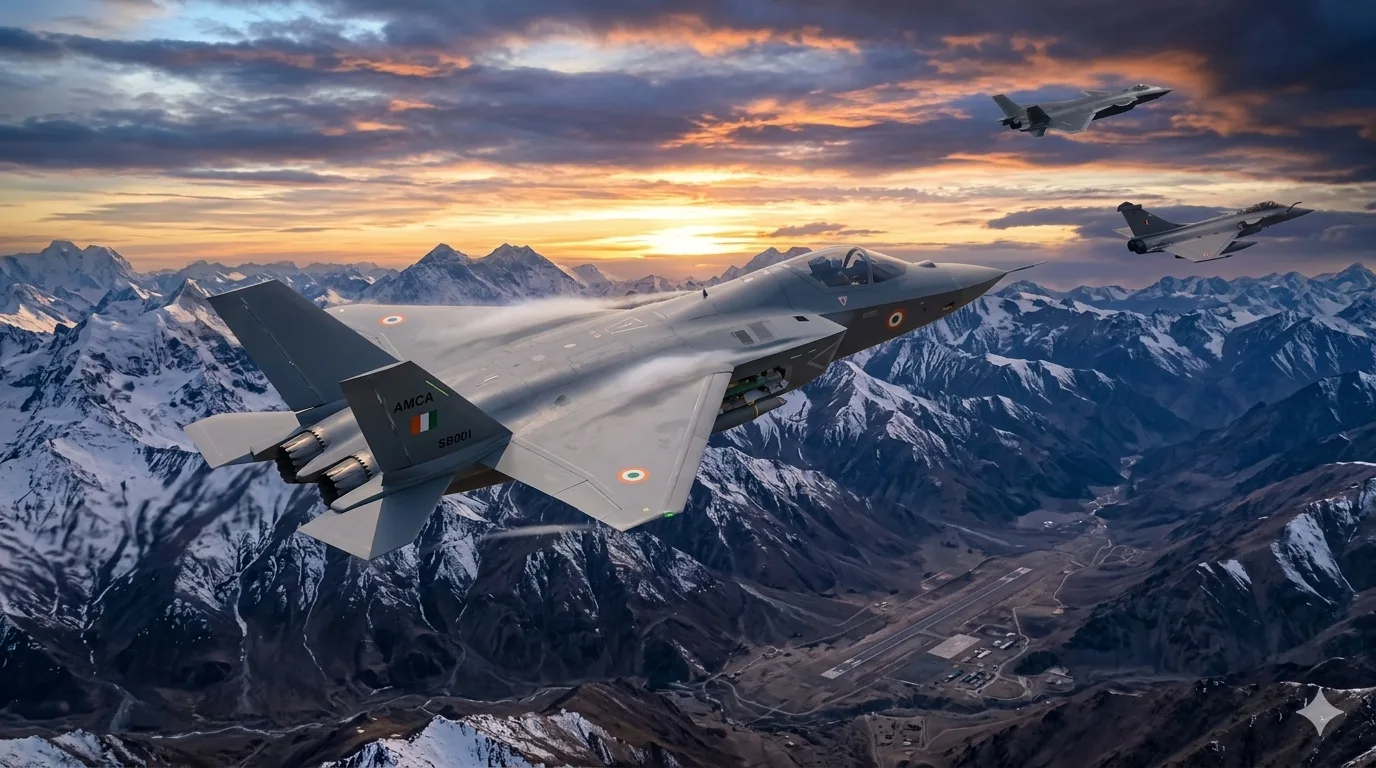
The Indian aerospace sector is currently undergoing its most severe structural overhaul since independence. For decades, the public sector unit Hindustan Aeronautics Limited (HAL) functioned as the default integrator for military aviation. However, following the Cabinet Committee on Security’s approval of ₹15,000 crore for the AMCA’s Full-Scale Engineering Development (FSED) in early 2024, the Ministry of Defence fundamentally altered its procurement architecture.
Defense planners concluded that HAL’s existing order book—currently standing at roughly eight times its annual revenue due to Tejas Mk1A, Tejas Mk2, and various helicopter commitments—rendered it incapable of absorbing a fifth-generation stealth program without inducing severe developmental delays. To prevent the AMCA from becoming an unviable industrial bottleneck, the government disqualified HAL at the primary screening stage for the final integration role, citing strict financial eligibility and production bandwidth criteria. This maneuver forced a pivot toward private conglomerates, turning the AMCA into the primary engine for India’s domestic industrial growth.
The Private Consortia: A Competitive Blueprint
The Ministry of Defence has shortlisted three distinct private-sector consortia to build the initial five flying prototypes, each bringing unique industrial advantages to the table. Tata Advanced Systems, operating as a standalone integrator, leverages its extensive experience in manufacturing airframes for global giants like Boeing and Lockheed Martin. Their facility in Hyderabad already produces fuselages for the AH-64 Apache, providing a proven template for high-precision robotic assembly required for stealth aircraft.
The second consortium, led by Larsen & Toubro (L&T) in partnership with Bharat Electronics Limited (BEL) and Dynamatic Technologies, focuses on the structural and electronic convergence of the platform. L&T’s expertise in specialized aerospace alloys and BEL’s dominance in radar and electronic warfare systems provide a vertically integrated solution. The third group, led by Bharat Forge alongside BEML and Data Patterns, targets the heavy engineering and high-speed data processing requirements of the AMCA. This competitive landscape mimics the US defense model, ensuring that the final integration of the AMCA is handled by entities incentivized by delivery timelines and cost-efficiency rather than bureaucratic continuity.
The Puttaparthi Aerospace Corridor
The physical manifestation of this industrial pivot is the relocation of the manufacturing base. Historically, Bengaluru served as the center of Indian aviation. However, congested civilian airspace and a lack of dedicated testing infrastructure forced the Defence Research and Development Organisation (DRDO) and the Aeronautical Development Agency (ADA) to look elsewhere for a production facility capable of handling a projected fleet of 250 stealth fighters.
The Andhra Pradesh state cabinet has approved the allotment of 600 acres to the DRDO in Puttaparthi, Sri Sathya Sai district. This site will serve as the primary production hub, with an additional 400 acres earmarked for future expansion. The location was selected due to its proximity to the ADA headquarters (approximately 50 kilometers from the Karnataka border) combined with streamlined airspace coordination that allows for aggressive flight testing schedules. Central government officials estimate that the broader aerospace corridor surrounding the Puttaparthi facility will eventually draw ₹1 lakh crore ($12 billion) in ancillary investments, effectively creating a secondary defense node in southern India to handle the projected rollout of 140 AMCA units from this specific facility alone.
The Multi-Layered Fleet Architecture: A Unique Global Model
The AMCA program does not exist in an operational vacuum; it is the final node in a multi-layered fleet architecture that has no direct equivalent globally. While the United States relies on a homogenous, domestically produced force structure and China leans heavily on domestic production pipelines, the Indian Air Force (IAF) operates a highly diverse inventory spanning multiple design philosophies. This “High-Medium-Low” mix creates a complex but lethal operational environment.
Once inducted, the AMCA will serve as the apex tier, integrating downward with indigenous light combat platforms like the Tejas Mk1A and Tejas Mk2. These will be supported by heavy Russian air superiority fighters (Su-30MKI), precision French multirole jets (Rafale and Mirage 2000), and external platform evaluations like the Su-57 Felon. Managing the avionics, datalinks, and maintenance supply chains for this multi-origin fleet requires unprecedented logistical coordination. However, this diversity also presents a distinct tactical variance. Adversarial planners cannot prepare for a single, uniform air combat doctrine; they must account for the synchronized deployment of French electronic warfare suites, Russian heavy payloads, and indigenous stealth and sensor networks operating simultaneously in the same theater. The AMCA’s role is to act as the “quarterback,” using its stealth to penetrate deep into enemy territory while directing the fire of these legacy assets.
The Geopolitical Imperative: Racing China and the Global Benchmark
The urgency driving the AMCA’s accelerated timeline is dictated by power dynamics along the Line of Actual Control (LAC). However, the technological mandate extends far beyond regional deterrence. India is engineering the AMCA not merely to match the expanding fleet of Chinese stealth platforms, but to field an airframe capable of challenging the global kinematic and low-observability benchmarks established by the American F-22 Raptor.
While the F-22 represents the pinnacle of dedicated air superiority, the AMCA is designed to integrate that level of radar evasion with deep-penetration multirole capabilities. Regional intelligence estimates indicate the People’s Liberation Army Air Force (PLAAF) has operationalized over 250 J-20 stealth fighters. To counter this, the IAF is pushing for a platform that surpasses current fifth-generation standards. By aiming for the metrics of the F-22 while directly targeting the vulnerabilities of the J-20 and the upcoming J-35, New Delhi is positioning the AMCA as an apex platform in the Indo-Pacific. In operational doctrine, the AMCA is tasked primarily with Suppression and Destruction of Enemy Air Defenses (SEAD/DEAD). The IAF intends to use the stealth platform to neutralize advanced surface-to-air missile networks like the Chinese HQ-9, creating sanitized corridors for munitions like the NASM-SR and Astra Mk3.
Defeating the Propulsion Bottleneck: The Safran Agreement
A stealth airframe is only as effective as the engine that powers it. Decades of reliance on imported propulsion systems exposed deep vulnerabilities in India’s strategic supply chain. The defense ministry has codified a phased rollout strategy to advance toward total sovereign propulsion. The first batch of approximately 40 aircraft, designated as AMCA Mark-1, will utilize the imported General Electric F414-INS6 engine. While reliable, this 98 kN engine cannot support supercruise.
The strategic core of the program is the AMCA Mark-2. To achieve true fifth-generation kinematics, New Delhi finalized a €6.7 billion agreement with France’s Safran Group to co-develop a 110 to 120 kN class engine. The decisive factor in selecting Safran was the French authorization of a 100 percent transfer of technology, including the highly guarded metallurgical know-how required for the engine’s “hot section.” By securing full intellectual property rights, India ensures that future upgrades and exports will not be subject to foreign legislative vetoes. Five prototype engines are scheduled for delivery by 2027 to align with the airframe’s testing phase.
Engineering Low Observability and the IFCC
True stealth requires uncompromising geometric precision. ADA researchers recently validated a new S-duct intake configuration. In conventional aircraft, engine compressor blades are highly reflective to enemy radar. The AMCA utilizes curved S-ducts to physically hide these blades. The ADA’s new configuration achieved a 98 percent pressure recovery rate at transonic speeds, ensuring the fighter maintains optimal thrust alongside a low radar cross-section.
Internally, the aircraft operates as a node within a Software-Defined Battlefield. The Integrated Flight Control Computer (IFCC) handles massive data loads from internal sensors, fusing them with telemetry from external assets like the OptoSAR satellite network. This allows the pilot to process targeting data for autonomous drone swarms (Manned-Unmanned Teaming or MUM-T) operating in contested airspace. This AI-driven architecture ensures that the AMCA remains relevant even as electronic warfare and cyber-kinetic threats evolve.
The Calendar is the Ultimate Judge
The schedule constructed by the Ministry of Defence leaves zero room for developmental drift. Following the shortlisting of the private consortia, the first AMCA prototype is expected to roll out by late 2027. The maiden flight is targeted for 2028 or 2029, with formal squadron induction by 2034.
The AMCA represents a terminal test for India’s military-industrial complex. By handing the integration program to private industry and securing full engine IP from France, New Delhi has cleared its own bureaucratic blockages. However, if the 2028 flight schedule slips, the technological and operational gap with Beijing may become permanent. The private sector now carries the responsibility of ensuring that India’s stealth ambitions materialize on the tarmac, rather than remaining trapped in the design phase.