
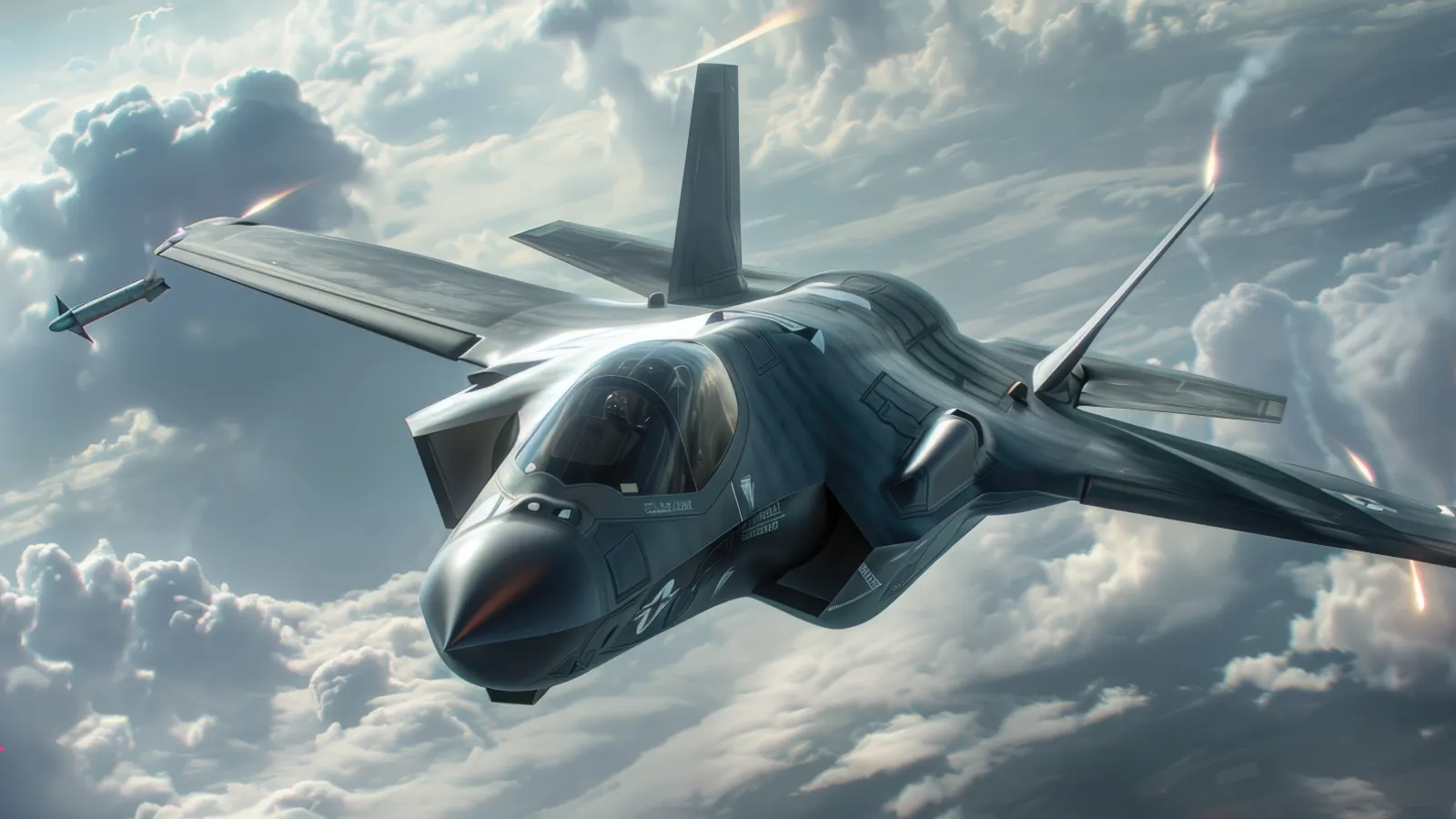
The opening weeks of the 2026 Middle East conflict exposed a fundamental vulnerability in modern aerial operations. On March 19, a U.S. F-35 Lightning II reportedly took shrapnel damage over Iran before executing an emergency landing at a regional airbase. While the aircraft survived and the pilot walked away, the strategic fallout surrounding this YLC-8B radar F-35 stealth encounter is still rippling through defense circles. The debate isn’t about the loss of an airframe; it is about how rapidly anti-access systems are adapting to defeat fifth-generation fighters.
The March 19 Incident: A Layered Defense
Regional intelligence and open-source tracking suggest Iranian air defense batteries did not act alone. They likely relied on a networked detection grid layering low-frequency surveillance radars, infrared trackers, and distributed targeting nodes.
Defense analysts heavily suspect the involvement of Chinese-origin anti-stealth platforms, specifically the YLC-8B UHF radar, in providing sector-level tracking. Even without official Pentagon confirmation on the exact radar model, the tactical reality is clear: stealth fighters are becoming highly visible inside networked battlespaces.
This does not render stealth obsolete. The F-35 remains incredibly survivable. However, the era of a single radar trying to lock onto a single jet is over. Today, nations are building sensor webs designed to track anomalies across multiple spectrums simultaneously.
The YLC-8B Radar F-35 Stealth Dynamic: X-Band vs. UHF
The core of the YLC-8B radar F-35 stealth issue lies in radar wavelengths. Most stealth platforms, including the Lightning II and the F-22, are built to defeat high-frequency X-band radars. These are the systems typically mounted on enemy fighter jets and surface-to-air missile (SAM) batteries for precision targeting. Against short X-band wavelengths, sharp geometric angles and radar-absorbent coatings act as a near-perfect shield.
Low-frequency systems operate on an entirely different physical principle. Radars in the UHF and VHF spectrum emit much longer waves. Instead of bouncing off the jet’s angles, these waves resonate with the physical size of the aircraft itself—like the wingspan or tail section.
While a UHF radar lacks the precision to guide a missile to a direct hit, it can easily detect a stealth fighter’s presence at long range. In short: a low-frequency radar won’t tell a missile exactly where to strike, but it tells the entire air defense network exactly where to look. Once cued, shorter-range targeting radars and infrared sensors can narrow the kill box.
China’s Battlespace Awareness Strategy
This networked approach has been the backbone of Chinese military doctrine for years. Beijing has aggressively funded anti-stealth radar development to enforce its anti-access/area-denial (A2/AD) zones across the Taiwan Strait and the South China Sea.
The People’s Liberation Army (PLA) knows Washington relies on stealth for deep-strike missions. Rather than trying to make American jets completely visible, China’s strategy focuses on stripping away their element of surprise. By extending detection windows, they give their own SAM operators and interceptors the critical seconds needed to react.
The fact that these advanced radar profiles are now appearing in Iran is a massive red flag. Iran lacks the fully integrated, multi-domain defense grid that China wields in East Asia. If a fractured, partially connected Iranian network can coordinate enough data to damage an F-35, a future conflict involving a fully integrated PLA sensor web will be exponentially more lethal.
The AMCA Imperative: Moving Beyond Pure Stealth
For the United States, this simply changes the baseline requirements for air superiority. For India, currently finalizing the design of the Advanced Medium Combat Aircraft (AMCA), the F-35 incident offers a brutal, free lesson in modern combat.
The AMCA will form the backbone of India’s future airpower. By the time it enters service, anti-stealth networks will be vastly more sophisticated than the ones operating today. Consequently, relying solely on radar cross-section reduction is a guaranteed path to obsolescence.
- Cognitive Electronic Warfare: EW must be treated with the same priority as stealth shaping. The AMCA will require AI-driven jamming suites capable of blinding low-frequency surveillance networks before targeting data can be transmitted.
- Infrared Signature Reduction: Since low-frequency radars increasingly cue infrared search-and-track (IRST) systems, minimizing the AMCA’s heat signature and engine exhaust is non-negotiable for its survival.
- Manned-Unmanned Teaming (MUM-T): The era of the lone fighter is dead. India’s air combat strategy must aggressively integrate “loyal wingman” drones. These unmanned systems will need to fly miles ahead of the crewed AMCA to jam radar nodes, deploy decoys, absorb surface fire, or hunt down early-warning systems before the manned jet even enters contested airspace.
The Bottom Line
Stealth remains a critical advantage, but the concept of the totally invisible fighter is history. The future belongs to platforms that can survive inside a digital battlespace where detection is always imminent. For India’s AMCA program, that single reality must dictate every engineering decision made from today onward.
ow did the YLC-8B radar F-35 stealth encounter happen?
The YLC-8B radar F-35 stealth encounter occurred because the Chinese-developed YLC-8B is a UHF-band surveillance radar. It uses longer wavelengths that resonate with the physical size of an aircraft, allowing it to detect fifth-generation fighters at long ranges and cue other air defense systems to their location.
Was a US F-35 damaged in Iran?
es. On March 19, 2026, a US F-35 Lightning II sustained shrapnel damage from ground fire over Iran. The aircraft survived and landed safely, but the incident highlighted the growing effectiveness of networked anti-stealth air defenses.
Can stealth aircraft be detected by radar?
Yes. While stealth fighters easily evade high-frequency targeting radars (X-band), they are vulnerable to detection by low-frequency early warning systems (UHF/VHF bands), which can track their general location and guide other weapons to the target.
How will this affect India’s AMCA fighter?
The vulnerability of pure stealth means India’s 5th-generation AMCA must focus heavily on electronic warfare (EW) jamming, thermal signature reduction, and Manned-Unmanned Teaming (MUM-T) with loyal wingman drones to survive modern air defense networks.