
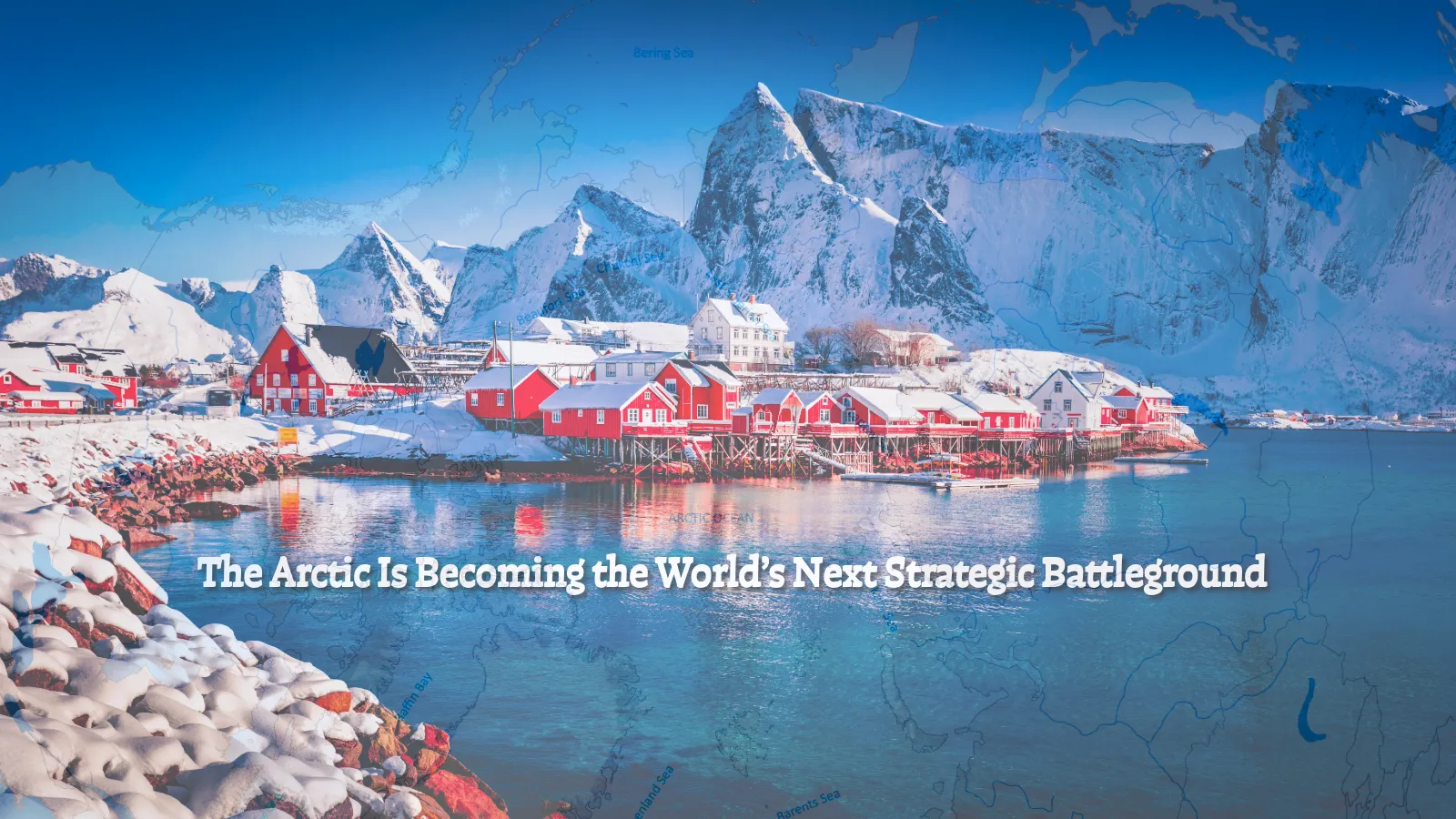
The High North is being reshaped by melting ice, Arctic trade routes, military expansion and the growing AI mineral race.
For years, Greenland sat at the edge of global politics — geographically vast, strategically quiet, and mostly associated with glaciers, fishing communities and climate research.
That perception is beginning to change.
Washington’s growing focus on the Arctic island is being driven by several developments unfolding at once: shrinking sea ice, new shipping routes, rising military competition in the Arctic and a widening scramble for the minerals needed to support advanced technologies and artificial intelligence systems.
In strategic circles, Greenland is no longer viewed as a remote territory. It is increasingly being treated as infrastructure.
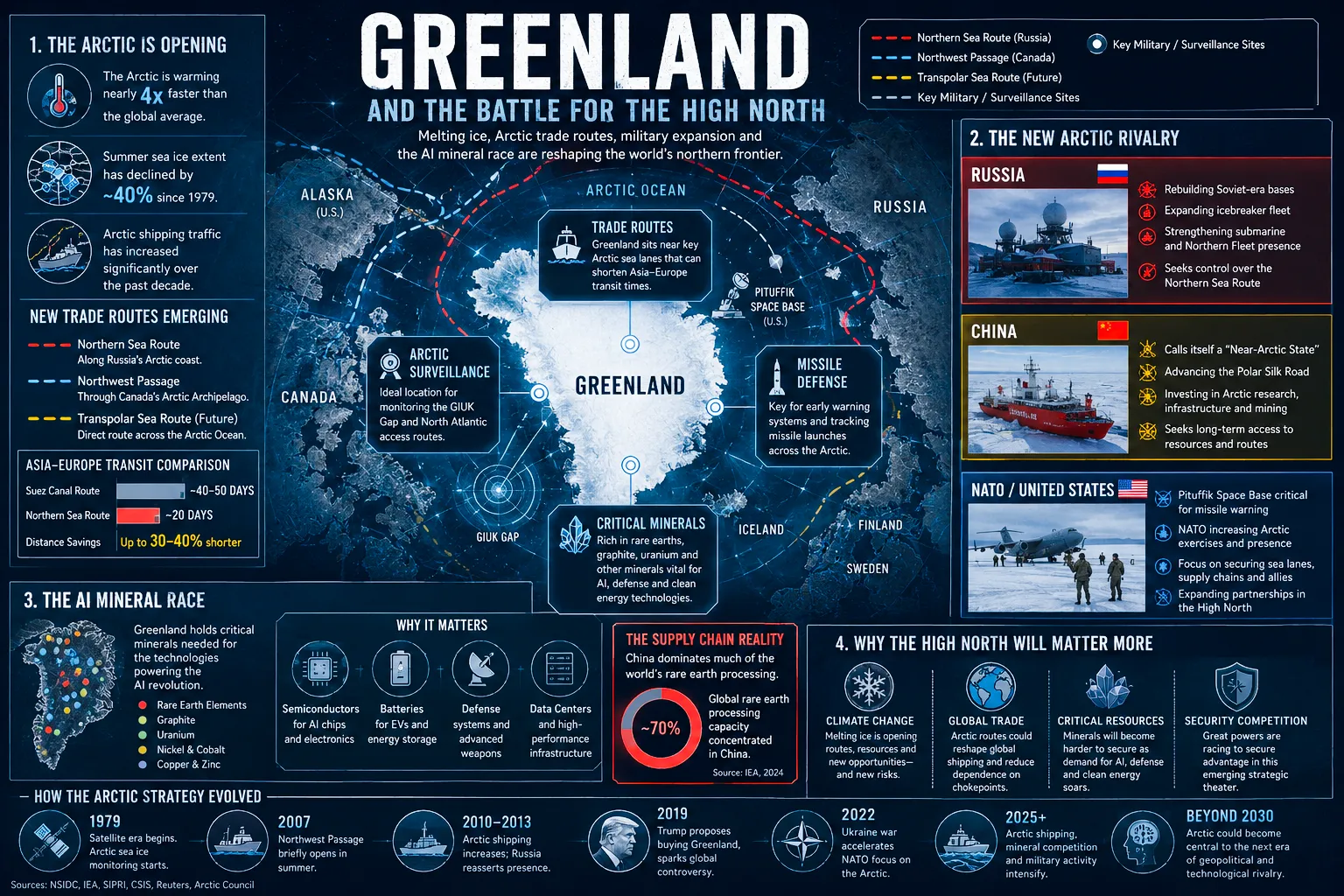
The Arctic is warming faster than most other regions in the world. As ice coverage declines, waterways that were once inaccessible for large parts of the year are gradually opening.
That shift is beginning to alter global shipping calculations.
Routes along Russia’s northern coastline and through parts of the Canadian Arctic can significantly reduce transit times between Europe and Asia compared to traditional routes through the Suez Canal. Traffic remains seasonal and limited, but governments, shipping companies and military planners are increasingly treating the trend as long term rather than temporary.
Greenland sits close to several of these emerging maritime corridors.
For the United States and its NATO allies, the implications go beyond trade.
A more accessible High North also means a more contested Arctic.
Russia has spent years rebuilding military infrastructure across its northern territories, reopening Cold War-era facilities and expanding its Arctic capabilities. China, despite not being an Arctic state, has steadily increased its regional presence through research projects, shipping ambitions and investments linked to what Beijing calls the “Polar Silk Road”.
American officials increasingly view the region through the lens of strategic competition.
The Arctic Is Becoming a Military Theater Again
Greenland’s military importance is not new.
During the Cold War, the United States operated major installations on the island as part of its early warning and missile tracking network. Pituffik Space Base — formerly Thule Air Base — still plays a central role in missile warning and space surveillance systems.
Its location matters.
The Arctic remains one of the shortest paths for missiles traveling between North America and Eurasia. As hypersonic weapons and long-range missile systems evolve, Arctic positioning is becoming more important to military planners on both sides of the Atlantic.
There is also renewed attention on the GIUK Gap — the maritime corridor between Greenland, Iceland and the United Kingdom that NATO monitored heavily during the Cold War to track Soviet submarines entering the Atlantic.
That strategic geography never disappeared. It simply became less urgent after the collapse of the Soviet Union.
Now it is returning to the center of defense planning.
NATO’s northern posture has also shifted after Finland and Sweden moved closer to the alliance following Russia’s invasion of Ukraine. Large-scale Arctic military exercises have become more frequent as Western governments adapt to a region that no longer feels strategically isolated.
The AI Economy Runs on Minerals
Another factor drawing attention to Greenland lies underground.
The island contains significant deposits of rare earth minerals and other materials considered important for batteries, semiconductors, defense systems and advanced computing infrastructure.
As governments race to secure supply chains linked to artificial intelligence and high-end manufacturing, access to critical minerals has become a strategic issue rather than simply an industrial one.
Right now, much of the world’s rare earth processing capacity remains concentrated in China. That dependence has become increasingly uncomfortable for Washington and European governments alike.
Greenland offers a potential alternative, even if large-scale extraction remains politically and environmentally sensitive.
Several mining projects on the island have already become entangled in broader geopolitical competition involving American, European and Chinese interests.
For policymakers in Washington, the concern is straightforward: the next phase of technological competition will depend heavily on who controls the supply chains behind advanced computing systems, electric infrastructure and defense manufacturing.
Climate Change Is Rewriting Arctic Strategy
The Arctic conversation is no longer limited to climate science.
Climate change is now directly influencing military planning, trade routes, infrastructure decisions and energy security discussions.
That shift is reshaping how governments think about geography itself.
For decades, the Arctic functioned as a natural defensive barrier — cold, remote and difficult to operate in at scale. As ice conditions change, that geographic protection becomes less reliable.
Shipping lanes become more viable.
Military access expands.
Resource extraction becomes more practical.
Competition intensifies.
The region’s strategic value increases almost automatically.
This helps explain why Greenland keeps appearing in discussions involving everything from missile defense to AI infrastructure.
There is also a quieter technological dimension to the story.
Modern AI systems require enormous computing infrastructure. Data centers consume huge amounts of electricity and generate significant heat. Cold climates reduce cooling costs, which partly explains why Arctic regions are drawing interest from technology and infrastructure planners.
Greenland’s climate and geographic isolation could eventually make it attractive for certain forms of secure computing infrastructure, though most of those discussions remain speculative for now.
Still, the broader direction is becoming clearer.
The Arctic is increasingly tied to technology, trade and national security in ways that would have seemed unusual a decade ago.
Greenland Is No Longer Peripheral
Donald Trump’s past remarks about buying Greenland were widely mocked at the time. But beneath the rhetoric sat a more serious concern shared across parts of Washington’s strategic establishment: the Arctic is becoming important much faster than many governments expected.
Greenland happens to sit near the center of that transition.
The island connects several trends shaping the next phase of global competition — climate change, Arctic shipping, missile defense, critical minerals and the infrastructure behind artificial intelligence.
For decades, those issues were largely discussed separately.
Now they increasingly overlap in the same geography.
That does not mean the Arctic is heading toward immediate confrontation. The region remains governed by complex legal frameworks, overlapping territorial claims and long-standing diplomatic arrangements.
But the direction is difficult to miss.
As polar ice retreats and strategic competition intensifies, Greenland is no longer simply a remote Arctic territory on the edge of the map.
The High North It is becoming one of the world’s most consequential frontiers.

2 thoughts on “Greenland and the Battle for the High North”