

Jadugora Uranium Mine (also spelled Jaduguda) Is Back in Strategic Focus| Explained
Beneath the forests and tribal villages of eastern Jharkhand lies one of the most sensitive pillars of India’s nuclear story. At a time when India is rapidly expanding its nuclear energy ambitions, global oil markets are once again facing instability, and governments worldwide are scrambling to secure strategic minerals, the Jadugora uranium belt has quietly returned to the center of India’s energy security debate.
With new units of Kudankulam Nuclear Power Plant moving closer to commissioning and India targeting 100 GW of nuclear power capacity by 2047, domestic uranium supply chains are becoming strategically important again. Rising tensions in West Asia, concerns over shipping routes such as the Strait of Hormuz, and volatile oil prices have also pushed policymakers to rethink long-term energy resilience.
Located in Jharkhand’s East Singhbhum district near Jamshedpur, Jadugora Uranium Mine is not just a mining town — it is one of the oldest and most critical links in India’s nuclear fuel chain.
Where Is Jadugora and Why Is It Important?
Jadugora Uranium Mine is located in the Singhbhum Shear Zone in eastern Jharkhand, around 25–30 kilometers from Jamshedpur. The region is considered one of India’s most important uranium-bearing geological belts.
India’s uranium exploration accelerated after independence:
- Uranium deposits were first confirmed in the Jadugora region in 1951.
- Uranium Corporation of India Limited (UCIL) was established in 1967.
- Commercial uranium mining operations began during 1967–68.
According to UCIL documents, Jadugora was not only India’s first commercial uranium mine, but also the country’s first uranium ore processing hub.
Over time, the wider uranium mining cluster expanded to include Bhatin, Narwapahar, Turamdih, Bagjata and Mohuldih mines — making the Jadugora uranium belt one of the most strategically significant mining regions in India.
Why Nuclear Energy Matters More During Global Oil Crises
India imports nearly 85% of its crude oil requirements, much of it from the Gulf region. Any geopolitical disruption in West Asia directly impacts inflation, energy prices and economic stability in India.
Recent tensions in the Middle East and concerns over maritime chokepoints have once again highlighted the risks of excessive fossil-fuel dependence.
This is one reason why India is now emphasizing not only solar and wind energy, but also stable “base-load power” from nuclear reactors. Unlike renewables that depend on weather conditions, nuclear plants can generate uninterrupted electricity around the clock.
That is precisely why projects like Kudankulam — and domestic uranium supply chains such as the Jadugora uranium belt — are becoming strategically important again.
How Much Uranium Does India Have?
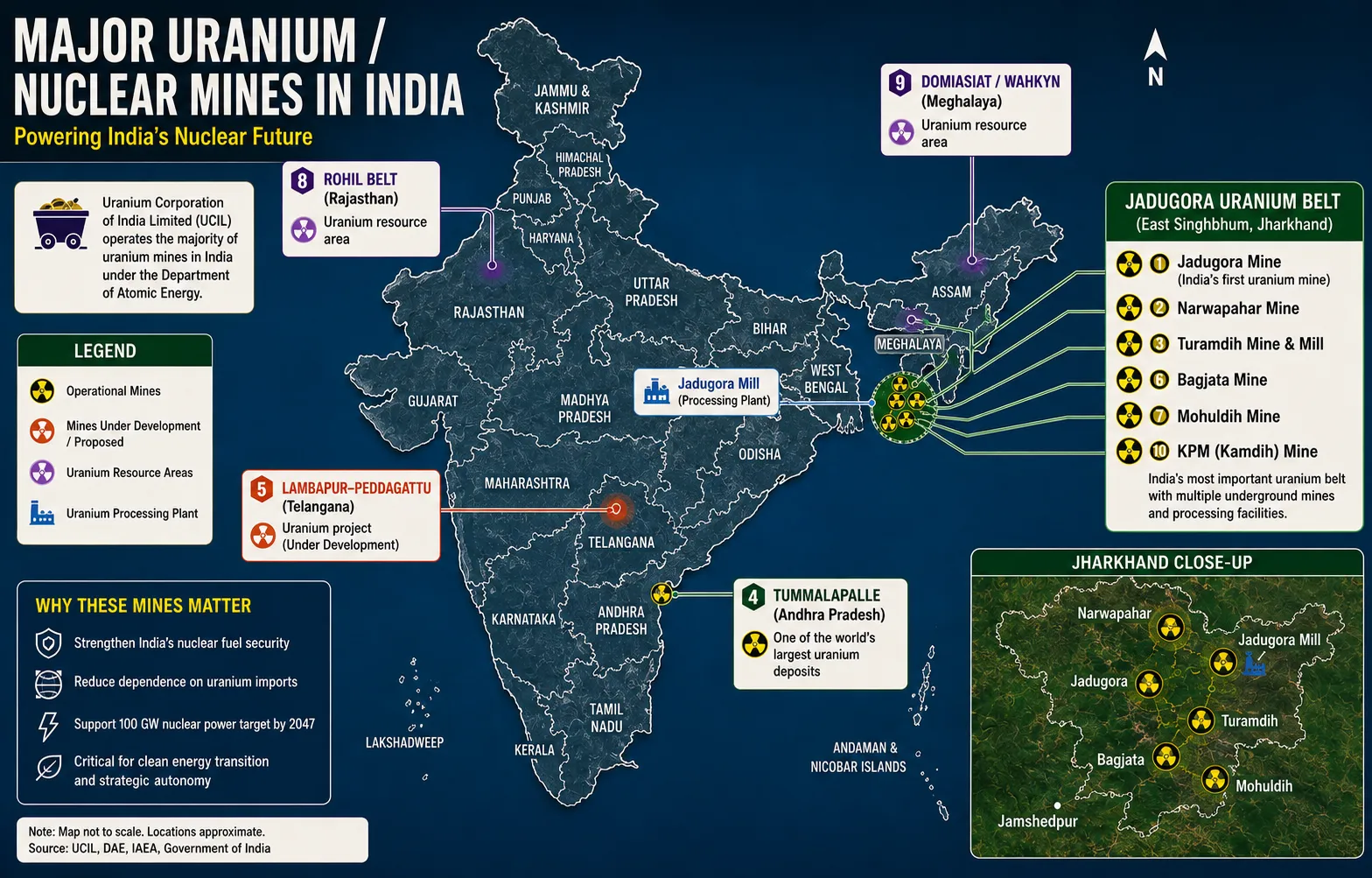
India possesses domestic uranium reserves, but experts believe current production levels are still insufficient to fully support the country’s long-term nuclear expansion plans.
As a result, India has been pursuing a dual-track strategy:
- Expanding domestic uranium mining
- Securing long-term international uranium supply agreements
Recent India-Canada uranium cooperation discussions have again highlighted the importance of supply diversification. Analysts say India is increasingly adopting a “multi-source uranium strategy” amid growing global competition for nuclear fuel resources.
Despite these international deals, the strategic value of the Jadugora uranium belt remains intact because domestic uranium resources are still considered important for India’s long-term nuclear self-reliance.
How Uranium Is Extracted in Jadugora
India’s first underground is Jadugora Uranium Mine. Uranium ore is found deep beneath the surface inside rock formations hundreds of meters underground.
Workers and mining equipment descend through underground shafts and tunnels to extract uranium-bearing ore.
Because Jadugora’s uranium is considered “low-grade ore,” enormous quantities of rock and soil must be processed to obtain usable uranium.
The extracted ore is transported to the Jadugora mill, where uranium is separated through multiple stages:
- Crushing and grinding
- Acid leaching
- Ion exchange
- Chemical precipitation
The final product is “yellowcake” — a uranium concentrate.
U3O8
According to UCIL, the yellowcake is packed into specially secured steel drums and transported under strict security to Hyderabad’s Nuclear Fuel Complex, where it is further processed into nuclear reactor fuel.
The Jadugora Radiation Controversy
Alongside its strategic importance, the Jadugora uranium belt has remained at the center of environmental and radiation-related debates for years.
Local tribal communities, activist groups and some independent studies have alleged health concerns in villages located near mining and tailing pond areas.
The biggest concern revolves around radioactive tailing ponds — the sites where radioactive waste generated during uranium extraction is stored.
Critics have raised concerns over possible radioactive dust dispersion and long-term contamination risks.
However, UCIL, the Atomic Energy Regulatory Board (AERB), and government agencies have repeatedly stated that radiation levels in the area remain within prescribed safety standards. Official reports have also linked several regional health problems to poverty, malnutrition and limited healthcare access rather than directly attributing them to radiation exposure.
The debate therefore continues as a broader question of balancing strategic development, environmental protection and local community concerns.
What Role Do the Jharkhand Government and Jamshedpur Administration Play?
Although uranium mining operations are directly controlled by UCIL and India’s Department of Atomic Energy, the East Singhbhum district administration based in Jamshedpur also plays a significant coordination role.
District authorities are involved in:
- Law and order
- Health services
- Land administration
- Environmental grievance coordination
- Local rehabilitation and public administration
Whenever concerns emerge around Jadugora Uranium Mine, the district administration often acts as a bridge between state authorities, central agencies and local communities.
In recent years, the Hemant Soren government has increasingly positioned uranium, copper and critical minerals as part of Jharkhand’s future industrial identity and strategic economic role.
State-level policy discussions around strategic minerals, energy security and mining investment have also intensified as India seeks to strengthen domestic supply chains.
Jharkhand’s Emerging Strategic Mineral Economy
Jharkhand is now increasingly being viewed as a future hub of India’s strategic mineral economy.
A recent agreement between UCIL and Hindustan Copper Limited (HCL) to explore uranium extraction from copper tailings in Jharkhand has further reinforced the state’s importance in India’s nuclear fuel ecosystem.
Analysts believe that as global competition over critical minerals intensifies, regions like the Jadugora uranium belt could become even more strategically valuable in the coming decades.
The Future of India’s Nuclear Expansion
India plans to rapidly expand its nuclear energy capacity over the next two decades through new reactors, indigenous fuel cycles and Small Modular Reactors (SMRs).
In that future, Jadugora Uranium Mine importance is unlikely to decline.
For policymakers in New Delhi, the region represents energy security, strategic autonomy and long-term nuclear resilience.
For many local communities, however, it remains tied to unresolved questions around health, environmental protection and sustainable development.
That tension — between strategic ambition and local realities — continues to define the story of Jadugora.
What is the Jadugora uranium belt?
The Jadugora uranium belt is India’s oldest and most strategically important uranium mining region located in East Singhbhum district of Jharkhand. It plays a major role in India’s nuclear fuel supply chain and domestic uranium production.
Where is Jadugora located?
Jadugora is located in Jharkhand’s East Singhbhum district, around 25–30 kilometers from Jamshedpur in the Singhbhum Shear Zone region.
Why is Jadugora important for India’s nuclear energy security?
The Jadugora uranium belt supports India’s domestic uranium supply, which is considered strategically important for the country’s long-term nuclear energy expansion and fuel security.
How is uranium extracted in Jadugora?
Uranium ore is extracted through underground mining operations. The ore is then processed through crushing, acid leaching, ion exchange and chemical precipitation to produce “yellowcake” uranium concentrate.
What is yellowcake uranium?
Yellowcake is a concentrated uranium product produced after processing uranium ore.
U3O8
It is later refined and converted into nuclear fuel for reactors.
Why is Jadugora back in the spotlight?
The Jadugora uranium belt has regained strategic attention due to India’s nuclear expansion plans, Kudankulam reactor expansion, global oil market instability, and rising concerns over uranium supply security.
Does India import uranium?
Yes. India imports uranium from countries such as Kazakhstan, Canada and Russia because domestic production alone is not considered sufficient for future nuclear energy requirements.
What is the Jadugora radiation controversy?
Local communities and activist groups have raised concerns over radiation safety and health issues linked to uranium mining and radioactive tailing ponds. However, UCIL and Indian nuclear regulatory agencies maintain that radiation levels remain within prescribed safety limits.
What role does Jharkhand play in India’s strategic mineral economy?
Jharkhand is emerging as one of India’s most important strategic mineral hubs because of its uranium, copper, coal and critical mineral resources. The state government has increasingly linked mining projects with India’s energy security strategy.
What is India’s nuclear energy target for 2047?
India aims to expand its nuclear power capacity to around 100 GW by 2047 as part of its long-term clean energy and energy security strategy.