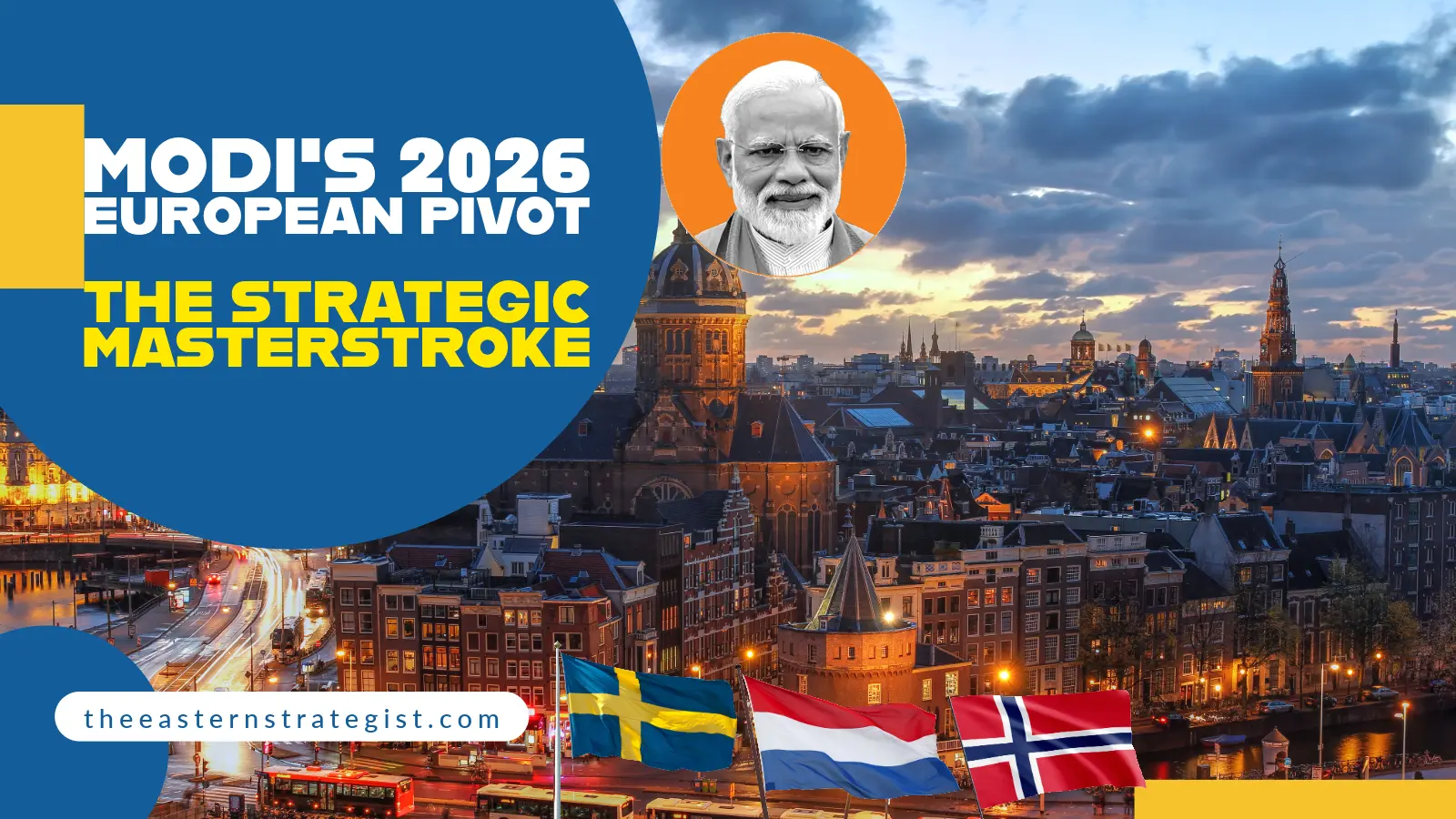
The international system is currently navigating a period of profound structural churn. As nations seek strategic resilience, the ongoing India European Pivot bridges the immediate need for fossil fuel security with long-term imperatives in Northern Europe…
The international system is currently navigating a period of profound structural churn. Global supply chains are fracturing, critical technologies are being weaponized, and a severe destabilization is ripping through global energy markets. The escalating friction in the Middle East has triggered a blockade of the Strait of Hormuz—a vital maritime chokepoint that handles 20% of the world’s petroleum supply. For a rapidly industrializing India, a nation that imports 87% of its crude oil, this is not just a diplomatic headache; it is a direct threat to core macroeconomic stability and developmental trajectories.
Against this precarious backdrop, New Delhi is executing a masterclass in strategic hedging. Prime Minister Narendra Modi’s five-nation European tour bridges the immediate need for fossil fuel security with long-term imperatives in Northern Europe: green energy, semiconductors, and advanced defense co-production. India is no longer engaging as a peripheral dialogue partner; it is positioning itself as an indispensable co-shaper of global supply chains.
Chapter 1: The Netherlands & The “Silicon Shield”
The first crucial European node in this strategy is the Netherlands. With the recent conclusion of negotiations for the India-EU Free Trade Agreement (FTA), the Netherlands has emerged as India’s primary economic gateway into continental Europe. The impending FTA will systematically reduce tariffs across roughly 97% of EU lines, providing unprecedented market access for Indian goods. However, the absolute strategic center of gravity here is silicon.
Securing ASML Lithography
India’s $20 billion Semiconductor Mission is fundamentally reliant on the Dutch tech giant ASML, which holds a near-total monopoly on advanced semiconductor lithography. Large-scale domestic projects, such as Tata Electronics’ massive $14 billion fabrication plant in Dholera, require uninterrupted access to ASML’s extreme and deep ultraviolet (EUV/DUV) lithography systems. Without these machines, India’s ambitions for silicon sovereignty cannot launch.
The Silicon Shield Protocol
Beyond merely securing hardware delivery, New Delhi and The Hague are co-developing a highly classified “Silicon Shield” protocol. This initiative aims to embed advanced security features directly into the hardware architecture of chips manufactured in India, effectively mitigating vulnerabilities to state-sponsored cyber sabotage. Furthermore, the two nations are collaborating to protect deep-sea critical infrastructure. Utilizing Dutch autonomous underwater vehicles and acoustic intelligence, India aims to safeguard its vast network of submarine communication cables from geopolitical sabotage.
Chapter 2: Sweden, Aerospace Ecosystems & the AMCA
Moving north to Gothenburg, the strategic focus shifts to the “Three Ts”: Trade, Technology, and Talent. Defense cooperation between India and Sweden is expanding at an unprecedented rate, moving past traditional buyer-seller dynamics into deep structural integration.
100% FDI and the Gripen E Pitch
In a watershed moment for Indian defense manufacturing, Swedish aerospace conglomerate Saab established a fully owned manufacturing facility for the Carl-Gustaf weapon system in Haryana. This represents the first foreign defense facility in India approved under an open 100% Foreign Direct Investment (FDI) route. However, Saab’s most ambitious proposal centers on the Indian Air Force’s (IAF) depleting squadron strength.
Saab is pitching its Gripen E fighter under a framework called the Indian Aircraft Company (INAC). The proposal outlines the local assembly of up to 144 aircraft, backed by a full transfer of technology (ToT) and the integration of indigenous Indian AI algorithms into the fighter’s avionics. Crucially, Saab proposes linking this ecosystem directly with India’s DRDO and ADA to support the long-term design and production of India’s highly anticipated fifth-generation fighter, the Advanced Medium Combat Aircraft (AMCA).
Space Interoperability
Simultaneously, the Swedish Institute of Space Physics is officially joining ISRO’s Venus Orbiter Mission. By providing specialized scientific instruments, this partnership demonstrates a deep level of technical and scientific interoperability between the two nations.
Chapter 3: Norway & The Arctic Blueprint
The final northern segment of the tour brings the Indian delegation to Oslo, marking a historic bilateral visit aimed at anchoring India’s presence in the High North. You can read our detailed background breakdown on the historical significance of the PM’s visit to Norway after 43 years. The geopolitical disruptions of early 2026 exposed India’s vulnerability regarding a heavy reliance on foreign-flagged vessels for its Liquefied Natural Gas (LNG) and petroleum shipments. Through the newly implemented India-EFTA Trade and Economic Partnership Agreement (TEPA), New Delhi is systematically addressing this bottleneck.
The Polar Research Vessel (PRV)
A landmark achievement of this leg is a ₹2,329 crore contract between India’s Garden Reach Shipbuilders & Engineers (GRSE) and Norwegian maritime designers to co-design India’s first indigenous Polar Research Vessel (PRV) by 2030. This asset will eliminate India’s historical reliance on chartering foreign icebreakers. As receding polar ice opens new, highly contested shipping routes, securing access to critical mineral components remains paramount. This is a challenge heavily mirrored in the recent Trump-China summit regarding rare earth element supply chains, making domestic resource autonomy an absolute baseline for major powers.
Arctic Governance and Himadri
India’s engagement with Norway anchors its strategic presence in the Arctic theater. By maintaining a permanent, active research presence at the Himadri station in Svalbard, India ensures it retains a credible, institutional voice in Arctic governance, preventing adversarial regional powers from unilaterally monopolizing northern trade corridors and resource pools.
Conclusion: The Strategic Synthesis
When we analyze this diplomatic marathon holistically, a profound paradigm shift emerges. India is systematically decoupling its economic growth from volatile energy corridors while upgrading its technological baseline. By tying its economic destiny to the technological gateways of the Netherlands, the aerospace corridors of Sweden, and the maritime blueprints of Norway, New Delhi is engineering a resilient framework for 21st-century strategic autonomy. The European pivot is not merely diplomatic routine; it is the construction of an unshakeable geopolitical foundation.