
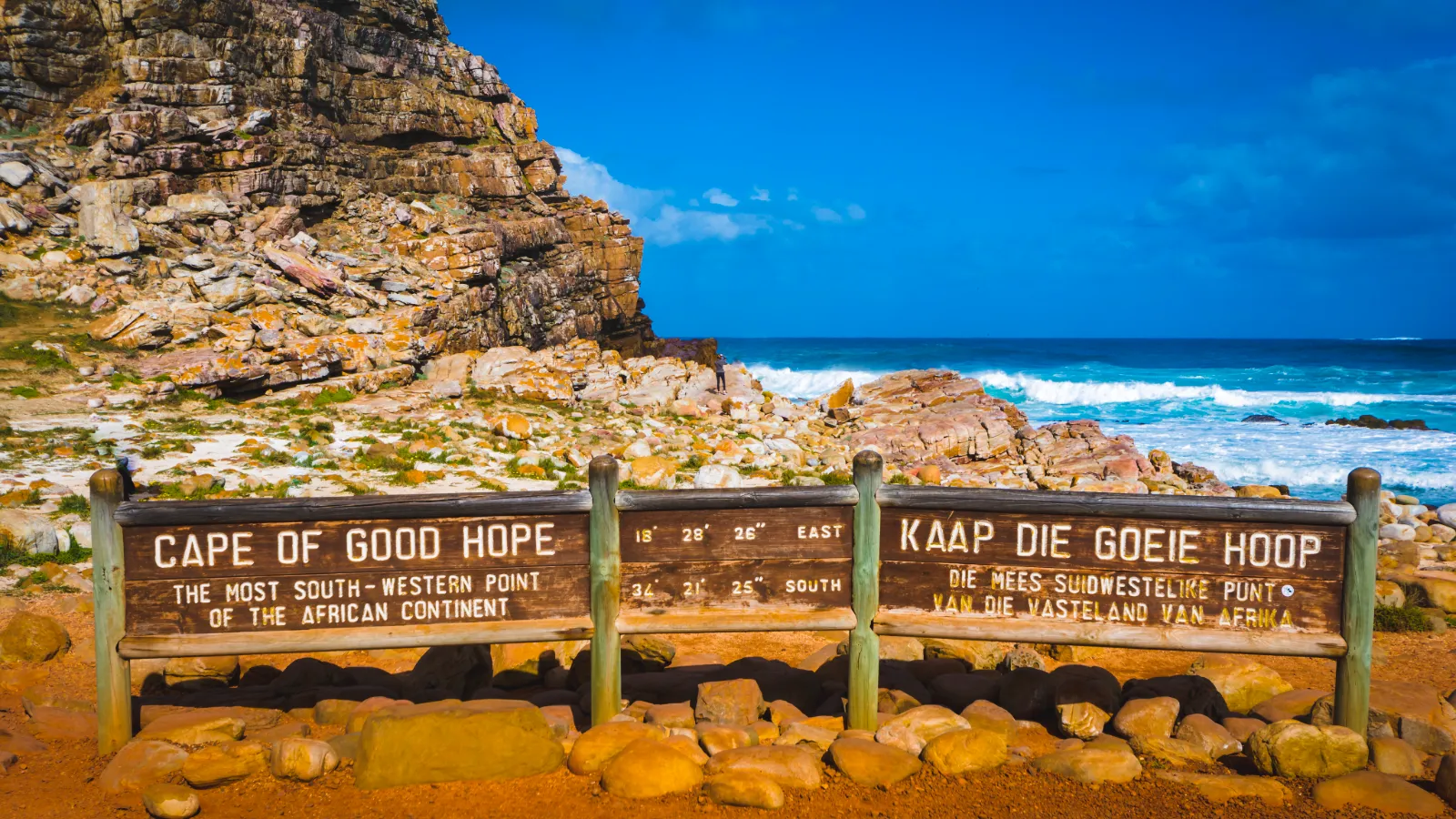
The Cape of Good Hope shipping route is emerging as one of the world’s most critical maritime corridors as instability in the Red Sea forces vessels around southern Africa, raising freight costs, energy security concerns, and pressure on global supply chains.
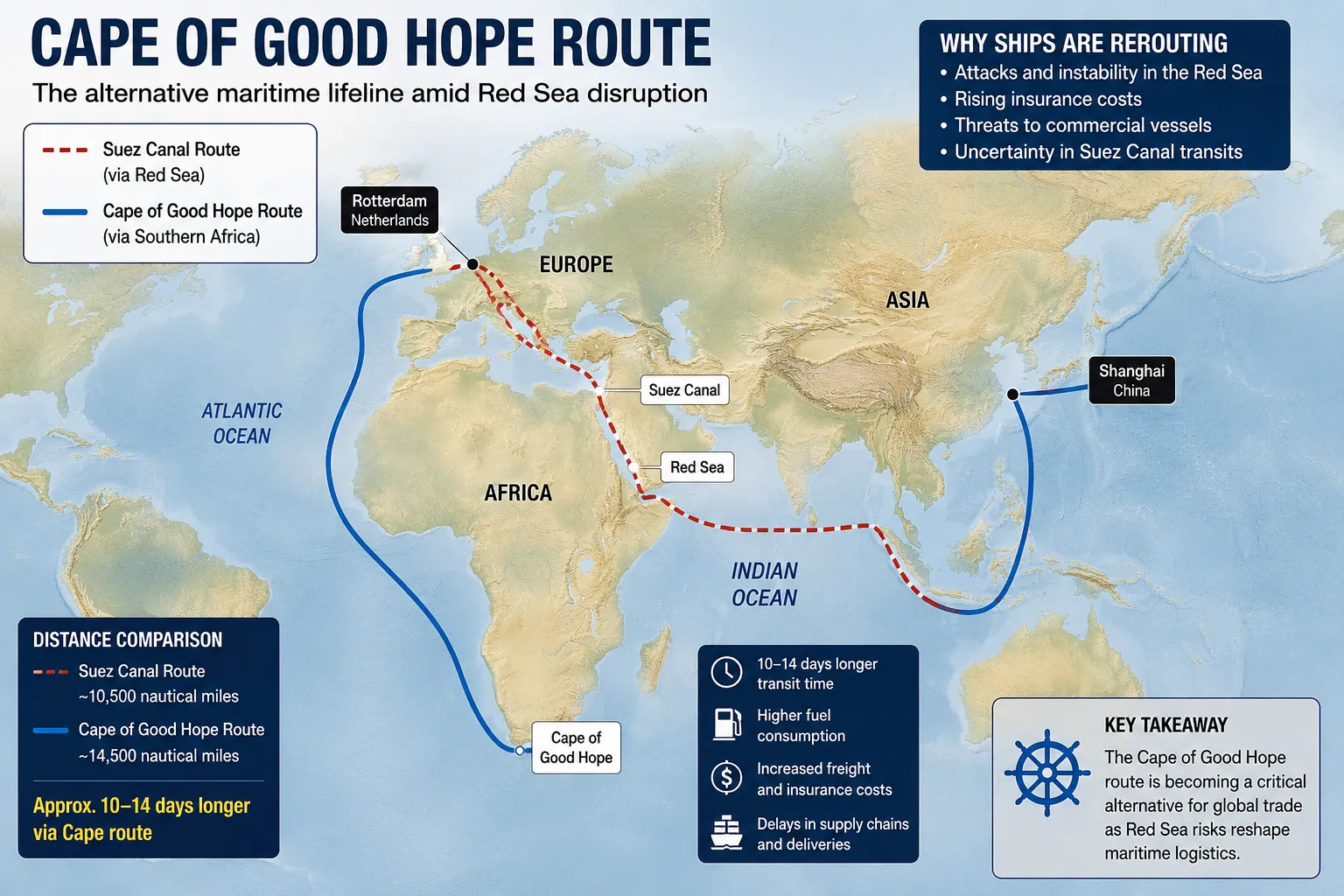
The Cape of Good Hope shipping route is no longer functioning merely as an emergency detour for global trade. As instability continues disrupting the Red Sea and Suez Canal corridor, the route around southern Africa is rapidly becoming a strategic pressure valve for the international shipping system.
The shift matters because a corridor once treated as a secondary option is now absorbing the economic burden of geopolitical instability elsewhere. For major import-dependent economies like India, that means higher freight costs, longer delivery cycles, and increased exposure to maritime disruption.
Red Sea crisis is reshaping global shipping routes
The current rerouting trend is closely tied to instability in the Red Sea and Bab el-Mandeb corridor, one of the world’s most important maritime chokepoints connecting the Indian Ocean to the Mediterranean through the Suez Canal.
Major shipping companies including Maersk, Hapag-Lloyd, and MSC have repeatedly adjusted routes as security risks in the region intensified.
According to analysis from the United Nations Conference on Trade and Development (UNCTAD), rerouting around Africa can add nearly two weeks to some Asia-Europe shipping journeys while increasing fuel consumption and operational costs.
Industry estimates suggest voyages diverted through the Cape of Good Hope shipping route may add roughly 3,500 to 4,000 nautical miles depending on origin and destination ports.
From alternative corridor to strategic pressure valve
For decades, the Cape route remained strategically important primarily as a contingency option whenever disruptions affected the Suez Canal system.
That logic is now changing.
The Cape is increasingly functioning as the global trade system’s emergency pressure valve whenever geopolitical instability disrupts traditional east-west shipping corridors.
This transition matters because global maritime trade operates on efficiency, predictability, and timing. When one corridor becomes unsafe, pressure immediately shifts onto another route.
The Cape therefore inherits the strategic and economic burden of conflicts occurring thousands of kilometers away.
Why the Cape of Good Hope shipping route matters now
The route sits inside one of the world’s most important trade systems connecting:
- Asian manufacturing hubs
- Middle Eastern energy exporters
- European consumer markets
- African trade corridors
According to the International Maritime Organization (IMO), nearly 90 percent of global trade moves by sea, making maritime stability central to the functioning of the global economy.
Unlike narrow chokepoints such as the Strait of Hormuz or Bab el-Mandeb, the Cape is geographically open. However, that openness does not reduce its strategic importance. Instead, it makes the route a critical absorber of redirected maritime traffic during crises.
The economic impact of rerouting around Africa
The real cost of maritime rerouting is not simply additional sailing distance. The larger issue is systemic inefficiency across global shipping networks.
When container ships and oil tankers spend more time completing voyages, fewer vessels remain available for the next shipping cycle. That effectively tightens global shipping capacity and pushes freight rates higher.
The consequences include:
- Higher container freight rates
- Rising tanker charter prices
- Longer delivery timelines
- Supply-chain delays
- Inflationary pressure on imported goods
Data from the World Bank and shipping analytics firms has repeatedly shown that maritime disruptions quickly feed into inflation, industrial costs, and energy markets.
South Africa becomes a maritime pressure point
As vessel traffic increasingly shifts south, South Africa’s maritime infrastructure faces mounting operational strain.
Ports including Durban and Cape Town may experience congestion, delayed vessel turnaround times, and increased pressure on logistics systems.
The challenge is not only commercial but strategic. A sudden increase in vessel density places additional pressure on coastal monitoring systems, emergency response networks, and maritime oversight capabilities.
South Africa may gain some economic activity from increased shipping flows, but it also becomes an unintended buffer zone for wider geopolitical instability affecting global trade.
Why India should care about the Cape route
For India, this is not merely a distant shipping issue.
India imports a significant share of its crude oil, LNG, LPG, fertilizers, and industrial commodities through maritime trade routes. Any disruption affecting shipping efficiency directly influences landed import costs.
If vessels reroute through the Cape of Good Hope shipping route instead of using the Red Sea-Suez corridor:
- Freight costs rise
- Insurance premiums increase
- Energy shipments take longer to arrive
- Inventory pressure grows for refiners and importers
That eventually affects fuel prices, transport costs, industrial production, and inflation inside India’s economy.
The issue therefore connects maritime security directly to India’s economic security.
China, Europe, and global supply-chain vulnerability
The consequences extend beyond India.
China’s export-driven economy depends heavily on uninterrupted maritime access to European markets. Longer transit times and higher shipping costs increase pressure on already fragile global supply chains.
European importers also face rising logistics expenses as shipping companies reroute cargo around southern Africa.
The Cape route is therefore becoming part of a wider geopolitical contest involving:
- Global supply-chain resilience
- Energy transportation security
- Maritime insurance markets
- Naval competition in the Indian Ocean
- Trade-route diversification
What to watch next
Several indicators will determine whether the Cape becomes a long-term structural trade route rather than a temporary detour.
- Continued Red Sea insecurity
- Persistent rerouting around Africa
- Higher freight and tanker rates
- Rising marine insurance costs
- Congestion at South African ports
- Expanded naval deployments in the Indian Ocean
If rerouting becomes normalized, the Cape of Good Hope shipping route could evolve from an emergency bypass into a permanent feature of global trade disruption.
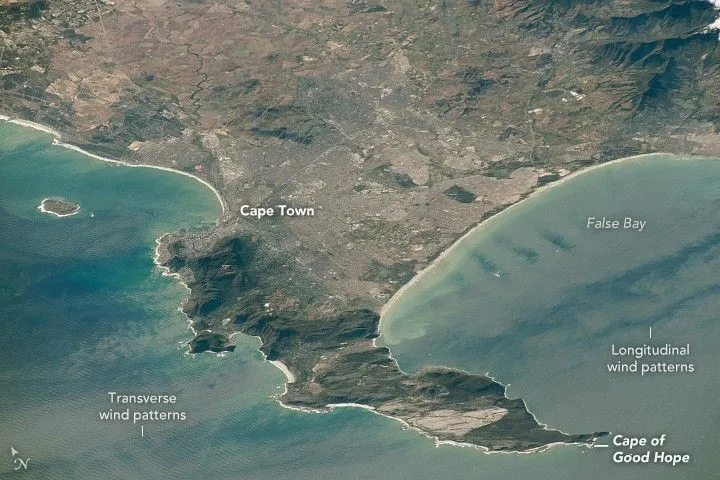
A NASA astronaut photograph of the Cape of Good Hope captured from the International Space Station highlights one of the world’s most strategically important maritime corridors as global shipping increasingly reroutes around southern Africa during the Red Sea crisis.
Astronaut photograph ISS059-E-78303 was acquired on May 28, 2019, using a Nikon D5 digital camera aboard the International Space Station and is provided by the ISS Crew Earth Observations Facility and the Earth Science and Remote Sensing Unit at NASA Johnson Space Center. The image has been cropped and enhanced for clarity.
What is the Cape of Good Hope shipping route?
The Cape of Good Hope route is a major maritime shipping route that goes around the southern tip of Africa near the Cape of Good Hope and passes around southern Africa and connects Asia, Europe, the Middle East, and the Atlantic Ocean.
Why are ships avoiding the Red Sea?
Commercial vessels are avoiding the region because attacks, geopolitical instability, and rising insurance risks have increased threats to maritime traffic.
Why is the Cape of Good Hope strategically important?
The Cape provides an alternative maritime corridor linking Asia, Europe, Africa, and the Middle East whenever the Suez Canal or Red Sea becomes unstable.
How does rerouting affect India?
Longer shipping routes increase freight expenses, energy import costs, insurance premiums, and supply-chain delays for Indian importers.
Does the Cape route increase inflation?
Indirectly yes. Higher shipping and fuel costs can raise prices across global supply chains and contribute to inflationary pressure.
Why are ships using the Cape of Good Hope route?
Shipping companies are increasingly using the Cape route to avoid instability, attacks, and security risks in the Red Sea and Suez Canal corridor.
Is the Cape of Good Hope route longer than the Suez Canal route?
Yes. Ships rerouting around the Cape of Good Hope can travel thousands of additional nautical miles and may add 10–14 extra days to voyages between Asia and Europe.
Which countries are most affected by Cape rerouting?
India, China, European economies, Middle Eastern energy exporters, and major global shipping hubs are among the most affected.
Is the Cape of Good Hope replacing the Suez Canal?
No. The Suez Canal remains the faster and more efficient route, but the Cape route becomes important during geopolitical disruptions.
Closing analysis
The Cape of Good Hope is no longer simply a historic maritime landmark. It is rapidly emerging as one of the world’s most important strategic trade pressure points.
The deeper issue is not geography alone but the growing fragility of global trade systems operating under geopolitical stress.
For India and other major import-dependent economies, maritime disruption now carries direct consequences for energy security, inflation, and long-term economic stability.
2 thoughts on “Why the Cape of Good Hope Shipping Route Is Gaining Strategic Importance Amid the Red Sea Crisis”