
Russia Spring Nuclear Drill With Belarus Explained
Russia has launched a large strategic exercise involving nuclear-capable missile systems, submarines, bombers, and joint operations with Belarus, in what analysts see as one of Moscow’s clearest military signals to NATO this year.
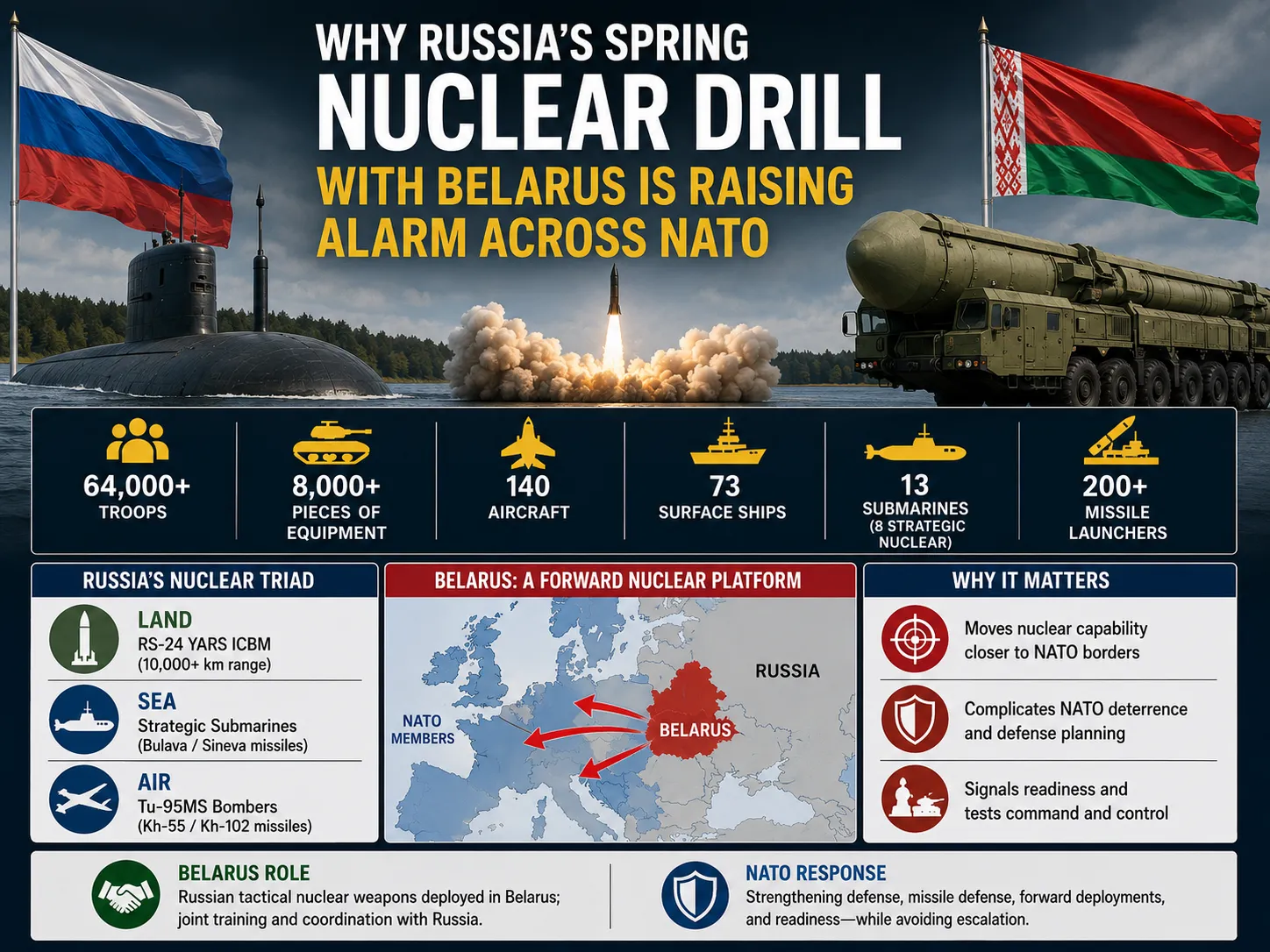
The three-day operation, running from May 19 to May 21, involves more than 64,000 troops, around 8,000 military vehicles and platforms, strategic missile forces, naval assets from the Northern and Pacific Fleets, and aircraft linked to Russia’s nuclear deterrence structure. Russian officials say the exercise is designed to test readiness under conditions of external aggression.
The scale of the operation has pushed the Russia Spring Nuclear Drill With Belarus into focus across European defense circles, especially because the exercise includes land, sea, and air components tied to Russia’s nuclear triad.
Why the Russia Spring Nuclear Drill With Belarus Matters
Russia conducts strategic-force drills regularly, but timing matters.
Moscow usually stages major nuclear-readiness exercises during autumn military cycles. Holding the Russia Spring Nuclear Drill With Belarus in May, during continued tensions with the West over Ukraine, changes how the exercise is being interpreted inside NATO capitals.
Western officials increasingly see the drill less as routine military training and more as political and strategic signaling.
The exercise reportedly includes ballistic and cruise missile simulations, strategic submarine deployments, and long-range aviation activity. Russian state media also reported the involvement of 13 submarines, including eight strategic nuclear submarines capable of launching ballistic missiles.
Russia’s Nuclear Weapons and Missile Systems Involved
The Russia Spring Nuclear Drill With Belarus reportedly involves units linked to Russia’s Strategic Missile Forces, including systems associated with the RS-24 Yars intercontinental ballistic missile.
The Yars missile is a road-mobile ICBM believed to have a range exceeding 10,000 kilometers and the ability to carry multiple independently targetable nuclear warheads. The system is considered one of the core elements of Russia’s land-based nuclear deterrent.
Naval assets involved in the exercise are also believed to include submarines connected to Russia’s sea-based nuclear deterrence fleet, likely tied to Borei or Delta-class submarines, although Moscow has not officially identified the classes participating.
These submarines are designed to carry Bulava or Sineva submarine-launched ballistic missiles, both central to Russia’s strategic nuclear posture.
Long-range aviation units are also likely operating aircraft such as the Tu-95MS strategic bomber, capable of carrying Kh-55 and Kh-102 nuclear-capable cruise missiles.
The combination of missiles, submarines, and bombers gives the Russia Spring Nuclear Drill With Belarus added strategic weight because it demonstrates readiness across all three legs of the nuclear triad.
Belarus Is Becoming More Important in Russia’s Strategy
Belarus has become one of the most closely watched parts of the exercise.
Since 2023, Russia has stationed tactical nuclear weapons inside Belarus and expanded military coordination with Minsk through missile deployments, air patrols, and command exercises.
The current Russia Spring Nuclear Drill With Belarus reportedly includes coordination involving Russian nuclear systems already deployed on Belarusian territory.
For NATO planners, that creates additional pressure along the alliance’s eastern flank, especially near Poland and the Baltic states.
The deployment of nuclear-capable systems closer to NATO territory complicates missile-defense planning and increases uncertainty during any future crisis scenario.
NATO’s Response to the Russia Spring Nuclear Drill With Belarus
Publicly, NATO governments have responded cautiously.
Western officials have largely avoided dramatic rhetoric around the Russia Spring Nuclear Drill With Belarus, partly because Russia has repeatedly used nuclear signaling since the Ukraine war began.
Behind the scenes, however, the drills reinforce trends already visible across Europe: rising defense budgets, expanded missile-defense programs, stronger forward deployment planning, and larger ammunition production targets.
NATO’s concern is less about immediate nuclear conflict and more about how nuclear pressure could shape decisions during a conventional military crisis.
That thinking has increasingly shaped European defense strategy over the past two years. Many NATO governments now believe stronger conventional deterrence — air defense, logistics, precision strike capability, and rapid reinforcement — is necessary to prevent nuclear signaling from creating political leverage.
What the Drill Signals Beyond Europe
The Russia Spring Nuclear Drill With Belarus also reflects a wider shift in modern conflict.
Military signaling now operates alongside cyber operations, drone warfare, economic pressure, sanctions, and information campaigns as part of broader geopolitical competition.
For countries outside Europe, including India, the developments are being watched carefully. The Ukraine war has become a real-time example of how nuclear powers use escalation management and strategic messaging without crossing into direct large-scale confrontation.
For now, NATO officials appear more focused on avoiding overreaction than matching Moscow’s rhetoric publicly. But the timing, scale, and visibility of the exercise ensured the message was noticed.