
In this article
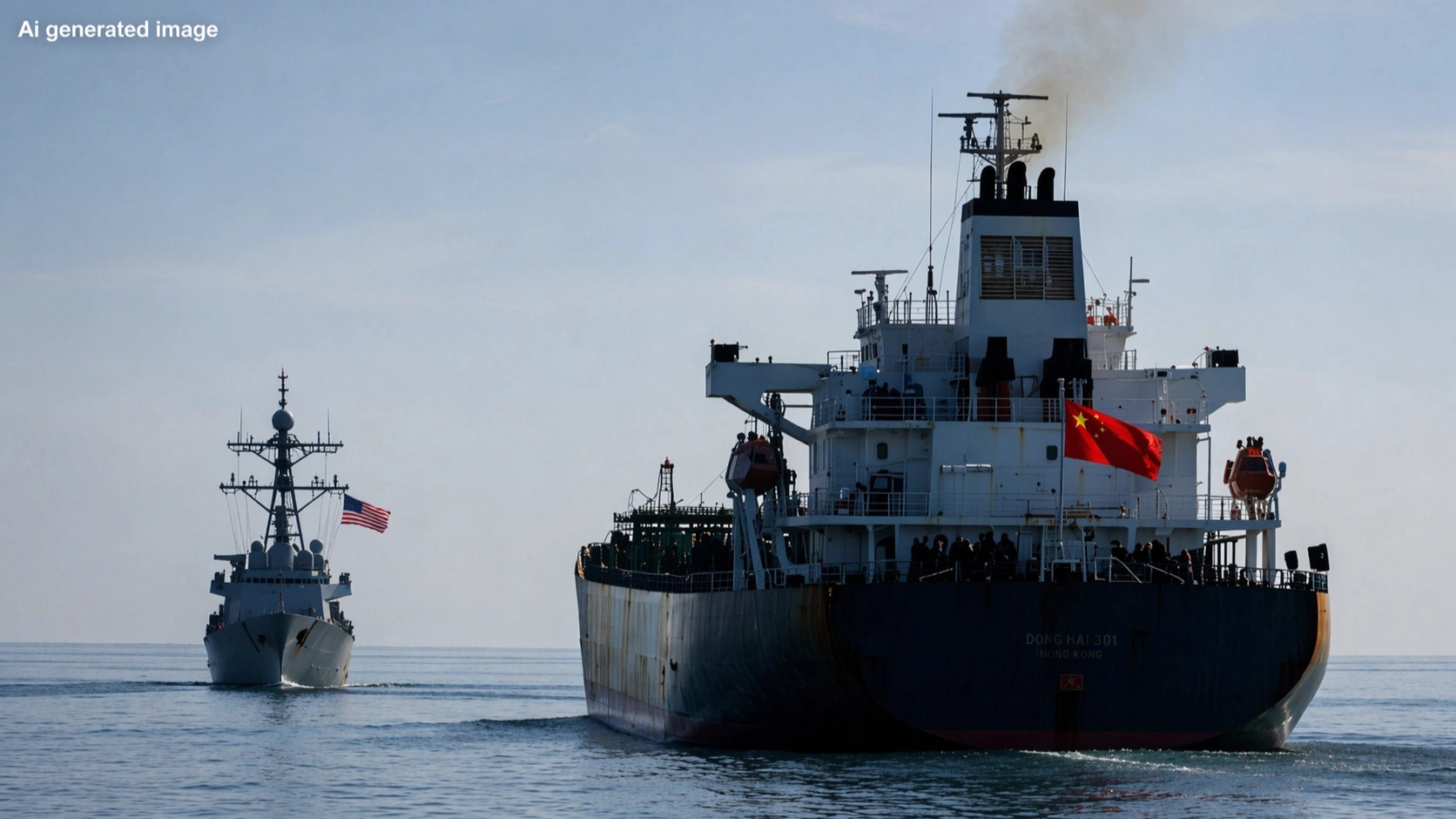
The Strait of Hormuz crisis is no longer just another West Asia flashpoint. It is now a test of how far major powers are willing to go in using sea lanes, shipping pressure and energy chokepoints as strategic tools. The United States has tightened pressure on traffic linked to Iranian ports, Iran has answered with threats and warnings, and oil markets are once again reacting to the risk of disruption. In the middle of that, China has delivered a message that looks calm on the surface but carries far more weight than a routine diplomatic line.
That is why this story deserves a closer reading. China is not merely commenting on a distant conflict. It is speaking as a power with deep energy exposure, growing naval ambition, and a strong interest in preventing key trade routes from turning into zones of open military coercion. The bigger story is not just what Beijing said, but what its words reveal about the future of the crisis, the balance of sea power, and the vulnerability of Asia.
At a glance: Why this crisis matters
- The US move is aimed at traffic linked to Iranian ports, not a formal closure of all Hormuz shipping.
- Hormuz remains one of the world’s most sensitive oil and gas chokepoints.
- China has pushed back politically, but has avoided any direct naval challenge.
- The crisis exposes both China’s growing maritime ambitions and its present limits.
- The economic shock is likely to be felt more sharply in Asia than in the United States.
Why China matters in the Hormuz crisis
At first glance, the crisis may appear to be mainly about Washington and Tehran. That would be too narrow a reading. Hormuz is not just a regional waterway; it is a global energy artery. A large share of Gulf oil and gas passes through this narrow route, which means any serious disruption can travel quickly from the sea to refineries, freight rates, inflation and household fuel bills.
That is where China enters the picture. Beijing is deeply tied to West Asian energy flows and has spent years trying to reduce the strategic risks created by distant chokepoints. So when China says the route must remain open and stable, it is not making a symbolic point. It is defending a core economic interest. In many ways, the Hormuz crisis is showing how energy security and sea power are now part of the same geopolitical story.
For readers tracking the wider shipping risk, it is also worth looking at our earlier analysis on why the collapse of the Islamabad talks pushed Hormuz shipping risk back into focus. The broader diplomatic fallout is also linked to our report on how Pakistan’s mediation effort turned into a wider oil-market risk story.
What Beijing is saying, and what it really means
China’s official language has been measured. It has called for calm, restraint and unimpeded navigation. It has argued that the route should remain open for global trade and energy security. On paper, that sounds like standard diplomacy. In practice, it is a rejection of the idea that one side can use overwhelming sea power to reshape the rules of movement through a vital international route without triggering wider consequences.
Beijing’s approach is careful for a reason. It does not want to be pulled into a direct military confrontation with the United States in a distant conflict zone. At the same time, it does not want to silently accept a precedent under which a major power can squeeze a strategic sea lane and force the rest of the world to adjust. So China is choosing words that sound restrained, while sending a message that is actually quite firm: sea routes that sustain the global economy cannot be turned into open instruments of pressure without blowback.
That is the real meaning of China’s message. It is not a war cry. It is a warning that the economic system itself begins to wobble when military pressure touches global shipping arteries. That is especially relevant in a region where any small maritime incident can quickly push oil prices higher and trigger fresh panic across markets.
China’s message in 4 points
- Keep sea lanes open
- Avoid military escalation
- Protect energy and trade flows
- Do not normalise coercion at chokepoints
China’s sea strategy: power close to home, caution far away
To understand China’s response, it helps to understand how its maritime thinking has changed. Beijing is no longer thinking only in terms of coastal defence. It now works with a wider vision: strong control in nearby waters, and gradually expanding reach in distant waters where trade and energy routes matter. That is why China’s navy has grown so fast in recent years. It is not only about Taiwan or the South China Sea. It is also about the long shipping routes that keep China’s economy running.
Still, there is a major difference between a navy that is large by ship count and a navy that can step into any crisis far from home and impose order. China has become much stronger in waters close to its own strategic core. It can raise the cost for rivals, shape the local military picture and complicate outside intervention. But distant crisis management is a different challenge. It needs logistics, overseas support, operational depth and the political willingness to risk confrontation at long range.
That is why Hormuz matters as a real-world stress test. The crisis is showing that China wants to protect distant energy interests, but it is still doing so mainly through diplomacy, economic weight and long-term naval preparation, not through an immediate hard-power challenge. This is the gap between ambition and present reach.
For readers following the broader strategic frame, our earlier explainer on the geopolitics of the Strait of Hormuz helps place the current crisis inside the larger contest over trade corridors, energy security and maritime leverage.
What China can do in Hormuz, and what it still cannot
China is not helpless in this situation. It can use its diplomatic weight. It can quietly coordinate with partners. It can seek safer passage arrangements, protect contracts, diversify routes and accelerate long-term planning around strategic vulnerabilities. It can also use the crisis to strengthen its argument that reliance on unstable chokepoints remains one of Asia’s biggest strategic weaknesses.
But there are also clear limits. China has not announced any direct naval challenge to the US posture in the region. It has not signalled that it wants to test the crisis through visible force projection. That tells us something important: when the risk of direct military collision becomes too high, Beijing still prefers caution over confrontation in faraway waters.
That should not be misread as passivity. China is learning from this crisis in real time. It is watching how the US enforces pressure, how insurers react, how commercial shipping behaves, and how quickly markets absorb the shock. Every such episode becomes a lesson for future planning. In that sense, Hormuz is not only a crisis for China. It is also a classroom.
Why Asia may pay the highest price
The most underappreciated part of this crisis is that the economic pain may not fall where the military pressure originates. The United States may be the power applying pressure, but Asia is more exposed to the energy shock that can follow. China, India, Japan and South Korea all depend heavily on the wider flow of energy from this region. If Hormuz remains tense for too long, the first visible effects may be on oil prices, shipping costs, insurance rates and inflation across Asian economies.
India’s position reflects that reality. New Delhi has every reason to approach the crisis quietly and practically. For India, this is not about rhetoric. It is about keeping supplies stable, avoiding fresh inflation pressure and managing risk without being dragged into the loudest part of the confrontation. That is why the story matters beyond West Asia. It touches everyday economics in Asia.
Readers interested in the wider economic chain reaction can also see our earlier piece on the seven biggest ways the US-Iran ceasefire phase reshaped the wider regional and market picture. Even a partial de-escalation never removed the basic vulnerability of the route.
Why Asia is more exposed
- Higher dependence on Gulf energy flows
- Shipping and insurance costs hit importers quickly
- Oil shocks pass into inflation faster
- Market panic in Hormuz travels quickly to Asian economies
The deeper meaning of the crisis
The real value of China’s Hormuz message lies in what it tells us about the next phase of great-power competition. Beijing is no longer just a coastal power watching events from afar. It has real stakes, real exposure and growing tools. But it is also not yet in a position where it can step into every distant crisis as a decisive maritime enforcer. That tension defines China’s current moment at sea.
So the bigger story is not simply that China criticised the US move. The bigger story is that the world is entering a phase where sea lanes, oil routes, naval posture and economic vulnerability are becoming part of the same contest. Hormuz is one of the clearest places where that reality is now visible.
China’s message matters more than it seems because it is not just about this week’s crisis. It is about the future of maritime power, the limits of coercion, and the price Asia may have to pay when a global energy artery becomes a theatre of strategic pressure.