
| Strategic affairs / defence-industrial policy analysis |
|---|
| Why industrial depth, critical materials, and logistics resilience now shape national military power |

Introduction: the new frontline
Military power is increasingly determined not only by visible platforms such as ships, aircraft, missiles, armoured systems, and unmanned platforms, but by the industrial networks that sustain them under pressure. In an era shaped by fragmented production, material bottlenecks, sanctions risk, contested sea lanes, export controls, and technology dependence, defence capability now depends on whether a nation can reliably source, process, manufacture, transport, repair, and replenish the inputs behind its military systems.
For India, this shift has major policy implications. The country has expanded domestic defence manufacturing significantly, with annual defence production reaching Rs 1,50,590 crore in FY 2024-25, according to the Ministry of Defence. Yet the strategic question is no longer only how many systems India can assemble domestically. It is how much control India has over the upstream supply-chain layers that make sustained defence production possible in crisis conditions.
“In modern conflict, platforms win battles only when supply chains sustain endurance.”
The central argument is simple: in prolonged competition or conflict, the decisive measure of defence-industrial strength is not just what a nation can display, but what it can continue to produce, repair, and replenish when external pressure rises. Supply chains are therefore no longer the background to defence strategy. They are part of its core architecture.
From platforms to production systems
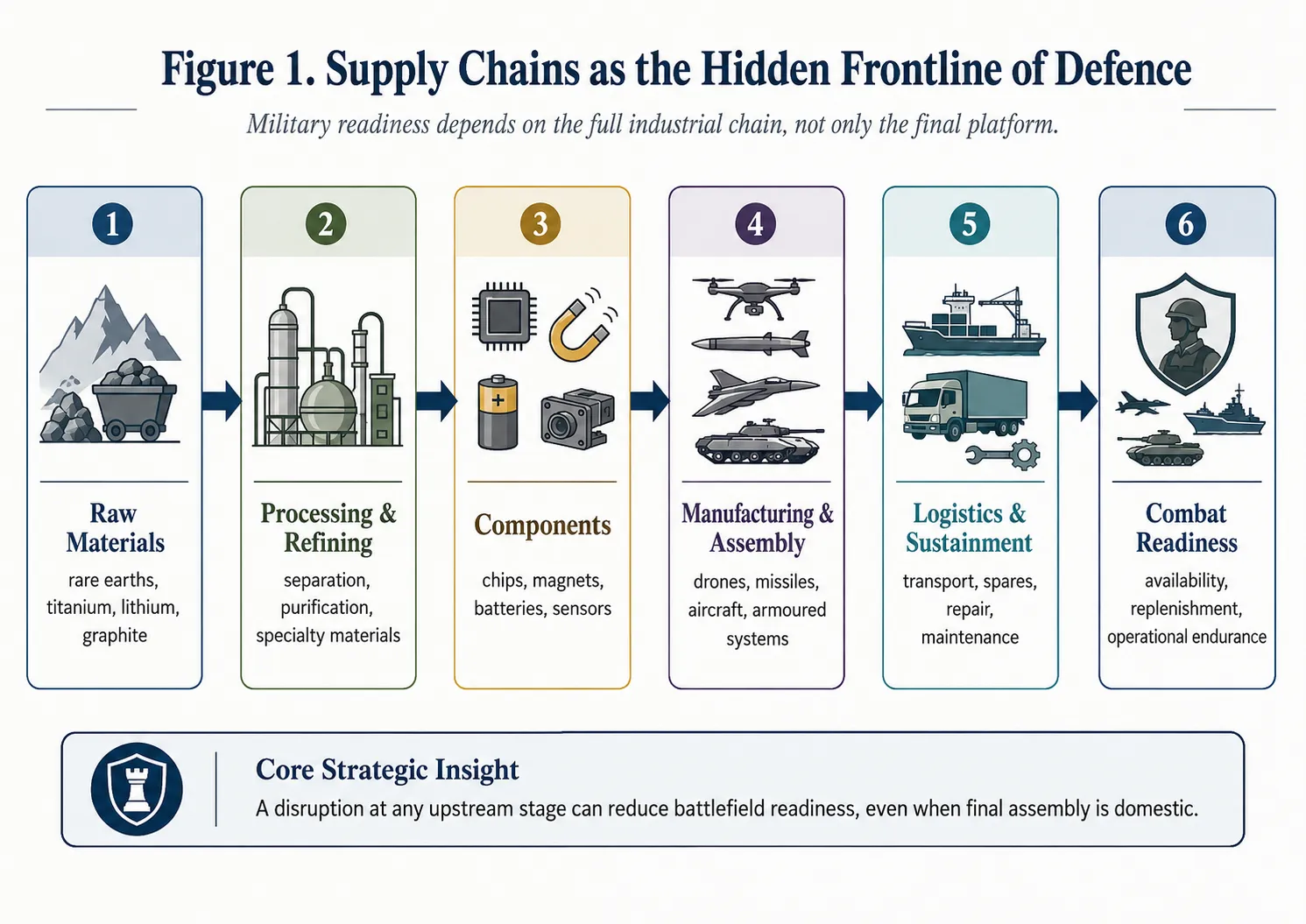
Traditional defence debates often focus on end products: fighter aircraft, drones, artillery, naval vessels, missile systems, and armoured platforms. But each of these systems is the final expression of a far larger industrial chain. Raw materials must be extracted and refined; components must be fabricated; electronics must be integrated; logistics networks must move inputs to factories and field formations; and maintenance systems must keep equipment operational over time.
This means military readiness increasingly rests on production systems rather than platforms alone, as Figure 1 illustrates. A force may field advanced equipment, but if one critical input becomes unavailable, the practical combat value of that equipment erodes quickly. In prolonged competition or conflict, the ability to replenish stocks, repair damaged systems, and surge production can become as consequential as initial battlefield strength.
The lesson is visible across modern war. High-intensity conflict consumes ammunition, drones, missiles, spare parts, sensors, and batteries at a pace that peacetime procurement systems rarely anticipate. A defence force that cannot sustain flows of material quickly discovers that tactical performance is constrained by industrial endurance.
Why supply chains are now strategic
For decades, global manufacturing was optimised around efficiency. Supply chains were distributed across borders to reduce cost, exploit specialisation, and minimise inventory. That model raised productivity in normal conditions, but it also created hidden fragility. When geopolitics turns hostile, transport routes are disrupted, export controls tighten, or a single supplier becomes unavailable, the same efficiencies can become vulnerabilities.
Defence production is particularly exposed because many military inputs are not easily substitutable. Components often require exact tolerances, secure production environments, long qualification cycles, and certified suppliers. A missing semiconductor, specialty alloy, processed magnet material, propulsion input, or communications module may stall an entire production line. The consequence is that supply-chain resilience is no longer a support issue. It is a core element of national defence preparedness.
The strategic test is therefore not whether a country participates in global supply chains. All modern defence economies do. The test is whether it understands where dependence becomes dangerous and whether it has a plan to manage those chokepoints before a crisis begins.
The critical-materials constraint
One of the clearest indicators of this shift is the growing importance of defence-critical raw materials. In December 2024, NATO published a list of 12 defence-critical raw materials: aluminium, beryllium, cobalt, gallium, germanium, graphite, lithium, manganese, platinum, rare earth elements, titanium, and tungsten. These materials are essential across batteries, electronics, armour, aerospace systems, high-performance alloys, sensors, propulsion systems, and precision-guidance technologies.
The strategic problem is not only access to mineral deposits. In many cases, the real bottleneck lies in midstream processing and refining. Mining may occur in several countries, but conversion into usable industrial inputs is often concentrated in far fewer locations. This makes processing capacity, rather than extraction alone, the decisive control point in many modern defence supply chains.
That distinction matters for policy. A country may appear diversified because it imports raw material from multiple origins, yet still remain exposed if refining, separation, purification, or intermediate manufacturing are concentrated in one geography. For defence planners, the relevant question is not simply where resources are found, but who controls the industrial ladder from raw material to final component.
China and the processing concentration problem
China’s role in critical-mineral processing illustrates why this issue has moved to the centre of strategic planning. Estimates vary by stage of the value chain, but China holds dominant capacity in several rare-earth processing and permanent-magnet segments. This gives it substantial leverage over materials that feed into motors, sensors, electronics, guidance systems, energy storage, and other advanced technologies.
The issue should be described precisely. China does not control every stage of every critical-mineral value chain. The vulnerability lies in dominant capacity at specific processing, separation, refining, and magnet-manufacturing stages that are difficult to replace quickly. In 2025, the International Energy Agency highlighted how new rare-earth export controls turned concentration risk into a practical supply-security concern for strategic sectors including defence, semiconductors, aerospace, industrial systems, and energy technologies.
For India, this is the central upstream challenge. Building more domestic production capacity is necessary, but it will not by itself eliminate vulnerability if processing, conversion, high-value intermediates, and critical components remain externally dependent. A resilient defence industrial base requires capability not only in final assembly, but across refining, specialty materials, precision components, electronics, testing, certification, and sustainment.
Fragility by design
Modern defence supply chains are often fragile not by accident, but by design. They were built to perform efficiently in peacetime conditions. Lean inventories, globally dispersed suppliers, and just-in-time manufacturing reduce cost, but they also reduce slack. When one tier of the network fails, the disruption can cascade rapidly across the rest of the system.
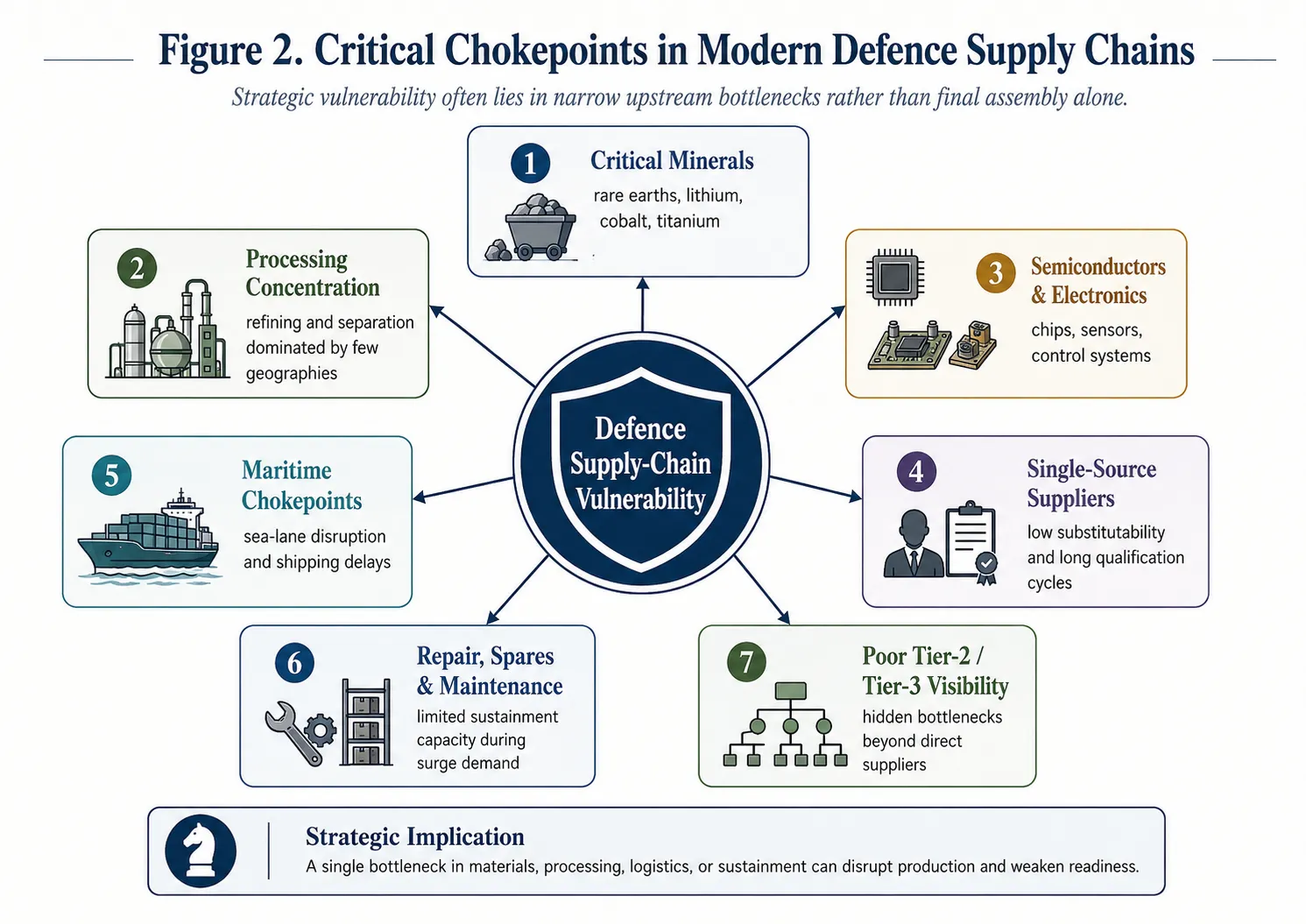
The problem is compounded by poor visibility beyond direct suppliers. Prime contractors may understand their first-tier vendor relationships, yet have limited insight into second- and third-tier dependencies where real bottlenecks often sit. A subcontractor’s reliance on a single imported processed material or specialised subcomponent may remain unnoticed until it interrupts production.
This is why resilience requires deliberate redesign, particularly around the chokepoints highlighted in Figure 2. It cannot be achieved simply by asking existing supply chains to perform better. Governments and industry must identify where concentration exists, where substitution is impossible, where lead times are long, and where domestic capability is strategically worth building despite higher short-term cost.
Logistics as warfighting infrastructure
Logistics is often discussed as an administrative or rear-area function, but in strategic terms it is warfighting infrastructure. Armies depend on fuel, transport, ammunition flow, repair cycles, warehousing, medical support, and spare parts. Air forces depend on maintenance turnarounds, engine servicing, avionics support, and munition replenishment. Naval forces depend on docks, repair facilities, materials supply, and stable maritime logistics. Drone-heavy forces depend on batteries, communications modules, sensors, processors, motors, propellers, and rapid component replacement.
Consider a drone-intensive operational environment. A country may produce airframes domestically, but if battery cells, rare-earth magnets, thermal imagers, radio-frequency modules, flight controllers, or high-density processors are delayed for 60 to 90 days, operational availability falls quickly. The platform exists, but sorties decline. The lesson is that military endurance comes from the whole sustainment chain, not from the airframe alone.
Digital logistics tools can improve readiness by identifying shortages, forecasting failure, and optimising inventory. But they do not replace physical resilience. A predictive system can warn that a critical stock is running out; it cannot manufacture a missing processed material or reopen a disrupted shipping route. The strategic objective is therefore to build logistics systems that can continue functioning under stress, not merely systems that operate efficiently under normal conditions.
India’s defence-industrial opportunity
India’s current position is significant because it combines expanding manufacturing ambition with growing strategic urgency. Official data reported defence production of Rs 1,50,590 crore in FY 2024-25, reflecting a continued rise in domestic output. Government messaging has also emphasised increased private-sector participation, stronger domestic procurement, defence exports, and the broader push toward self-reliance under Make in India and Atmanirbhar Bharat.
This progress is real, but it should be assessed carefully. Production growth does not automatically equal full-spectrum strategic autonomy. A country can raise domestic output while still depending on vulnerable import channels for electronics, specialty materials, propulsion inputs, machine tools, advanced sensors, or intermediate industrial processes. The next stage of India’s defence-industrial growth will therefore depend less on headline production numbers and more on depth across the supply chain.
This is particularly relevant in high-growth segments such as drones, counter-drone systems, autonomous platforms, electronic warfare, smart munitions, space-enabled systems, and advanced sensors. These sectors depend heavily on batteries, processors, communications hardware, composites, rare-earth permanent magnets, secure software, and miniaturised electronics. As India expands into these domains, upstream dependency management will become just as important as production-scale expansion.
The National Critical Mineral Mission as a policy anchor
India has begun to address this vulnerability through the National Critical Mineral Mission, approved by the Union Cabinet in January 2025. The mission is designed to strengthen exploration, mining, beneficiation, processing, recycling, acquisition of overseas mineral assets, trade with resource-rich countries, and stockpiling. It also envisages mineral processing parks, critical-mineral technology research, and a Centre of Excellence on Critical Minerals.
For defence strategy, this mission should not be treated only as an economic or energy-transition initiative. It should be integrated with defence-industrial planning. The same minerals and processing capabilities that support batteries, semiconductors, advanced manufacturing, and clean-energy technologies also support military mobility, unmanned systems, sensors, directed-energy components, propulsion systems, and precision weapons.
The strategic opportunity for India is to connect mining policy, industrial policy, defence procurement, research and development, and trusted international partnerships into a single resilience architecture. If these streams remain separate, India may improve domestic manufacturing without adequately reducing upstream exposure.
Not every dependency is equally dangerous
A stronger defence-industrial strategy must distinguish between normal interdependence and dangerous dependence. No large defence economy is completely self-sufficient, and trying to localise every input would be economically inefficient and strategically unnecessary. The real issue is concentrated dependence in inputs that have low substitutability, long replacement cycles, limited supplier diversity, or high wartime significance.
This distinction is important for India. Some imported components can be managed through diversified sourcing and reliable partners. Others require domestic capability, stockpiling, reserve capacity, or active substitution policy because failure in those nodes would cripple production or readiness. Strategic policy should therefore focus on chokepoints, not blanket localisation.
A practical criticality framework should examine five questions: Is the input essential for a priority military capability? Can it be substituted without redesign or re-certification? Is supply concentrated in a single country, company, or route? What is the replacement lead time? Would shortage affect wartime readiness, replenishment, or deterrence credibility? Inputs that score high across these questions deserve priority treatment.
The macroeconomic trade-off: resilience as insurance
Resilience is not free. Stockpiles tie up capital. Dual sourcing can raise unit costs. Domestic processing may be more expensive than imports. Reserve manufacturing capacity may appear inefficient in peacetime. Trusted sourcing and security requirements may reduce the lowest-cost supplier options. A serious strategy must acknowledge these economic costs rather than hiding them.
But defence economics is not ordinary commercial optimisation. In national-security terms, resilience is an insurance premium against strategic paralysis. The relevant comparison is not between the cheapest peacetime input and a more expensive domestic or trusted alternative. It is between modest recurring cost and the much larger cost of losing military choice in a crisis.
The macroeconomic challenge is therefore to apply resilience selectively. India should not seek autarky. It should invest where the national-security value of control, redundancy, or trusted access exceeds the efficiency loss. This is how industrial policy, fiscal discipline, and defence preparedness can be reconciled.
Stockpiling, dual sourcing, and substitution
One of the most practical bridges between diagnosis and action is resilience planning around critical bottlenecks. Governments should identify which materials and components would create disproportionate disruption if supply were interrupted, then build targeted protections around them. These protections may include strategic stockpiles, dual-sourcing arrangements, reserve manufacturing capacity, trusted-country partnerships, recycling systems, and accelerated domestic capability-building.
Stockpiling should not be treated as a blunt instrument. Broad accumulation without prioritisation can be expensive and inefficient. Instead, stockpiles should focus on high-impact inputs with low substitutability and long lead times. In parallel, substitution research should aim to redesign systems so they can rely on more available materials or more flexible architectures over time.
This is where industrial strategy and innovation policy intersect. A defence system designed with modularity, alternate material pathways, open standards, and adaptable component specifications is inherently more resilient than one built around a narrow import dependence. Procurement policy should reward not only performance and price, but manufacturability, repairability, upgradeability, and strategic independence.
Ecosystem depth, not just prime contractors
A resilient defence industrial base cannot rest on a handful of prime contractors alone. It requires a layered ecosystem of materials suppliers, machine-tool firms, component manufacturers, electronics companies, testing laboratories, certifying bodies, logistics providers, software teams, cyber-security providers, and maintenance networks. Strategic strength comes from the interaction of these layers, not from isolated flagship platforms.
This makes the role of India’s private sector especially important. Private firms are increasingly involved across aerospace, electronics, naval systems, unmanned systems, space-linked technologies, and dual-use innovation. But their ability to scale depends on policy consistency. Long-term orders, predictable technical standards, efficient testing and certification pathways, and clearer procurement signals are essential if firms are to invest in deeper manufacturing capacity rather than shallow assembly roles.
NATO’s recent defence-industrial initiatives point in the same direction. The Alliance’s Defence Production Action Plan and subsequent updates emphasise aggregating demand, boosting production capacity, addressing supply-chain challenges, improving interoperability, and protecting defence-critical supply chains. These themes are not NATO-specific; they reflect a broader global recognition that defence production capacity is now a strategic asset.
What India should do next
Several policy priorities follow from this analysis and are summarised in Figure 3.
- First, India should map critical defence supply chains far beyond first-tier suppliers. Second- and third-tier visibility is necessary to identify real chokepoints in materials, subcomponents, processing pathways, tooling, electronics, and logistics routes.
- Second, India should invest more seriously in midstream capabilities such as refining, processing, separation, specialty materials, rare-earth permanent magnets, advanced alloys, and intermediate manufacturing. Assembly without control over these layers leaves strategic dependence intact.
- Third, procurement policy should encourage trusted domestic vendors through stable demand, long-term contracting, faster qualification pathways, and transparent technical standards. Industrial resilience requires confidence that capability-building will be commercially and strategically supported over time.
- Fourth, India should build targeted stockpiles and diversify supply relationships for the narrow set of inputs that are highly concentrated, difficult to substitute, and critical for wartime continuity.
- Fifth, research and innovation policy should incentivise material substitution, modularity, recycling, domestic alternatives, and design-for-manufacture in sensitive technologies such as drones, sensors, electronics, communications, propulsion systems, and high-performance components.
- Finally, supply-chain resilience should be incorporated into defence-readiness assessment. A weapons platform should not be evaluated only by performance specifications and procurement cost. It should also be assessed by supply security, repairability, component traceability, cyber integrity, replenishment time, and vulnerability to coercive disruption.
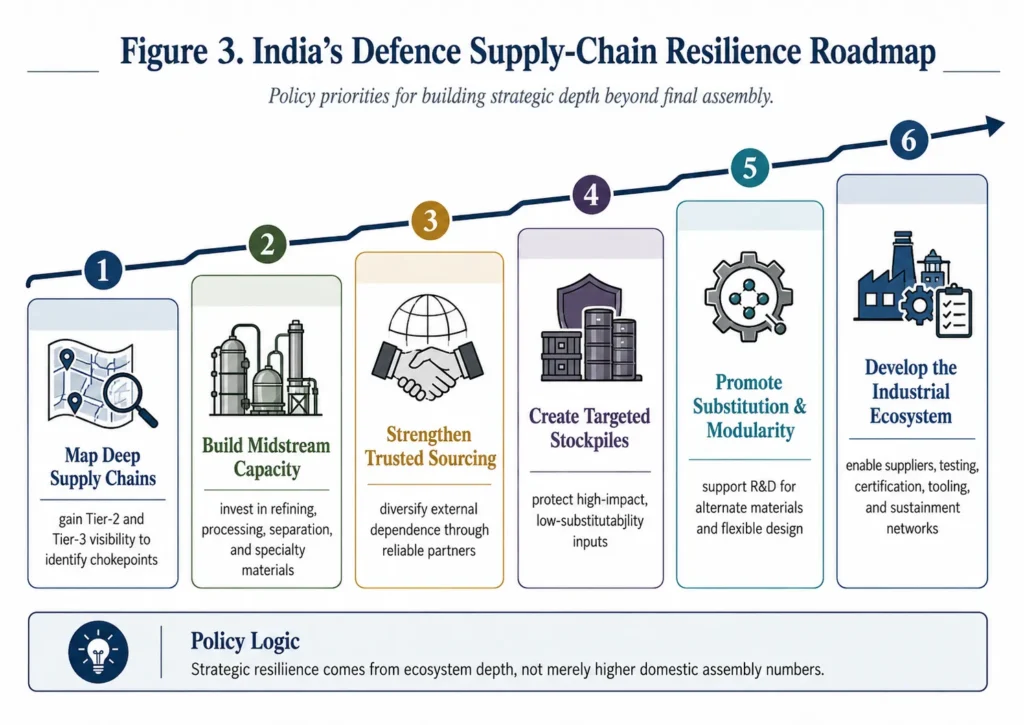
Source: Author-generated figure.
Conclusion
The future of defence power will be shaped not only by what appears in military parades or acquisition announcements, but by what can be sustained under pressure. A nation that can manufacture, process, transport, repair, and replenish critical inputs during disruption has strategic endurance. A nation that cannot will discover that industrial weakness limits military choice long before open conflict begins.
Defence, Geopolitics & Strategic Affairs Contributor
Lt Col Abhishek Mishra (Retd) is an Infantry and Special Forces veteran with extensive experience across military operations, UN peacekeeping, defence logistics, security leadership and high-tempo supply-chain operations.
Following retirement from military service, he held leadership positions with Reliance Industries and Amazon India. His writing focuses on defence strategy, military modernization, geopolitical risk, critical supply chains and emerging aerospace technologies. He is currently engaged in aerospace and defence technology entrepreneurship.
For India, the message is clear. The country has already built meaningful momentum in domestic defence manufacturing, but the next phase is not simply more production. It is greater control over the inputs, processes, supplier relationships, and logistics systems that determine whether production can continue under stress.
In that sense, supply chains are no longer a support function beneath defence strategy. They are one of its hidden frontlines.
Source / Reference List [1] Government of India, Press Information Bureau, Ministry of Defence. Defence production soars to an all-time high of Rs 1.51 lakh crore. 9 August 2025 [2] NATO. NATO releases list of 12 defence-critical raw materials. 11 December 2024. [3] Prime Minister’s Office, Government of India. Cabinet approves National Critical Mineral Mission to build a resilient value chain for critical mineral resources. 29 January 2025. [4] International Energy Agency. With new export controls on critical minerals, supply concentration risks become reality. 23 October 2025 [5] NATO. Updated Defence Production Action Plan. 13 February 2025. [6] NATO. NATO’s role in defence industry production. 26 June 2025.
© 2026 Lt Col Abhishek Mishra (Retd). All rights reserved.
The author retains copyright in this article. Submission of this article for editorial consideration does not constitute transfer or assignment of copyright. Any publication is subject to a separate written agreement between the author and the accepting publication.
Unless expressly agreed otherwise in writing, the author grants only first-publication rights and non-exclusive archival and display rights. No exclusive rights, derivative rights, translation rights, syndication rights, republication rights, or copyright ownership are conveyed by submission alone.
No part of this article may be reproduced, distributed, transmitted, adapted, translated, stored, or republished without the prior written permission of the author, except for brief quotations with appropriate attribution and as permitted under applicable law.
Disclaimer: The views expressed are solely those of the author and do not necessarily reflect the official position of any current or former employer, government agency, military organization, or institution with which the author has been associated.

Good and detailed article and worthy of taking note by industries and policymakers alike. However, supply chains have long been established as the lifeline across industries. Defence, probably would be amongst the foremost industries where the relevance of a strong supply chain has been documented. Dating back to Alexander the Great and likely even before. In recent years, multiple industries have faced supply constraints leading to economic downturn and increased inflation. A few of exclusions that could be highlighted are: a) the reference to local infrastructure like road, rail, air connectivity and ability to ship/transport raw materials or finished goods in a timely manner b) The other is the just in time approach to manage inventory, costs, updates and warehousing c) the physical location strategy and the proximity to the frontlines or where the finished goods are needed is a key strategic consideration and d) diversification of manufacturing facilities and vendors would help alleviate risks to a certain extent.
Overall a great insightful article though. Well done.
Amazing write up