
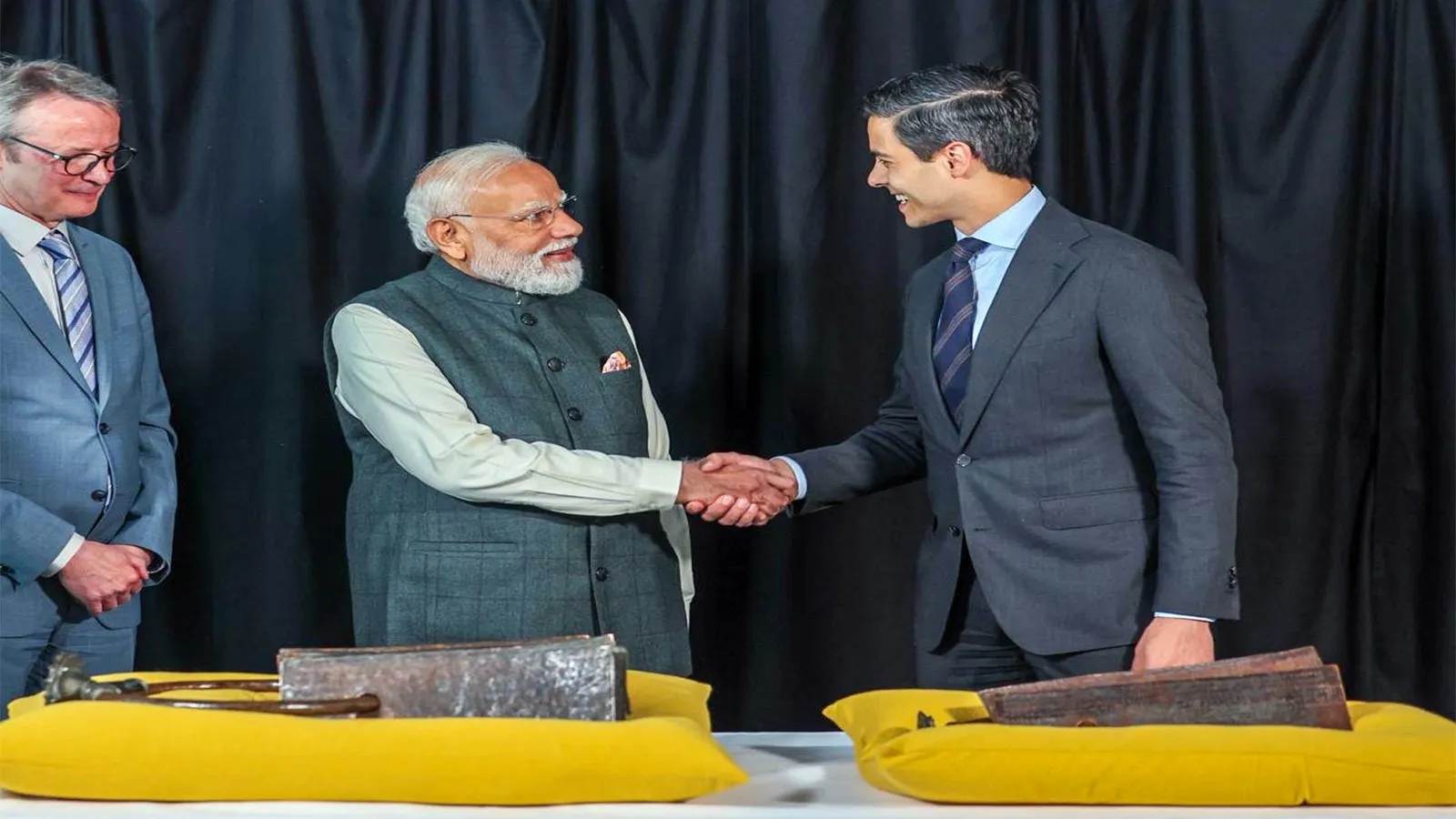
Why did the Netherlands return the Chola-era copper plates to India? What do these inscriptions reveal about one of Asia’s greatest maritime powers? And why are the Cholas increasingly relevant to India’s modern Indo-Pacific vision?
The return of the Chola copper plates is more than a cultural event. The inscriptions document the achievements, maritime reach, governance, and international connections of the Chola Empire, one of Asia’s most influential powers. Their return reflects India’s broader effort to reclaim civilizational heritage while reconnecting modern strategic thinking with its historical maritime legacy.
When Prime Minister Narendra Modi highlighted the return of the Chola copper plates during his latest Mann Ki Baat address, the announcement attracted attention far beyond the world of archaeology. The plates, recently returned by the Netherlands, are not merely historical artefacts. They are records of a period when the Chola Empire emerged as one of the most powerful maritime and commercial forces in Asia.
For India, their return represents both the recovery of a lost chapter of history and a reminder that the country’s engagement with the wider Indo-Pacific did not begin in the modern era. Centuries before European colonial powers entered the Indian Ocean, the Cholas were projecting influence across maritime trade routes stretching from South India to Southeast Asia.
Why It Matters
- The copper plates provide rare insights into Chola governance, trade networks, and maritime influence.
- Their return is part of India’s wider effort to recover historically significant artefacts from overseas collections.
- The Cholas were among Asia’s most influential maritime powers, connecting India to Southeast Asia through trade and diplomacy.
- The story aligns with India’s growing focus on the Indo-Pacific and the Indian Ocean Region.
- Cultural diplomacy is increasingly becoming an important element of international relations.
What Are the Chola Copper Plates?
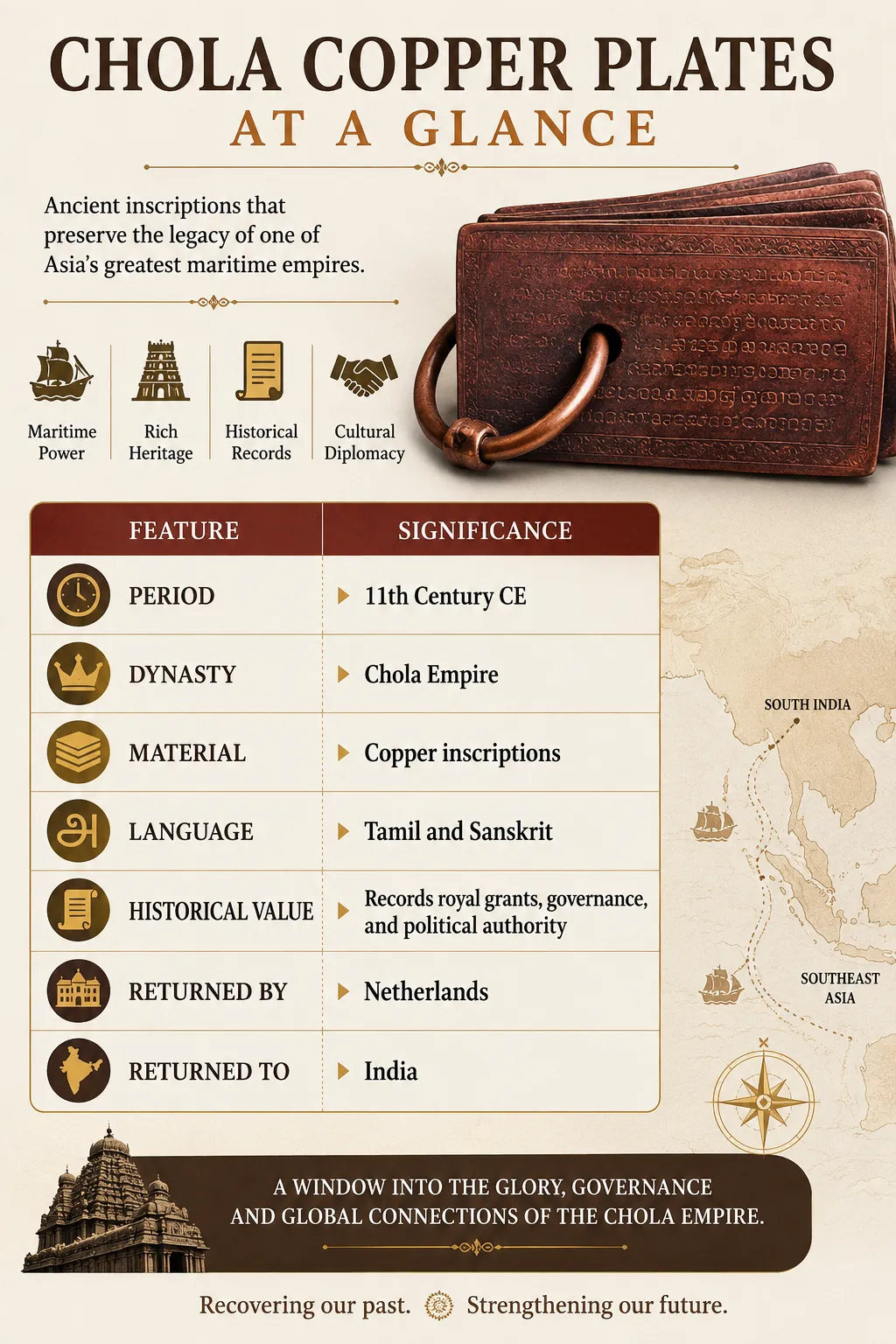
The returned copper plates are a collection of royal inscriptions dating back to the 11th century CE during the height of the Chola Empire.
Chola Copper Plates at a Glance
| Feature | Significance |
|---|---|
| Period | 11th Century CE |
| Dynasty | Chola Empire |
| Material | Copper inscriptions |
| Language | Tamil and Sanskrit |
| Historical Value | Records royal grants, governance, and political authority |
| Returned By | Netherlands |
| Returned To | India |
These inscriptions contain valuable information about royal decrees, land grants, religious institutions, administration, and social structures. Historians regard such copper plate inscriptions as some of the most reliable primary sources for reconstructing medieval Indian history.
Who Were the Cholas?
The Chola Dynasty was one of the most powerful and enduring empires in Indian history.
Under rulers such as Rajaraja Chola I and Rajendra Chola I, the empire expanded across much of South India and established influence throughout the Bay of Bengal. The Cholas were not only military rulers but also administrators, temple builders, traders, and naval strategists.
The Chola Empire’s Key Achievements
| Area | Achievement |
|---|---|
| Governance | Advanced administrative system |
| Architecture | Brihadeeswarar Temple and other monumental structures |
| Maritime Power | One of Asia’s strongest naval forces |
| Trade | Extensive Indian Ocean commercial networks |
| Diplomacy | Connections with Southeast Asian kingdoms |
| Culture | Patronage of Tamil literature and art |
Their influence extended well beyond the Indian subcontinent, linking India with Sri Lanka, present-day Indonesia, Malaysia, Thailand, and other parts of Southeast Asia.
Why Are Historians Interested in the Cholas’ Maritime Power?
The Cholas were among the few Indian dynasties that systematically projected power across the sea.
Their naval expeditions demonstrated an ability to protect trade routes, secure commercial interests, and maintain influence across key maritime corridors. At a time when much of global commerce moved through the Indian Ocean, the Cholas emerged as a dominant regional force.
The empire’s prosperity depended not only on territorial control but also on its ability to connect ports, merchants, and markets across Asia.
This maritime dimension explains why modern scholars increasingly describe the Cholas as one of the great sea powers of the medieval world.
Why Is the Return of the Copper Plates Significant Today?
The return of the copper plates forms part of a broader effort by India to recover cultural and historical artefacts that left the country during different periods of history.
Beyond their historical value, such returns carry symbolic importance.
They reinforce cultural ties, strengthen diplomatic cooperation, and contribute to the preservation of historical memory. The return also reflects growing international recognition of the importance of restoring significant artefacts to their countries of origin.
For India, the plates are not simply museum pieces. They are documents that help illuminate a period when Indian influence extended far beyond the subcontinent.
Is Modern India Rediscovering Its Maritime Heritage?
The renewed interest in the Cholas comes at a time when India is placing increasing emphasis on the Indian Ocean Region and the Indo-Pacific.
Today, policymakers speak of:
- Maritime security
- Regional connectivity
- Trade corridors
- Blue economy initiatives
- Naval modernisation
- Strategic partnerships across Southeast Asia
While the geopolitical realities of the twenty-first century differ greatly from those of the medieval world, the Chola experience demonstrates that maritime engagement has deep historical roots in India.
The empire’s success was built on connectivity, commerce, diplomacy, and naval capability—concepts that remain relevant in contemporary strategic discussions.
Why Do the Chola Copper Plates Matter Beyond History?
The significance of the copper plates extends beyond archaeology.
They provide evidence that India’s historical engagement with Asia was not passive. The Cholas actively shaped commercial networks, influenced regional politics, and participated in the exchange of ideas, goods, and culture across maritime Asia.
In an era when countries increasingly look to history to understand their strategic identity, the plates serve as a reminder of India’s longstanding role in the wider Asian world.
Why did the Netherlands return the Chola copper plates?
The return was part of cultural cooperation and efforts to restore historically significant artefacts to their country of origin.
Who were the Cholas?
The Cholas were one of South India’s most powerful dynasties, known for their administrative sophistication, temple architecture, maritime influence, and extensive trade networks.
Why are the copper plates historically important?
They contain inscriptions that document royal authority, governance, social structures, and international connections during the Chola period.
Strategic Outlook
The return of the Chola copper plates is not merely the recovery of an ancient artefact. It is the recovery of a historical memory.
At a time when India is seeking a larger role in the Indo-Pacific, the inscriptions serve as a reminder that maritime influence, commercial connectivity, and regional engagement are not new concepts in Indian statecraft. Long before the arrival of European empires in Asia, the Cholas demonstrated how naval power, economic networks, and cultural influence could project Indian presence across the wider region.
The copper plates therefore tell two stories simultaneously. One is about the achievements of a medieval empire. The other is about how modern India increasingly views its place in the world: as a nation reconnecting with a civilizational legacy that once linked the Indian subcontinent to the broader maritime landscape of Asia.