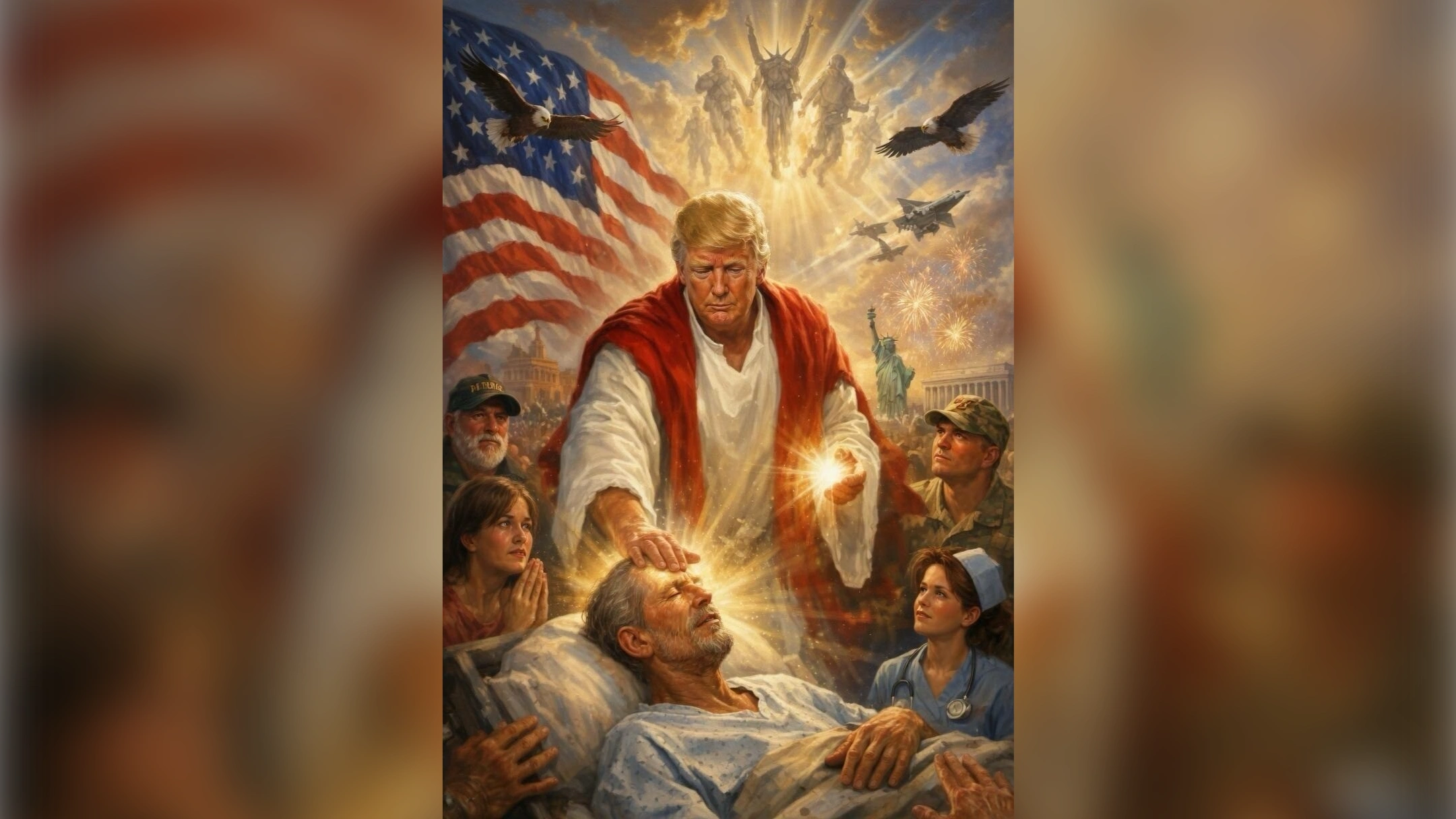
Trump posted an image that looked like a messiah. But the real story is darker: a U.S. blockade around Iranian ports could pull China deeper into the crisis, send oil prices higher, hit India through inflation, and push the world closer to a wider war.
Donald Trump’s latest image may become the perfect symbol of this crisis. In the picture he shared, he appears almost like a holy healer — raised hand, glowing light, calm face, a grand scene built to suggest power and destiny. It is the visual language of a man who wants to look chosen. But the reality in the Strait of Hormuz is very different. This is not the politics of healing. This is the politics of pressure, power and possible miscalculation.
That is what makes this moment so dangerous. A leader trying to look like a messiah is now tied to a naval move that could hit oil supply, freight costs, inflation, jobs and the energy security of billions of people far from the Gulf. India, China, Japan, South Korea and much of Asia may not be part of the battlefield, but they would still pay the price if this crisis gets worse.
What the U.S. has actually done
The U.S. military has announced a blockade focused on Iranian ports after the failure of talks in Islamabad. In simple words, ships going to or coming from Iranian ports in the Arabian Gulf and Gulf of Oman are now the target. The official line is that ships heading to non-Iranian Gulf destinations can still use the Strait of Hormuz. So Washington is not trying to shut the whole waterway to all traffic. It is trying to choke Iran’s port access while claiming that normal traffic to other Gulf states can continue.
But this neat distinction is exactly where the danger starts. On paper, “Iran-bound traffic only” sounds limited. At sea, it can quickly become messy. Warships do not operate in a spreadsheet. They operate in crowded waters, under stress, around nervous tankers, drones, patrol craft and rival forces. One wrong approach, one warning shot, one boarding attempt, one radar lock, one helicopter flying too close — and the situation can jump from pressure to crisis.
1) America says other Gulf shipping can still pass.
2) But any ship linked to Iranian ports could face interception.
3) If a Chinese-linked ship is stopped, this becomes much bigger than an Iran story.
4) Then oil, markets and war risk all move together.
Why China is the real pressure point
This crisis is not only about Tehran. It is also about Beijing. China remains the biggest buyer of Iranian crude. That means Iran’s oil trade is not just a regional issue. It is tied directly to China’s energy security and to the wider strategic contest between Washington and Beijing. If the U.S. starts stopping ships linked to Iranian trade, China cannot treat that as a small local problem.
This part is important to understand in very simple terms. If America pressures Iranian shipping, and Chinese-linked cargoes are caught in that pressure, then China will see this not only as anti-Iran action but also as a challenge to its own trade rights and energy access. That changes the mood completely. Now the question is no longer only “What will Iran do?” The real question becomes “How long will China stay patient if its oil lifeline is threatened?”
How China is likely to react
China’s first reaction will probably not be dramatic. Beijing usually starts with controlled language. It will likely condemn unilateral escalation, call for restraint and avoid sounding emotional. But calm words should not be mistaken for weakness. China has too much at stake to simply watch forever. It may begin with diplomacy and back-channel pressure, but if Chinese-linked vessels are directly challenged, Beijing will come under strong pressure to show presence.
That presence does not have to mean immediate war. China can increase surveillance, intelligence support, naval escort activity, political coordination with other powers, and public signalling that it will not accept American control over its energy access. Even a limited Chinese maritime posture near the crisis zone would sharply raise the temperature. Once two major powers begin shadowing the same shipping lanes in a war atmosphere, every encounter becomes a possible flashpoint.
Analysts broadly expect a standoff risk more than an instant full war. That is still dangerous enough. Great-power crises do not always begin with big speeches and missiles. They often begin with ego, misreading and small moves that suddenly become impossible to reverse. Hormuz is exactly the kind of place where one “small” incident can produce very large consequences.
What a bad scenario looks like
Imagine the chain clearly. A vessel linked to Iranian trade moves toward port. A U.S. warship challenges it. Another ship stays close. A drone appears overhead. Iran issues a warning. China says the vessel has lawful commercial status. Insurance prices jump. Oil traders panic. Markets start pricing in a wider conflict. In that situation, even if nobody wants a big war, the crisis begins to feed itself.
This is why the fear of a wider war is not exaggeration. The Strait of Hormuz is one of the world’s most important energy chokepoints. If tension there remains high for days or weeks, the impact will not stay limited to military circles. It will hit pump prices, LPG costs, shipping bills, manufacturing inputs and household budgets. India is not the target of this blockade, but Indian families would still feel the pain if oil and transport costs stay high.
- Higher crude prices can push up inflation.
- LPG supply from the wider Gulf region can face stress.
- Freight and insurance costs can rise.
- The rupee can come under pressure if energy bills climb.
- Stock markets can turn nervous when war risk rises.
Why India is better placed than China — but not safe
India’s position is different from China’s. New Delhi has spent years diversifying energy supply and reducing dependence on Iran itself. That gives India more room than China right now. But diversification does not mean total safety. India still depends heavily on imported energy, and a Hormuz shock would still push costs higher even if the supply basket is broader than before.
In simple terms, India is less trapped than China in the Iran question, but India is still exposed to the wider oil and shipping consequences. That means New Delhi may not react like Beijing, but India still has every reason to watch this crisis very closely. The route matters, prices matter and market psychology matters.
The biggest strategic question for Washington
There is also a deeper weakness in the U.S. strategy. After weeks of war and failed talks, Iran has still not bowed. Tehran has not accepted Washington’s terms. That matters because it raises a brutal question: if the U.S. is still struggling to force a satisfactory outcome against Iran, how does it plan to manage the next phase if China starts pushing back too?
This is where Trump’s gamble may become self-defeating. A move meant to show strength can end up multiplying fronts of tension. Instead of isolating Iran, it could harden Iran, pull China deeper into the crisis, shock oil markets and leave the U.S. carrying the burden of an open-ended naval confrontation in one of the world’s toughest maritime theatres.
Final word
Trump’s “messiah” image projects certainty. But the Hormuz blockade projects something else: risk. Risk of higher oil prices. Risk of inflation. Risk of shipping disruption. Risk of a military standoff with China. Risk of one miscalculation at sea turning into a much larger crisis.
That is the real story here. Not the pose. Not the optics. Not the performance. The real story is that one blockade, sold as a limited move, could become a strategic chain reaction. And once that chain reaction starts in Hormuz, the cost will not be paid only by warships in the Gulf. It will be paid by ordinary people across Asia, including in India.
Recommended internal reading
- Strait of Hormuz Geopolitical Guide
- Why the failed U.S.-Iran talks pushed Hormuz shipping risk back into focus
- Seven big ways the U.S.-Iran ceasefire has reshaped the regional picture
- How Pakistan’s role in the U.S.-Iran talks could trigger a global oil shock