Macroeconomics & Markets | Special Report
Imagine your entire neighborhood is dealing with a massive power cut, severe water shortage, and a street fight, but your house somehow has full electricity, a running AC, and a fresh cup of tea waiting for you.
That is exactly how the global economy looks right now. We are sitting in April 2026. US warships are blocking Iranian ports. The Middle East is a powder keg. Europe is shivering from high energy bills. Yet, the International Monetary Fund (IMF) just dropped its latest World Economic Outlook, and it paints a picture that should make every Indian sit up and pay attention.
While the world is busy surviving, India is busy growing. But why? Let’s break down the heavy financial jargon into plain English.
The Brutal Scorecard: India vs. The World
If the global economy was a school report card, the West is barely getting passing marks, while India is the kid ruining the curve for everyone else. Let that sink in. Countries like the UK and Germany—places we traditionally looked up to for wealth—are practically frozen. Their citizens are dealing with brutal cost-of-living crises, a topic we recently explored in our analysis of how the Hormuz crisis became a daily financial shock.
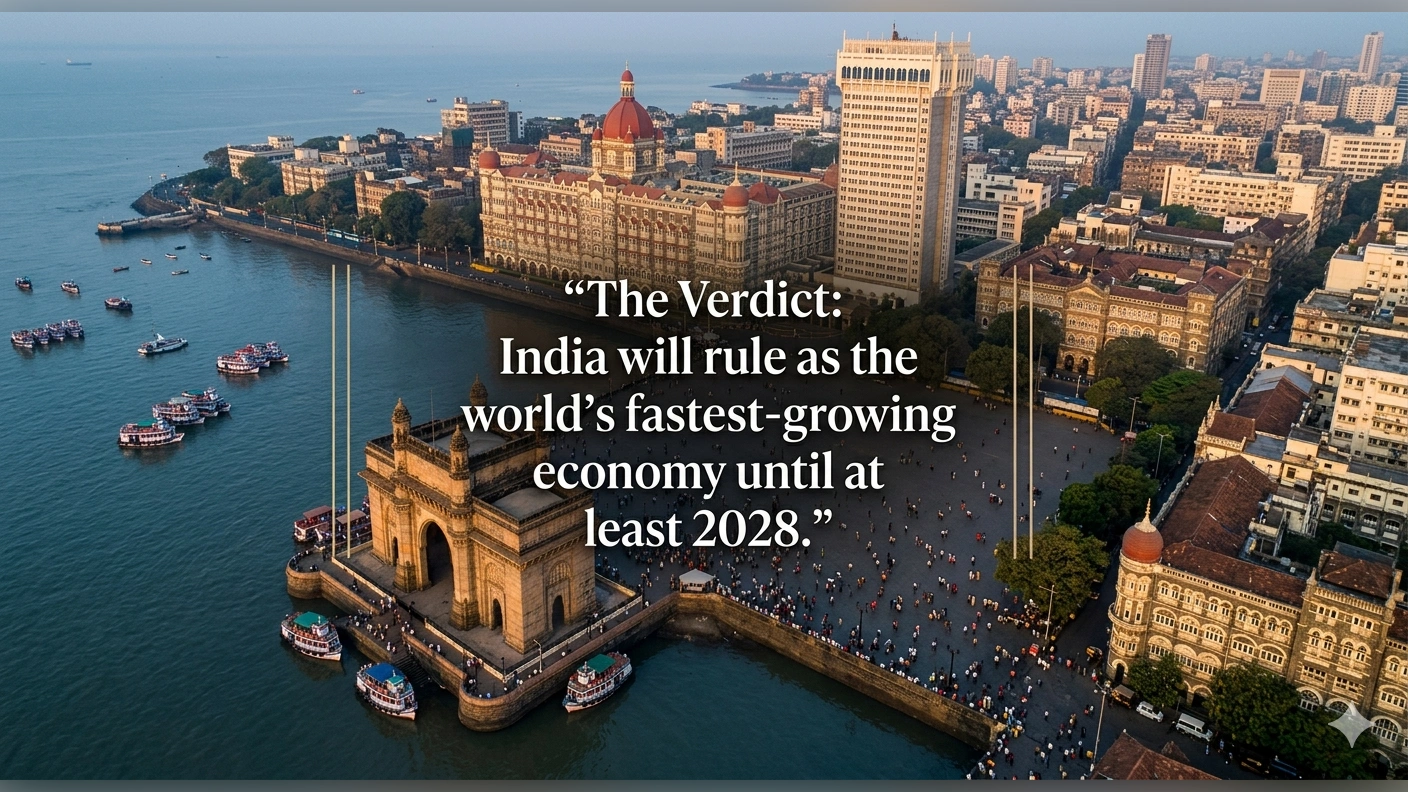
Meanwhile, India is cruising at 6.5%, retaining its crown as the fastest-growing major economy on the planet. And as for China? The dragon is officially out of breath, struggling with massive internal economic fractures. You can see the geopolitical fallout of this in our piece on why China’s silence in the Gulf actually matters.
A Scary Secret: The World is Drowning in Debt
Here is a fascinating, yet terrifying fact from the IMF report that most mainstream news channels are ignoring:
Global Debt Alert
By the year 2029, global public debt is projected to hit an unprecedented 100% of the world’s GDP.
What does that mean in simple terms? It means the world owes as much money as it actually produces. It’s like earning ₹1 lakh a year but having a credit card bill of exactly ₹1 lakh. According to data tracked by Bloomberg and the IMF, the United States and China are the biggest culprits, borrowing money recklessly to keep their economies from collapsing.
India, on the other hand, is managing its household budget much better. We aren’t building our growth on a mountain of dangerous foreign debt. We are building it on our own people.
Why is India Defying Gravity?
You might ask, “If the world is crashing, why are we flying?” It comes down to three massive safety nets:
1. We Buy Our Own Stuff
Look around you. The malls are full, UPI is pinging every second at the local vegetable vendor, and millions of cars are being bought. We have 1.4 billion people consuming goods daily. When global trade takes a hit, our massive domestic market acts like a giant shock absorber.
2. The “China Plus One” Jackpot
The world is tired of relying on China. Add the current geopolitical mess, and big global companies are desperately looking for a backup plan. India is rolling out the red carpet. Factories are shifting, and ‘Make in India’ is no longer just a slogan; it is becoming a survival tactic for Western brands.
3. The Digital Backbone
No country has digitized its street-level economy like India. From highway FASTags to instant loans on your smartphone, business moves faster here now than it did a decade ago.
🌍 READ IN HINDI: THE ASIAN POWER TRIANGLE
How is the massive clash between America, Iran, and China directly impacting India’s economy and foreign policy? Our Hindi editorial desk breaks down the geopolitics for you.
Read the full analysis here: होरमुज़ संकट: चीन, अमेरिका, ईरान और एशिया पर इसका सीधा असर
The Elephant in the Room: The Iran War Impact
Now, let’s be totally honest. It is not all sunshine and roses. The Indian middle class is feeling the heat, and the culprit is sitting in the Persian Gulf. As we previously warned in our breakdown of the Trump-era Hormuz blockades, any chokehold on the Middle East spells trouble for the East.
With the US Navy blocking Iranian ports, the global oil market is having a panic attack. India imports over 80% of its oil. When crude prices threaten to cross $100 a barrel, the math gets ugly for us. High oil prices mean expensive transport, which means expensive tomatoes, onions, and milk.
This is imported inflation. The IMF downgrade for the rest of the world directly ties to this war. But here is the difference: while a country like the UK is seeing its growth completely wiped out by this energy shock, India’s core engine is so strong that we are absorbing the hit and still projecting 6.5% growth. The war is a speedbreaker for us, but it is a brick wall for Europe.
Where is the Real Money Hiding?
If the country is growing, where is the action actually happening? If you are looking at where jobs and wealth will be created in the next three years, keep your eyes on these sectors:
- Defense & Aerospace: The US-Iran standoff just taught the world a hard lesson—you cannot depend on others for weapons. India is aggressively pushing to manufacture defense equipment locally. This sector is sitting on massive growth room.
- Green Energy & EVs: Every time oil prices shoot up because of Middle East drama, the government pushes harder for solar, wind, and electric vehicles. Moving away from imported oil is now a matter of national security.
- Infrastructure & Real Estate: Roads, ports, and housing. The government is spending heavily on capital expenditure, keeping the cement and steel sectors booming.
The Ground Reality
As a journalist who has watched markets rise and crash for two decades, I will tell you this: statistics don’t pay your grocery bills. The 6.5% growth figure might feel like a joke when you are paying a heavy price for a liter of petrol today.
However, perspective matters. Yes, the common Indian is fighting daily inflation. But step outside our borders, and you will see a world on the edge of a severe recession. Jobs are vanishing in Europe, and China’s golden era is fading fast.
We are navigating a global storm. But unlike the past, India isn’t in a fragile wooden boat anymore. We are in a heavy-duty cruiser. The waters are rough, and you will definitely feel the bumps, but we are moving forward faster than anyone else on the map.