
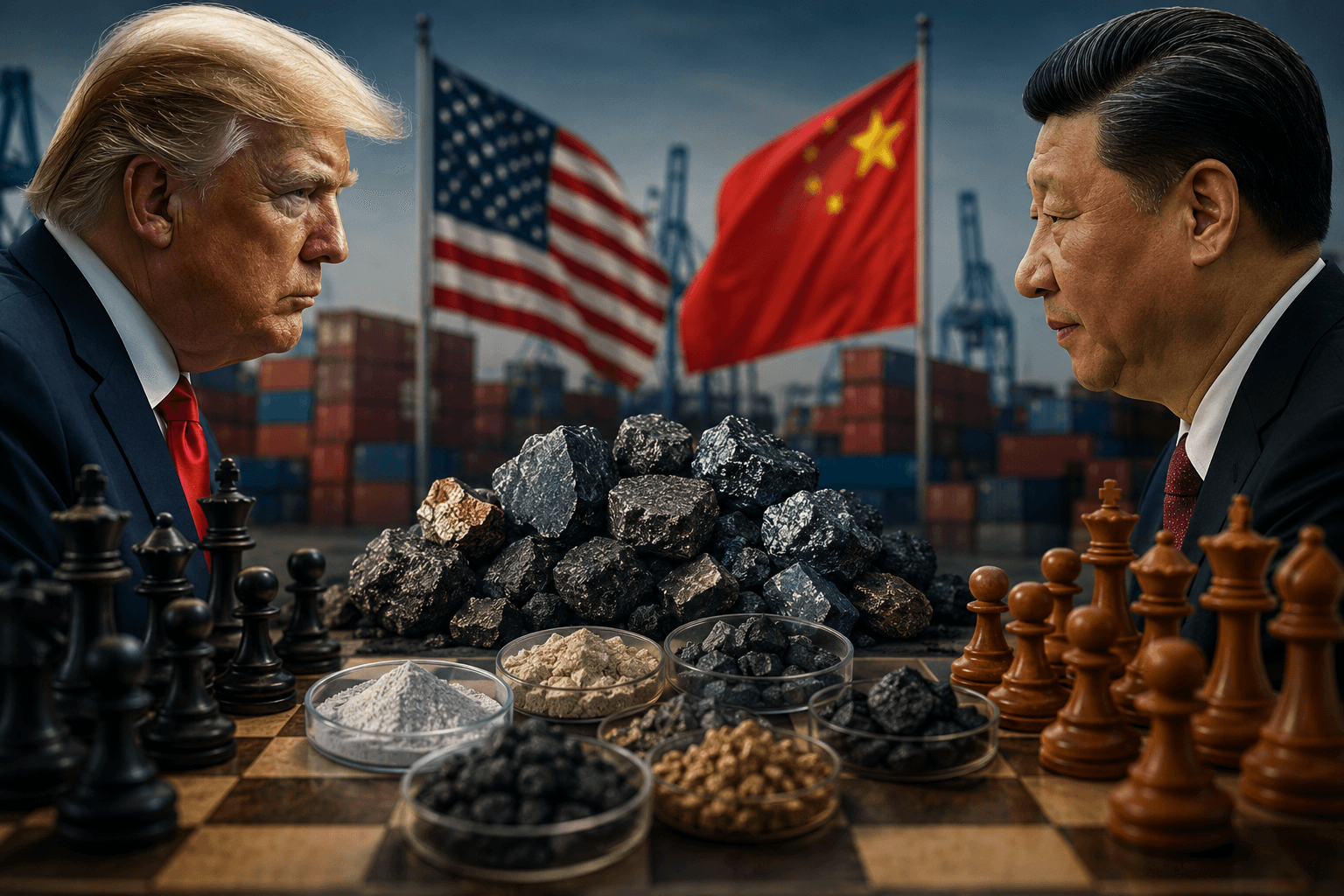
The growing battle over critical minerals is quietly reshaping the U.S.–China relationship.
Most of the attention around the Trump–Xi summit in Beijing has focused on tariffs, Taiwan and the broader effort to stabilise relations between the world’s two largest economies.
But another issue has quietly moved closer to the centre of the talks: rare earths and the industrial supply chains built around them.
U.S. officials have spent months trying to preserve access to Chinese rare earth exports even as tensions over trade and technology continue. Ahead of the summit, Reuters reported that both sides were discussing a possible extension of the current rare earth truce, though restrictions on several key materials remain in place.
The concern in Washington is straightforward. China remains dominant in the processing and refining of several rare earth elements used in semiconductors, defence systems, electric vehicles and advanced electronics.
Export controls introduced by Beijing in 2025 hit some materials particularly hard. Chinese customs data cited by Reuters showed exports of yttrium, dysprosium and terbium — heavy rare earths used in aerospace, magnets and military applications — were still down roughly 50% from earlier levels.
The effects have spread beyond the United States.
Japan and Germany have both reported disruptions linked to reduced supplies, while some aerospace manufacturers faced delays after shortages of specialised components. Prices for certain heavy rare earths have risen sharply since the restrictions were introduced.
That has changed the tone of the U.S.–China economic debate.
During Trump’s first term, much of the discussion revolved around tariffs and relocating manufacturing out of China. The current pressure point is narrower and more difficult to solve. Western companies are still deeply dependent on Chinese refining networks and industrial suppliers despite years of diversification efforts.
Reuters reported this month that many firms slowed relocation plans after trade tensions eased and supply chains stabilised. Some manufacturers that expanded into Vietnam, Thailand or India still remain heavily reliant on Chinese suppliers for components and processing capacity.
The broader supply chain debate is increasingly linked to military and strategic concerns. China’s growing leverage over critical industrial systems has already become visible in sectors tied to aerospace and stealth technology — an issue explored earlier by TES in its analysis of China’s YLC-8B radar and the future vulnerability of stealth aircraft .
Rare earth materials sit inside guidance systems, radar equipment, fighter aircraft, drones and advanced semiconductors. The same supply chains also underpin electric vehicles, renewable energy infrastructure and AI hardware.
For both governments, the issue is increasingly strategic rather than commercial.
The Trump administration wants stable access to critical minerals and fewer disruptions to industrial supply chains. Beijing, meanwhile, is seeking relief from U.S. export controls targeting advanced chips and technology.
Neither side appears close to a broader settlement. But both have reasons to avoid escalation.
That is visible in the language coming out of the summit. Xi Jinping warned Trump that mishandling Taiwan could push relations into a “dangerous” direction, while both governments publicly described the talks as constructive and stable.
At the same time, G7 countries have accelerated discussions on alternative critical mineral supply chains as concerns over dependence on China grow.
India is part of that conversation more often now than it was a few years ago.
Washington and its allies increasingly view India as a possible manufacturing and technology partner as companies look to diversify parts of their supply chains. New Delhi has also pushed aggressively into semiconductor assembly, electronics production and defence manufacturing.
The conversation also overlaps with larger questions surrounding maritime trade chokepoints and global shipping vulnerability. TES recently examined how alternative trade corridors could reshape Asian logistics in its report on the Kra Isthmus land bridge and the future of the Malacca Strait .
Energy security remains another parallel pressure point. Any prolonged disruption involving China, Taiwan or maritime trade routes would inevitably place renewed focus on critical energy chokepoints such as Hormuz — a subject TES explored in its analysis of why the Strait of Hormuz cannot remain closed for long .
But replacing China’s refining dominance is a far more complicated task than shifting final-stage assembly lines. Processing ecosystems take years to build and depend on specialised infrastructure, technical expertise and long-term investment.
According to the Reuters report on the Trump–Xi rare earth discussions , Chinese export controls continue to affect multiple industrial sectors despite broader efforts to stabilise trade ties.
The wider concern is now openly discussed across Western policy circles. A recent G7 discussion on critical mineral supply chains highlighted how dependence on Chinese processing capacity has become a strategic issue rather than a purely economic one.
For now, neither side appears ready for a full economic break. The summit has instead highlighted how the relationship has changed. Tariffs remain part of the dispute. The more sensitive issue is the industrial dependence underneath it.

3 thoughts on “The Hidden Front in the Trump–China Summit: Rare Earths, Missiles and Supply Chains”