
In December 2025, IndiGo cancelled approximately 4500 flights, affecting over ten lakh passengers across airports, due to non-compliance with the revised Flight Duty Time Limitation (FDTL) regulations. It faced a fine of ₹22.2 crore from the DGCA. This was not a black swan event, as the regulator had announced new pilot rest rules in January 2024. IndiGo had all the information it needed; however, it simply chose not to act on it.
I spent 21 years in the Indian Army before transitioning to 18 years in corporate leadership, most recently as Executive Vice President of Corporate Governance. Across my Army and Corporate careers, I have seen the same pattern – the decisions that destroy organisations are rarely made under conditions of ignorance. They are made under conditions of denial. The information is available and the signals are clear. But the CXO-level thought process – shaped by a brain wired by evolution for pattern-matching, loss aversion, and the comfort of the status quo – filters out precisely the most critical data.
This is less about stated intent and more about the way human judgment responds to uncertainty and pressure. It is the reason I believe that the single most underdeveloped competency in Indian boardrooms today is not strategy, technology, finance, or marketing. It is the act of deciding itself, as that is not formally taught in any business school.
Deciding in the Fog of Uncertainty
Most senior executives have been trained extensively in functional disciplines. They can read a balance sheet, build a go-to-market strategy, integrate technology to address business challenges, and negotiate a joint venture. But almost none have been trained in how to make a decision in a high-pressure environment – when stakes are high, data is incomplete, the clock is running, and the consequences are irreversible. In military terms, it is the difference between having a battle plan and adapting it when the terrain suddenly changes.
The military has spent centuries developing frameworks for exactly this problem – deciding under uncertainty with lives at stake. These frameworks are not theoretical. They have been tested under fire, refined through failure, and institutionalised through doctrine. They translate directly to the corporate arena, where the stakes are increasingly measured in billions of rupees, regulatory shutdowns, and institutional collapse.
Why Experienced Leaders Misread Situations
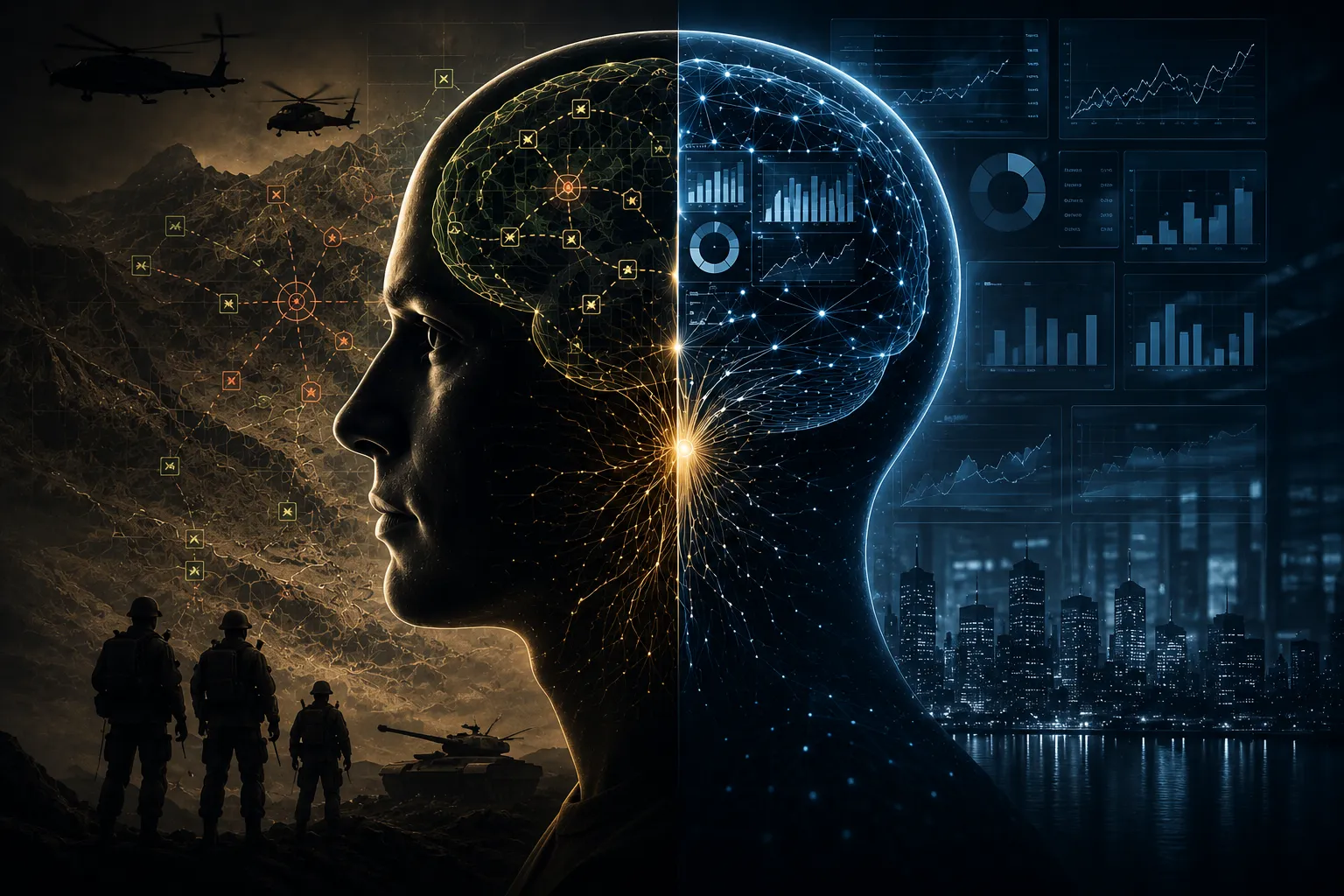
To understand any crisis situation, which has been mishandled, like in the case of IndiGo, you need to understand how the human brain functions under pressure. When the amygdala – the brain’s threat-detection centre – perceives danger, a neurochemical cascade floods the system with cortisol and adrenaline. This primal survival response effectively suppresses the prefrontal cortex, the region responsible for rational analysis and long-term strategic thought.
Consequently, the mind shifts from slow, analytical, deliberate thinking (System 2) to fast, intuitive, pattern-matching (System 1). This transition happens in milliseconds, well before conscious awareness can intervene. Such “tunnel vision” explains why even seasoned professionals may fall into cognitive traps like confirmation or normalcy bias, filtering out critical warnings in favour of familiar routines.
Daniel Goleman called this the amygdala hijack. Under sustained pressure, the brain defaults to confirmation bias (seeking only data that supports existing beliefs), normalcy bias (assuming the current situation will persist), and risk normalisation (treating small violations without consequence as acceptable practice).
The OODA Loop: Why Orientation Is Where Leaders Fail
Colonel John Boyd, a US Air Force fighter pilot and military strategist, developed the OODA Loop – Observe, Orient, Decide, Act, as a framework for competitive decision-making. Boyd’s central insight was that the side that is able to compress the OODA loop faster than its adversary gains a compounding advantage. But speed alone is not the point. The critical stage is Orient – making meaning out of raw information by applying
experience, context, and judgment. Most organisations are good at collecting information, but not always at interpreting what it means.
The military teaches a principle I call the 70% Rule: when you have 70% of the information you need, act. Today, when we are operating in a volatile, uncertain, complex and ambiguous (VUCA) world with fast-evolving situations, delayed decisions often create bigger problems than imperfect ones. IndiGo had far more than 70% of the information, nearly two years of it. But having information and acting on it are separated by orientation, and orientation is where cognitive biases do their damage.
Mission Command: Intent vs Optimisation
The second framework that transforms corporate decision-making is Mission Command – what the military calls Commander’s Intent. The principle is deceptively simple: tell people the what and the why
, but don’t micromanage the how. Good leadership is all about communicating the intent clearly to the team, in which the objective, its importance, and the boundary conditions are all articulated without ambiguity. Within this framework, the team has the freedom to use their judgment.
This approach works because real life is unpredictable. Plans unravel the moment they meet reality. In the armed forces, it is assumed that nothing ever works like you plan. All plans fall apart as soon as the first bullet is fired. As such, people on the ground who are closest to the situation need the confidence and authority to adapt and act – not wait endlessly for instructions. If every decision must flow upward through a hierarchy, the organisation’s OODA loop slows down. Mission Command distributes decision authority to the leaders closest to the problem, thereby compressing the OODA loop.
Reliance Industries demonstrated a leadership approach during the COVID-19 crisis that closely reflected the military principle of Mission Command. At the peak of the oxygen shortage, the organisation moved away from lengthy approval cycles and focused on a single clear objective – rapidly converting existing industrial capability into life-saving support. Engineers at the Jamnagar refinery were given the flexibility to solve problems on the ground instead of waiting for detailed central instructions. As conditions evolved,teams adapted quickly, scaling production from zero to 1,000 MT of medical-grade oxygen per day and eventually contributing nearly 11% of India’s oxygen supply.
RIL further proved the power of a compressed OODA loop by building a dedicated 1,000-bed COVID hospital in Jamnagar, with the first 400 beds operational within five days and scaling to 1,000 beds within three weeks. This was not about having perfect information; it was about the ‘70% Rule’ – acting decisively when the cost of delay far outweighed the risk of an imperfect plan. The response showed how organisations can move faster during crises when leadership provides clarity of purpose, trusts frontline teams, and allows decisions to be taken close to the problem.
Strengthening Judgment Under Pressure
These frameworks are practical tools that organisations can apply in real situations. They are tools that can be institutionalised. In my experience, the organisations that make consistently good decisions under pressure share three characteristics. First, they practise red teaming, formally appointing a protected group whose job is to attack their own strategy and surface the assumptions that could kill them and identify what could go wrong. In my 18 years across Indian conglomerates, I have seen that the most dangerous moments aren’t during the crisis, but in the ‘quiet’ periods when overconfidence prevents anyone from asking: ‘What if we are completely wrong?’ Second, they run pre-mortems before every major decision: “Imagine it is one year from now and this project has failed spectacularly. Write down every reason why.” Research by Mitchell, Russo, and Pennington – the cognitive science foundation behind Gary Klein’s pre-mortem technique – shows this technique increases the ability to identify reasons for future outcomes by 30%. Third, they maintain decision journals, structured recording of the decision, the alternatives considered, the information available, and the expected outcome before the outcome is known. A good decision can produce a bad outcome. A bad decision can produce a good outcome. Without documenting decisions properly, organisations often confuse good outcomes with good judgment.
The Training Deficit
There is a saying in the military that I have carried into every boardroom I have entered: you do not rise to the level of your expectations; you fall to the level of your training. Indian business leaders operate in a VUCA environment that is increasingly contested, adversarial, and subject to sudden disruption. Geopolitical tensions, cyberattacks, regulatory surprises, and AI-driven disruption are changing the landscape faster than many organisations can absorb. Decisions that once took weeks now need to be made in hours, sometimes minutes. Waiting for perfect clarity before acting has become a serious liability. Organisations where every important decision must move through layers of centralised approval struggle to respond with the agility that crises demand.
The larger problem is that many leadership teams still rely on experience, instinct, and individual judgement alone when making critical decisions under pressure. While intuition has value, high-stakes environments also require disciplined thinking, structured processes, and composure amid uncertainty. Armed forces across the world have spent decades studying how people react under stress and how teams can stay aligned when situations change rapidly. The corporate world does not need to adopt military hierarchy, but it can certainly benefit from learning how disciplined decision-making, clarity of intent, and trust within teams help people perform better when the pressure is highest.
The real challenge is whether organisations develop these decision-making capabilities before they are tested under pressure. In every leadership workshop I conduct, I ask a simple question: when information is incomplete, pressure is mounting, and time is limited, how do you decide? Many organisations recognise weaknesses in decision making only after a crisis exposes them.
Col Sandeep Sudan, Retd.
Veteran leader with nearly four decades of experience across the Indian Army and India’s corporate sector, including senior leadership roles at Deepak Fertilisers, Reliance Industries, Mahindra & Mahindra, and Pinkerton. A Certified Fraud Examiner (CFE), he specializes in corporate governance, risk management, and strategic leadership.
Very well written article with indepth analysis of both the corporate and the military would.