
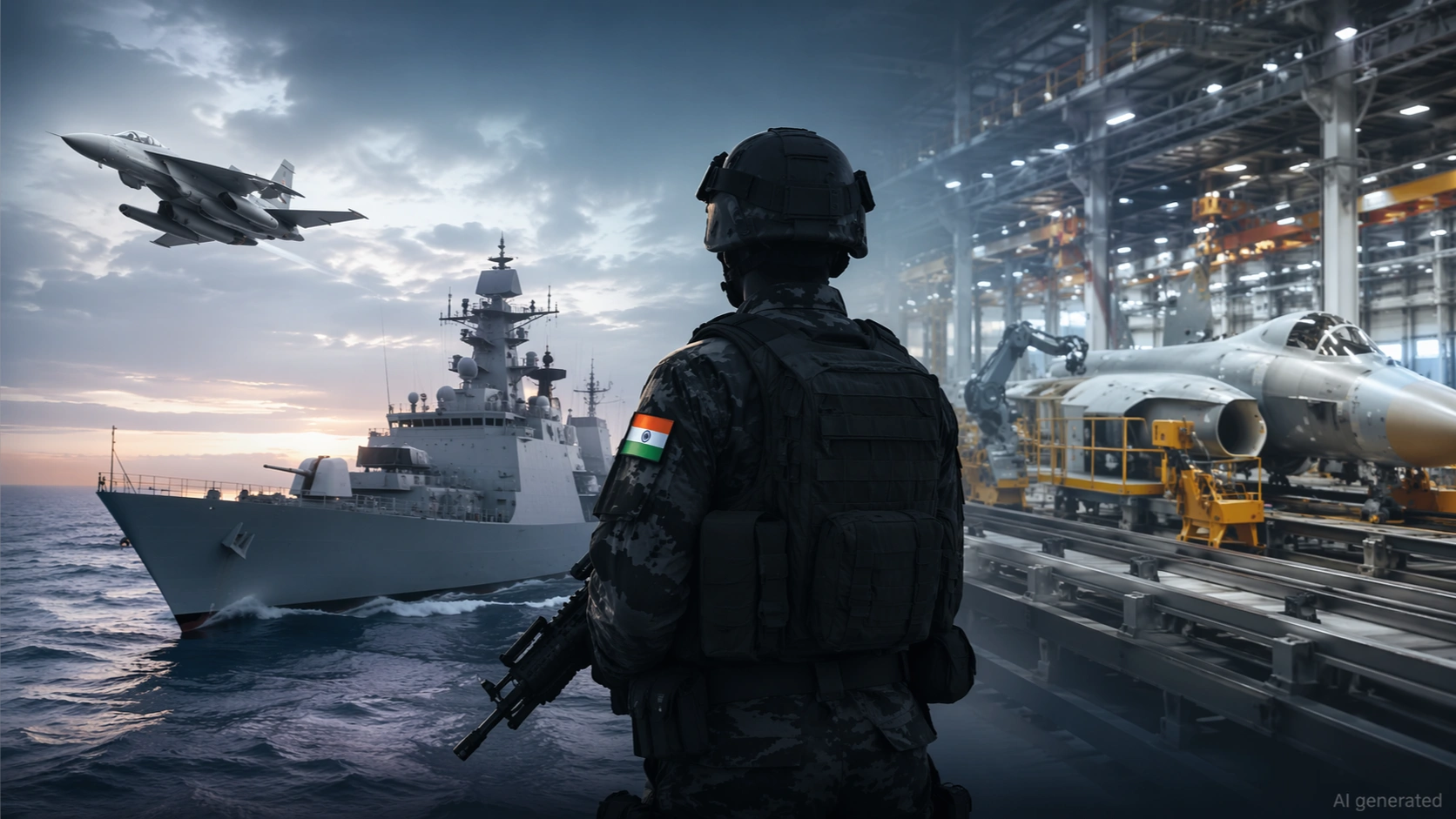
India 2035 defense superpower is no longer just a strategic phrase. It is becoming a real question because India’s economy is growing and its defence base is growing with it. If current projections broadly hold, India’s nominal GDP could reach around $11.3 trillion by 2035. Its purchasing power adjusted economy could move near $31.6 trillion, based on IMF linked estimates and the Lowy Institute’s Asia Power Index. India’s official 2026–27 defence allocation is ₹7.85 lakh crore. That is the highest so far. None of this makes India a military superpower today. It does show that New Delhi is building the base for a much larger defence role in the next decade.
India’s military rise looks more credible now because the money story is changing. No country becomes a major defence power without money, factories and the ability to keep spending through long cycles. India is trying to build all three at once. If that effort holds, the country could move far beyond being a large regional military. By 2035 it could start to look like a top tier military industrial power.
India’s problem is no longer a lack of ambition. The real problem is conversion. Can ambition turn into factories, supply chains, repair capacity and combat ready output? That is the harder test.
The implications go beyond South Asia. India sits across several strategic fault lines at once. There is the land balance with China. There is the Indian Ocean. There is also a wider Indo Pacific picture in which the United States, Europe and Japan increasingly see New Delhi as an important partner. Force size alone will not decide that role. The real test is whether India can turn growth and policy ambition into usable industrial and military power.
Why the India 2035 defense superpower debate matters
2035 matters because it is close enough for today’s choices to be judged. It is also far enough away for today’s industrial and budget decisions to produce visible results. The point is not that India will become a superpower overnight. The point is that the years from 2026 to 2035 may decide whether the country builds the foundations for one.
The economic story starts with growth. The IMF’s April 2026 World Economic Outlook still projects 6.5% real GDP growth for India. That keeps it among the fastest growing major economies. IMF data also show India’s current price GDP already above $4 trillion in 2026. That does not prove India will hit exactly $11.3 trillion by 2035. It does make that direction believable if growth holds and macro stability does not break. For the broader outlook you can refer to the IMF World Economic Outlook.
The longer range PPP estimate is larger still. The Lowy Institute’s Asia Power Index projects India’s purchasing power adjusted GDP in 2035 at roughly $31.62 trillion. PPP is not the best measure for buying imported weapons in dollar terms. So it should not be stretched too far. But it does say something important about the size of the domestic economy available to support infrastructure, labour, logistics, production and military maintenance. For the wider regional comparison see the Lowy Institute Asia Power Index.
Can India 2035 defense superpower ambitions be funded?
On paper, yes.
India’s official 2026–27 defence allocation is ₹7.85 lakh crore. The government says that is a 15.19% increase over the previous budget estimate. Not all of that will go into modernization. India still carries heavy salary, pension and maintenance costs. Those burdens continue to eat into capital spending. Even so, the direction is clear. New Delhi is creating more room for defence spending.
The old Indian defence problem has not disappeared. Bigger budgets do not automatically mean faster modernization. Too much money can still get trapped in manpower heavy structures. Meanwhile the harder requirements such as munitions, spares, engines, sensors and readiness move more slowly.
That is the real shift. Even if defence spending stays at a moderate share of GDP, the total pool of money can rise sharply as the economy expands. That changes the debate. The question is no longer only whether India can afford a larger modernization push. The question is whether it can spend better, build faster and turn budgets into readiness, production and deterrence.
That is the kind of problem rising powers face. It is harder than finding money. It is still a better problem to have.
What would make India look like a 2035 defense superpower?
Three things stand out. Scale. Self reliance. Technological depth.
First is scale backed by economics. India already has one of the world’s largest armed forces. It also occupies a strategic geography that stretches from the Himalayas to the Indian Ocean. What it has often lacked is the industrial and technological base needed to turn that size into faster and more flexible military power.
Second is defence self reliance. If India keeps reducing dependence on foreign suppliers for engines, munitions, electronics, maintenance chains and key subsystems, then the military profile of 2035 will look very different from the import heavy force structure India carried for much of the past. Domestic design, production, repair and upgrade capacity matter because wartime staying power depends on them.
This is where many defence claims get tested. India has become better at building around imported cores. The harder challenge is mastering the things that are least visible in press releases and hardest to replace in war. Engines. Seekers. Advanced electronics. Special materials. Deep subsystem integration.
Third is technology absorption. Serious military industrial powers do not emerge by assembling imported platforms alone. They emerge by mastering propulsion, materials, sensors, software, guidance systems and precision manufacturing. That is why aerospace engines, shipbuilding, missile systems, drones, satellites and electronics matter so much.
Where could India 2035 defense superpower plans still fall short?
This is where the story gets harder.
India’s rise is real. But it is not guaranteed. At least four problems could slow or distort the 2035 picture.
Defence transformation looks clean on paper. In practice it gets slowed by procurement culture, uneven industrial depth and the gap between announcement and output.
The first problem is procurement friction. India has improved speed in some areas. But long acquisition cycles, changing requirements and execution delays still weaken modernization.
The second problem is manufacturing depth. Moving from assembly or partial transfer to genuine industrial mastery remains hard. India has made progress. But not enough to assume every major capability gap will close smoothly.
The third problem is budget composition. A bigger defence budget helps only if enough money reaches modernization, R&D, infrastructure and force readiness. Pension and salary pressures can still crowd out transformation.
The fourth problem is the threat environment itself. A military rise is easier to manage in peacetime than under sustained pressure from China on the northern frontier, Pakistan on the western front and instability across the Indian Ocean. Crisis can speed up reform. It can also expose weaknesses very quickly.
That is why the phrase India 2035 defense superpower should be used with care. It works better as a directional frame than as a slogan.
What would India 2035 defense superpower mean for China and South Asia?
If India’s trajectory broadly holds, the most important result by 2035 may not be full parity with China across every military domain. That would be too broad a claim. The more realistic outcome is that India becomes harder to coerce, costlier to pressure and more capable of shaping the security balance across South Asia and the Indian Ocean.
That alone would change the regional balance.
A larger economy, stronger naval reach, better missile forces, deeper aerospace capability and a more resilient defence industrial base would not erase every military asymmetry with China. But they could narrow some of the most important ones and raise the threshold for coercion.
For South Asia the consequences could be sharper. India’s position in the subcontinent would rest not only on size. It would rest increasingly on technology, industrial resilience and staying power under pressure.
Why the economy matters in the India 2035 defense superpower story
This is the part many military discussions underplay. Defence transformation is often described through fighter jets, carriers, missiles or border crises. But the deeper engine of military power is usually less dramatic. It is GDP growth, tax capacity, manufacturing productivity, logistics, infrastructure and technological ecosystems.
Without economic strength, the defence argument does not stand.
If India does become the world’s third largest economy in the early 2030s, that will not be just a ranking milestone. It will mark the point at which India has more fiscal and industrial room to think in bigger strategic terms. That will not guarantee military success. It will mean the material base is stronger than before.
What does this mean for India’s defence industry?
The gains from a 2035 transformation would not be limited to the armed forces. They would also flow through the domestic defence ecosystem. That includes aerospace firms, shipbuilders, munitions companies, electronics makers, drone manufacturers, materials specialists and sensor suppliers.
If India wants to become more than a large buyer of weapons, it will need a defence economy that can produce at scale, export competitively and innovate under pressure. The next decade will test exactly that. A country starts to look like a defence superpower when its military rise and industrial rise begin to reinforce each other.
India has announced many defence ambitions before. The difference this time will be whether production depth follows procurement headlines.
In India’s case the policy language is already moving in that direction. Execution is where the whole argument will be tested.
What is the most realistic conclusion?
India is not guaranteed to become a full spectrum global defence superpower by 2035. That label still goes too far.
But India could plausibly become something very important. A top tier military industrial power with the economic weight, defence budget, strategic geography and industrial base to shape the Indo Pacific balance more directly than it does today.
That would matter on its own.
India does not need to match China system for system to alter the Asian balance. It needs to become harder to intimidate, better at sustaining force and far more capable of producing the hard things at home when crisis hits.
The path to 2035 will depend on whether economic growth remains strong, whether defence budgets keep rising in real terms, whether domestic manufacturing deepens and whether New Delhi can turn policy ambition into production, readiness and deterrence. Those questions are still open. But they sound more real now than they did a few years ago.
1 thought on “India 2035: Can New Delhi Turn Economic Power Into Military Power?”