
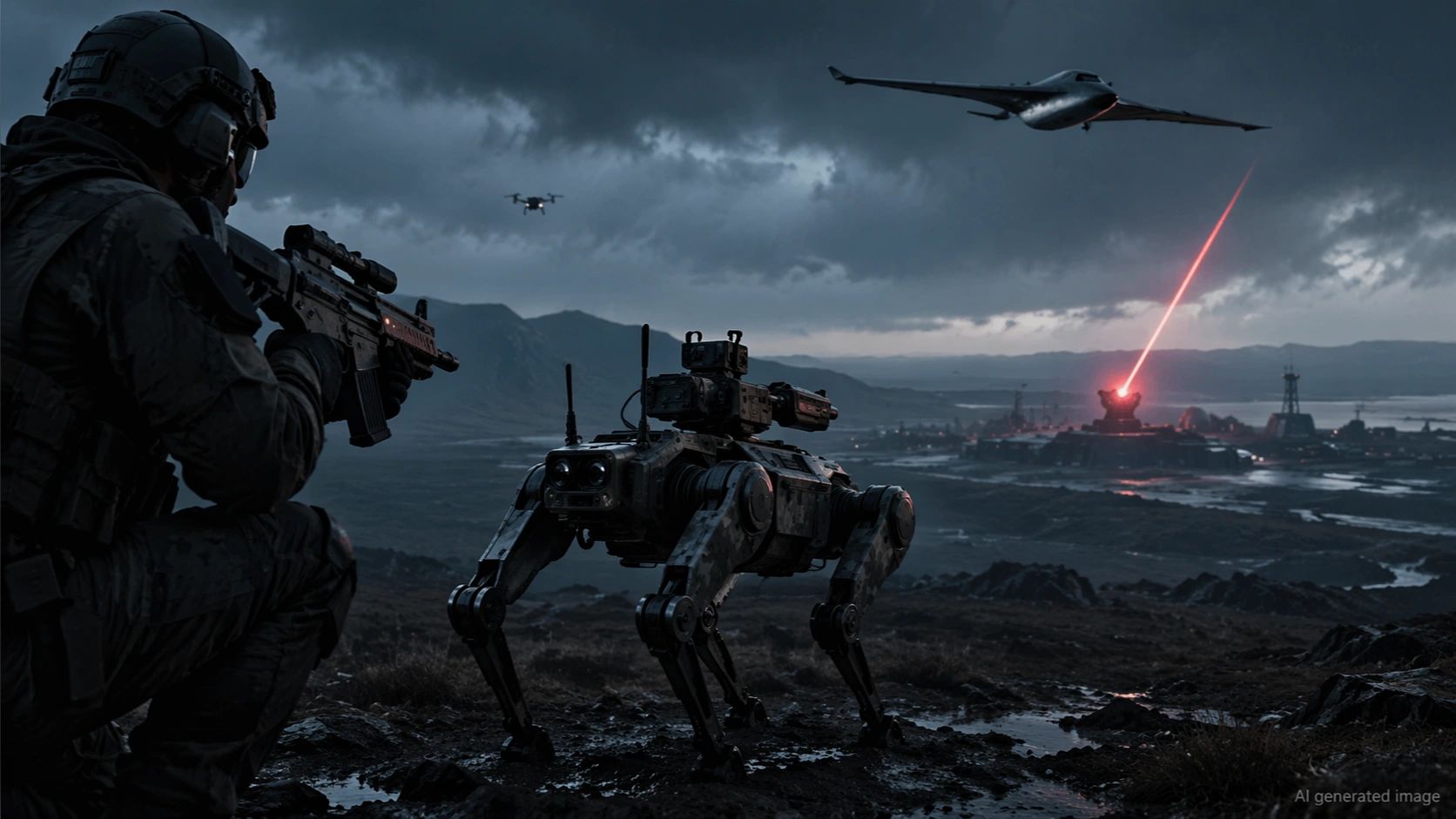
Star Wars age of war sounds dramatic. In 2026 it also sounds less ridiculous than it should. Modern militaries are building autonomous machines, quieter weapons, laser interceptors and AI assisted drones that can fight in places where humans struggle to survive. The comparison is not literal. There are no lightsabers and no Death Star. But the technology is moving in a direction that makes old science fiction feel less distant than it once did.
The better way to understand this shift is through three real changes. Weapons are becoming harder to detect. Robots are moving from support roles toward battlefield utility. AI is helping drones and other systems operate in jammed and fast moving combat zones. China, the United States, Israel, Ukraine and India are all part of that story, though not in the same way and not at the same pace.
China’s push toward quieter and lower-signature weapons
One of the most striking recent examples came from China. In April 2026, Chinese state linked coverage showcased a handheld electromagnetic coil gun, also known as a Gauss gun. Unlike a conventional rifle, it fires metal projectiles using electromagnetic coils rather than a standard gunpowder cartridge.
The attraction is obvious. Such a system can reduce noise, muzzle flash, smoke and shell casing ejection. That does not make it a battlefield revolution overnight. It does show why militaries are interested in weapons that make it harder to spot the shooter and easier to manage low-signature engagements in dense combat environments. For more on China’s handheld electromagnetic rifle, see this report by the South China Morning Post.
China is also pushing in the wider directed energy space. The country has displayed laser and high power microwave systems as part of its broader anti-drone and air defence effort. Some analysts believe these technologies could eventually threaten satellites or missiles. For now the more important point is simpler. China is investing in weapons that rely less on traditional gunpowder logic and more on energy, software and signal control.
Battle droids are no longer a fantasy concept
The robot side of this shift is easier to see because it is already visible in public demonstrations and procurement. In India, rifle mounted robotic dogs drew major attention during Republic Day parade rehearsals. Reports also said the Indian Army had already inducted around 100 robotic dogs. These systems do not prove the arrival of fully autonomous killing machines. They do show that armies now want machines that can move with troops, carry loads, support surveillance and potentially operate with weapons in tightly supervised roles.
The United States has explored a different side of the same trend. Lockheed Martin’s ONYX exoskeleton was designed to reduce strain on a soldier’s knees and back by using sensors and powered assistance that adapts to the user’s movement. The U.S. Army has also tested a passive “third arm” support system that helps carry the weight of a weapon or shield. This is not cinematic super-soldier technology. It is more practical than that. It is about reducing fatigue and extending what a human body can do under stress.
The real shift is not that robots have replaced soldiers. It is that soldiers are beginning to fight with more machine support around them than ever before. That is how doctrine usually changes in real life. Machines first help with carrying, stabilizing and moving. Then they become central to endurance, survivability and finally lethality.
AI drones are bringing the Star Wars comparison closest to reality
If one area makes the Star Wars analogy feel most real, it is drone warfare. In Ukraine, AI enabled guidance is increasingly being used to help drones keep tracking targets even under heavy jamming. This matters because a battlefield saturated with electronic warfare punishes any system that depends too heavily on GPS or stable radio links.
That is why AI in drones matters so much. It is not just about replacing pilots. It is about helping machines keep navigating, identifying, adjusting and staying on mission when the electronic environment becomes hostile. In plain terms, jamming is forcing militaries to build drones that can think for a few seconds without asking permission. Ukraine has become the hardest testbed for that transition. Reuters has reported on AI powered drone guidance kits being supplied for Ukraine’s battlefield needs here.
The same logic is reshaping airpower more broadly. The loyal wingman concept is no longer just a PowerPoint idea. Air forces now want cheaper autonomous or semi autonomous aircraft that can scout ahead, absorb risk, extend sensor reach and make crewed fighters more survivable. That does not mean the pilot disappears. It means the pilot is no longer flying alone.
Directed energy weapons are turning into practical tools
The strongest real world case for a so called Star Wars age of war is not the rifle or the robot dog. It is the economics of directed energy. Cheap drones have broken old air defence assumptions. A quadcopter worth a few hundred dollars can threaten an asset worth millions. That creates a brutal mismatch if the defender responds with expensive missiles every time.
This is not a prestige race first. It is a cost race. That is why laser and microwave systems matter. Israel’s Iron Beam and the U.S. Navy’s HELIOS are important not because they look futuristic, but because they aim to solve a brutally practical problem. How do you stop cheap aerial threats without bankrupting yourself in the process? Reuters reported on Iron Beam’s military readiness here.
That is the real military logic behind the energy weapon race. It is not about building a Death Star. It is about building a cheaper shot.
India’s stealth drone path belongs in this story too
India’s SWiFT and Ghatak story fits the same broader shift. DRDO’s Autonomous Flying Wing Technology Demonstrator has already flown successfully in autonomous mode. That matters because flying wing aircraft are hard to control and because autonomous stealthy strike platforms are likely to play a larger role in future air campaigns.
The cautious way to understand India’s progress is this. The country has already demonstrated key control logic for a tailless unmanned platform. That gives real credibility to the broader Ghatak path. What it does not yet prove is that a fully operational stealth combat drone is already ready or guaranteed on a fixed schedule. The programme is promising. It is not finished.
So are we living in the Star Wars age?
Yes and no.
No, because the comparison breaks down if it becomes too literal. Modern warfare is not about glowing swords or giant battle stations. Most of the systems now entering service are narrower, messier and less glamorous than science fiction imagined.
Yes, because the underlying pattern is real. Machines are taking on more of the sensing, carrying, stabilizing, navigating and targeting burden of combat. Energy weapons are moving from lab curiosity to military tool. Drones are becoming more autonomous under battlefield pressure. Humans remain central, but they are increasingly fighting inside a machine thickened battlespace.
That is the part the Star Wars metaphor gets right. The future of war is not just more firepower. It is more autonomy, more software and less visibility. It is quieter than fiction imagined. That may be the most unsettling part.