
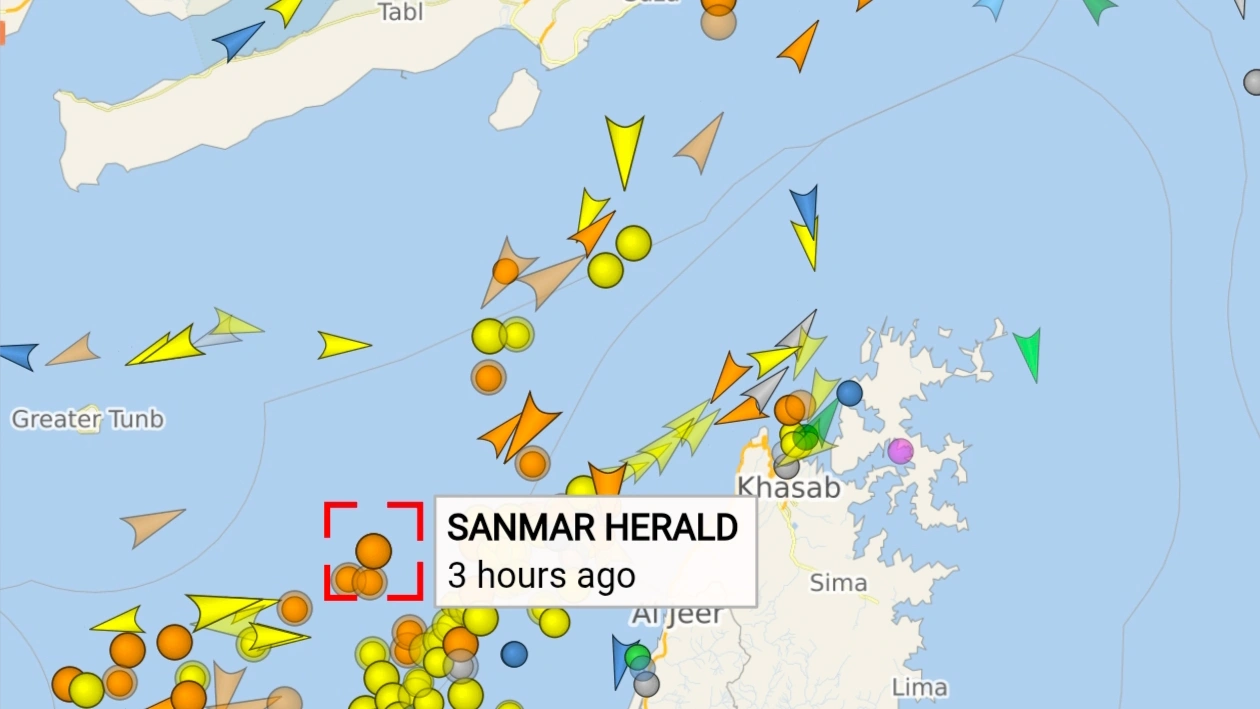
Two Indian-flagged vessels, Sanmar Herald and Jag Arnav, came under fire on April 18 while trying to cross the Strait of Hormuz, prompting India to summon Iran’s ambassador in New Delhi and register deep concern over the incident.
That is the hard fact. The larger question is what it may now force India to reconsider.
For years, New Delhi has treated instability in West Asia as something to manage through diplomacy, caution, and constant adjustment. But a firing incident involving Indian-flagged commercial vessels in one of the world’s most important energy corridors is not routine turbulence. It raises a more serious question: how long can India remain only a concerned stakeholder in Gulf security when its own ships are caught in the line of fire?
That is why this episode matters.
Even before the shooting, the mood around Hormuz had already turned tense. Shipping companies were seeking extra security assurances before attempting transit. The firing has now pushed that anxiety into a different category. It is no longer just a story about regional instability. For India, it is now a direct test of whether commercial traffic linked to its economy can move through a critical chokepoint without intimidation.
This is where timing becomes important.
The incident has come less than a year after Operation Sindoor, the Indian response to the April 22, 2025 Pahalgam terror attack that killed 26 people. Since then, New Delhi has tried to project a firmer national-security posture. Official messaging around Sindoor presented it as proof that India would not simply absorb another provocation and move on.
That does not mean India is about to rush into a military confrontation in the Gulf. But it does weaken an older assumption: that India will always answer pressure on vital sea lanes mainly through restraint, quiet diplomacy, and dependence on larger powers for security cover.
That is what gives the Hormuz firing its wider meaning.
The old regional pattern relied on ambiguity. Harass a vessel. Delay a passage. Raise shipping risk and insurance costs. Create enough fear to influence commercial movement, but not enough to trigger a major military response. For a long time, that model worked because most states preferred de-escalation.
But India’s response thresholds may now be changing.
After Sindoor, India appears more willing to signal resolve early and align its political and military response more quickly. That does not automatically lead to war. It does, however, make it harder for hostile actors to assume that New Delhi will swallow provocation quietly.
The immediate issue is diplomatic. India has already lodged its protest and demanded safe passage for India-bound ships. That is the necessary first step. But diplomacy works only when the other side believes the matter is urgent and that delay will carry a cost. By summoning Iran’s envoy and pressing for the safe and early passage of Indian vessels, New Delhi signaled that this was no longer a peripheral concern. It was treating the matter as a direct national interest issue.
The second issue is operational. India does not need to announce a dramatic new doctrine for its behavior to change. It only needs to conclude that protecting commercial shipping in the Gulf can no longer be handled as an occasional crisis-management exercise. If that conclusion hardens, India is likely to deepen surveillance, tighten escort planning, work more closely with partner navies, and prepare more seriously for future Hormuz disruptions.
The third issue is psychological, and it may be the most important.
Once a state starts to believe that its merchant vessels can be singled out during a regional crisis, the whole risk picture changes. Energy security stops being just a market concern and becomes a direct strategic worry. At that point, governments stop asking only how to calm prices and reassure shipping operators. They start asking how to prevent the next humiliation.
That is why this incident could shape India’s Gulf thinking more deeply than it first appears.
It also has a domestic defence angle. A prolonged risk environment around Hormuz would put more pressure on India to improve maritime surveillance, strengthen linked air-defence and electronic-warfare systems, and sharpen anti-drone capability. In that sense, the crisis becomes a real test of whether India’s push for defence self-reliance and faster operational readiness can hold up under pressure.
None of this means India should overreact. The temptation in moments like this is to turn every provocation into a countdown to war. That is bad analysis and worse statecraft.
What India needs now is not theatrical escalation, but clarity.
It must make clear that safe passage for Indian-linked commercial shipping is non-negotiable. It must prepare quietly for a period in which Gulf transit can no longer be treated as predictably stable. And it must ensure that any future harassment of Indian-flagged vessels brings visible diplomatic and operational consequences.
That will require steady policy, not slogans.
The firing on Sanmar Herald and Jag Arnav may not produce an immediate military showdown. But it has already done something important. It has stripped away the illusion that India can remain only an anxious observer while others define the rules of passage, pressure, and risk in a waterway so central to its interests.
That assumption may now be breaking down.
The bigger question is no longer whether India is angry. It clearly is. The real question is whether New Delhi treats this as a one-off outrage to be protested, or as a warning that it must play a more active and visible role in securing its maritime lifelines.
If policymakers settle on the second conclusion, April 18 may be remembered as more than a dangerous day in Hormuz.
It may be remembered as the moment India stopped treating Gulf shipping risk as someone else’s problem.
Related reading
For deeper context on the shipping and strategic picture, read our guide to the Strait of Hormuz crisis, our explainer on Indian ships in the Strait of Hormuz, and our analysis of Operation Sindoor and what it changed in India’s strategic posture.
For official and external reference, readers can also see India’s Ministry of External Affairs statement on the Iran meeting and the wider reporting on the Hormuz incident.