
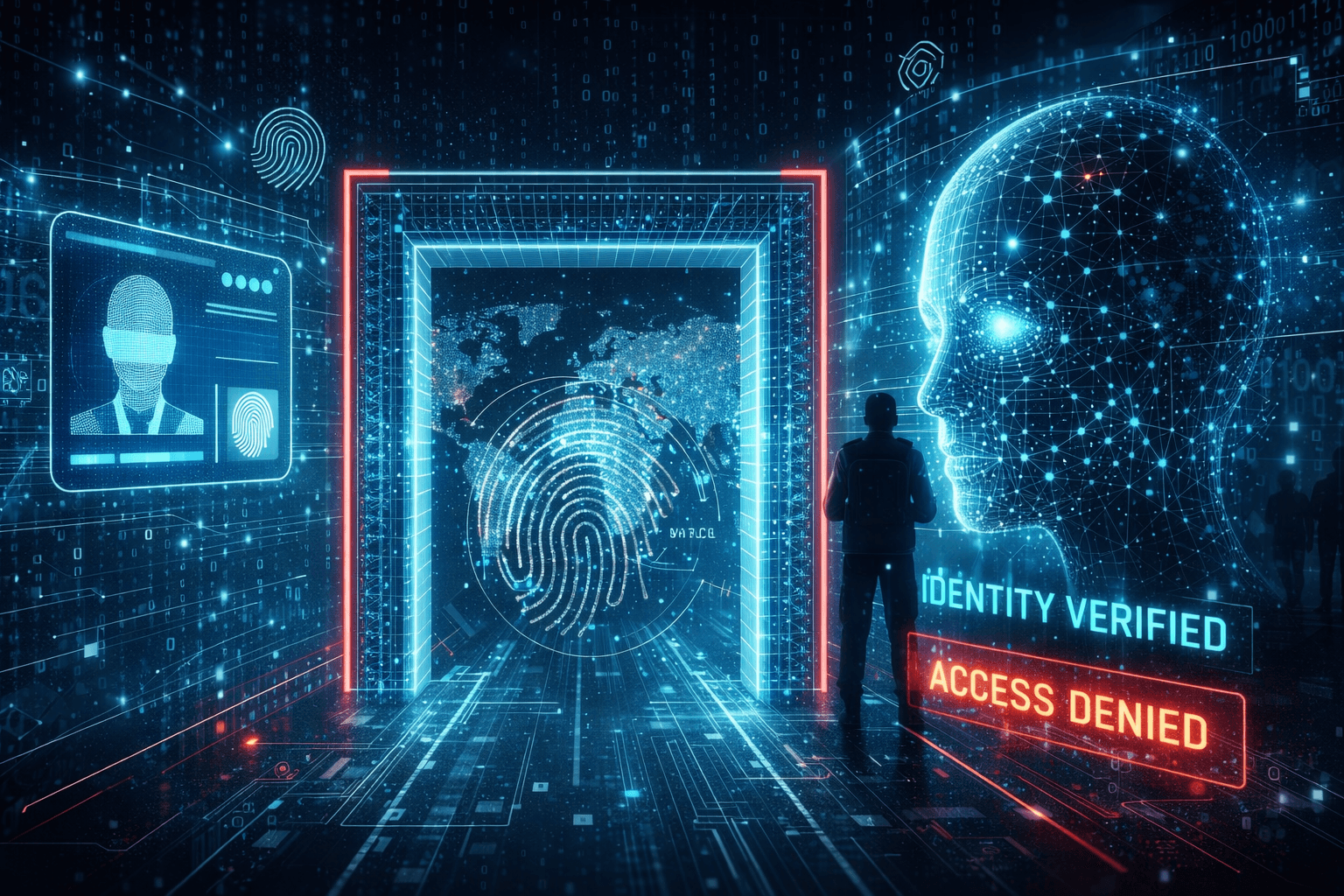
Digital identity and AI border security are quietly transforming how nations control borders, replacing traditional checkpoints with invisible layers of automated verification.
The Invisible Border: How AI and Digital Identity Are Redefining Global Security
At 02:47 UTC on February 12, 2026, Indicio’s AI system processed its first cryptographically verified digital passport without human intervention. The traveler—a Singapore executive transiting through Amsterdam—crossed into the Schengen zone in forty-three seconds. No document check. No queue.
Instead, a biometric scan verified his identity against blockchain-anchored credentials stored in a digital wallet. Machines authenticated the credentials in seconds—faster than any border officer could manually review a passport.
This moment was not a small technological milestone. It was a glimpse of the future of international mobility. While travelers experienced convenience, security agencies around the world saw something far more significant: a new layer of global security infrastructure emerging at the border.
INTEL SUMMARY
- Digital identity systems are rapidly transforming border control worldwide.
- Biometric verification and blockchain credentials are reducing reliance on physical passports.
- Governments are adopting AI-powered border security to manage growing global travel volumes.
- Digital identity infrastructure introduces new cybersecurity and geopolitical risks.
The Rise of Digital Borders
International travel is rebounding rapidly after the disruptions of the early 2020s. According to the
International Air Transport Association (IATA), global passenger traffic is expected to exceed pre-pandemic levels by 2026.
This surge is forcing governments and airport authorities to rethink how border systems function.
Traditional passport inspection processes were designed for a slower era of global mobility. Today, aviation hubs such as Amsterdam, Dubai, Singapore, and Doha handle millions of passengers every month. Manual verification is increasingly inefficient.
Digital identity systems offer a new solution. Instead of relying solely on physical passports, travelers can store verified credentials in encrypted digital wallets connected to biometric identifiers.
These credentials can be authenticated instantly through automated border systems, dramatically reducing waiting times and operational costs.
AI at the Border
Artificial intelligence is rapidly becoming a central component of border management.
AI-powered systems can compare biometric scans with national databases, verify travel credentials, and flag irregularities in real time. These capabilities allow governments to screen travelers more efficiently while maintaining strong security controls.
The European Union is preparing to deploy its upcoming Entry/Exit System (EES), which will digitally record border crossings and biometric data of non-EU travelers.
Meanwhile, the EU’s ETIAS travel authorization system is designed to screen travelers before they even arrive in Europe.
In Asia, Singapore’s Changi Airport has already introduced passport-free immigration lanes using facial recognition technology, offering a preview of what automated borders may look like in the future.
The Security Paradox
Digital border systems promise speed and efficiency—but they also introduce new security challenges.
Physical passports have limitations, but they are difficult to manipulate remotely. Digital identity systems operate across networked platforms that may become targets for cyberattacks, identity theft, or data manipulation.
Governments are therefore approaching the technology cautiously.
Blockchain-based identity systems offer strong resistance to tampering, but cybersecurity remains a constant concern. A compromised digital identity system could potentially allow malicious actors to bypass border controls without detection.
For intelligence and security agencies, the central challenge is balancing efficiency with resilience against sophisticated cyber threats.
The Geopolitical Dimension
Digital identity infrastructure is also becoming part of a broader geopolitical competition over technological standards.
Governments, technology firms, and international institutions are racing to define how digital credentials are issued, verified, and stored across global travel networks.
The standards adopted today could shape international mobility systems for decades.
This contest mirrors earlier geopolitical battles over internet governance, telecommunications networks, and satellite navigation systems.
Just as control over GPS infrastructure reshaped military and economic power in the late twentieth century, control over digital identity infrastructure may shape the rules of global mobility in the twenty-first.
A New Security Frontier
The shift toward automated borders represents more than an upgrade in airport technology. It reflects a deeper transformation in how states manage sovereignty in an interconnected world.
Physical checkpoints are gradually being supplemented by digital verification layers that operate before travelers even reach an airport terminal.
In this emerging architecture, identity itself becomes a form of infrastructure—encrypted, networked, and constantly monitored.
Digital Identity and AI Border Security: Strategic Implications
Positive outlook: Automated verification systems can dramatically improve efficiency, reduce waiting times, and help governments manage rising travel volumes without expanding manpower.
Negative outlook: Over-reliance on digital identity systems introduces new cyber vulnerabilities and could concentrate control of identity infrastructure in the hands of a few governments or technology providers.
The traveler who crossed the Schengen border in forty-three seconds experienced a moment of convenience.
Behind that moment lies a far deeper transformation—one that could redefine how borders function and how nations secure their sovereignty in a digital age.
Key Takeaways
- AI-driven identity verification is reshaping border management worldwide.
- Biometric and blockchain credentials are reducing reliance on physical passports.
- Governments are investing heavily in automated border infrastructure.
- Cybersecurity and geopolitical competition will shape the future of digital identity systems.