
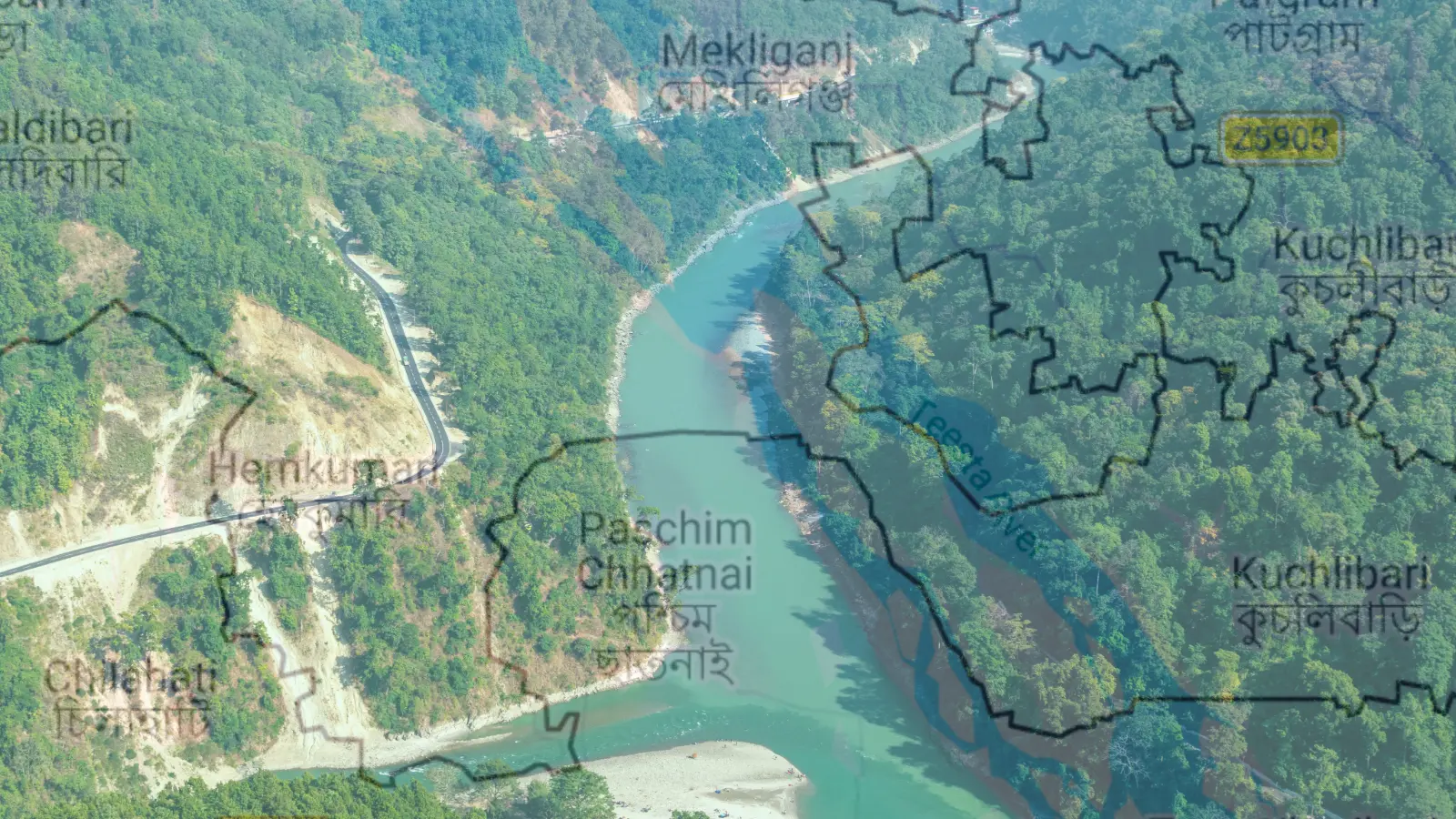
Teesta Strategic Geopolitics
The changes unfolding along India’s eastern frontier are no longer limited to state politics or border administration. In West Bengal, growing coordination between the central and state governments is beginning to reshape India’s approach toward Bangladesh, border security, and the wider Bay of Bengal region.
New Delhi is increasingly viewing the eastern corridor as a connected strategic space stretching from the Teesta River to the Siliguri Corridor and the Bay of Bengal.
Recent statements from Dhaka suggest that shift is already being noticed.
The Teesta Question Returns
The long-pending Teesta water-sharing agreement remains a major issue for Bangladesh, particularly for northern farming districts that depend heavily on the river system.
For years, the agreement remained stalled because of disagreements between New Delhi and the West Bengal government. But officials and analysts believe India’s position in the negotiations has become stronger under the current political alignment.
In May 2026, Bangladesh’s Water Resources Adviser Syeda Rizwana Hasan again emphasized the importance of the Teesta deal. Around the same time, discussions surrounding the China-backed “Teesta River Management Project” also resurfaced.
Bangladesh Foreign Minister Khalilur Rahman indicated that the issue would be part of his China visit.
Indian strategic observers do not see this purely as a water dispute. In New Delhi, there is a growing belief that Dhaka is using its engagement with Beijing to increase leverage in negotiations with India.
Dhaka’s Balancing Strategy
During Sheikh Hasina’s tenure, India and Bangladesh developed unusually close coordination on border management and counterterrorism.
That equation now appears more fluid.
Since the recent political changes in Bangladesh, Dhaka has been trying to maintain active engagement with multiple powers at once — including India, China, the United States, and major Islamic countries.
Some analysts believe excessive pressure from New Delhi could push Bangladesh into a closer strategic understanding with China. Others argue Dhaka is simply trying to expand its diplomatic space rather than align fully with any single bloc.
Pakistan’s Renewed Interest
Pakistan has also stepped up engagement with Bangladesh in recent months.
Relations between Islamabad and Dhaka remained relatively cold during the Hasina years, but recent developments have created new diplomatic openings.
China is widely seen as an important factor behind this shift. Beijing has steadily expanded its regional footprint through infrastructure projects, port access, and defense cooperation across South Asia.
For both Pakistan and China, Bangladesh has become strategically more valuable as regional competition intensifies.
Still, there is little indication that Dhaka intends to move entirely into any one geopolitical camp.
India’s Broader Security Concerns
Indian officials are closely monitoring reports of possible defense cooperation between Bangladesh and China involving J-10CE fighter aircraft.
But for Indian planners, the concern is broader than weapons purchases.
China’s expanding presence in the Bay of Bengal, combined with the growing importance of the Chattogram port, has pushed eastern maritime security higher on New Delhi’s agenda.
Washington is also paying closer attention to the region as part of its wider Indo-Pacific strategy.
The Siliguri Corridor Factor
The Siliguri Corridor — often called the “Chicken’s Neck” — remains one of India’s most sensitive strategic zones.
The narrow land corridor, roughly 22 kilometers wide at its narrowest point, connects India’s northeastern states to the mainland. It sits between Bangladesh, Nepal, and Bhutan.
Since the Doklam standoff, Indian security planners have remained particularly sensitive to developments around China’s Chumbi Valley.
In recent weeks, surveillance and coordination near the Doklam sector and parts of the Nepal border have reportedly increased.
Some international assessments have also noted rising Indian concerns over demographic shifts and cross-border settlement patterns in sensitive frontier districts.
The Expanding BSF Framework
A major operational shift is also taking shape on the ground.
In 2021, the Indian government expanded the jurisdiction of the Border Security Force from 15 km to 50 km in several border states, including West Bengal. The decision triggered political controversy at the time.
That debate has now largely shifted toward enforcement and coordination.
Officials believe closer cooperation between the BSF, state police, and central intelligence agencies could significantly improve action against smuggling routes, forged-document networks, and illegal cross-border activity.
The focus is increasingly moving beyond fencing alone toward integrated surveillance and intelligence-sharing.
Dhaka’s Alertness Along the Border
In early May 2026, Border Guard Bangladesh (BGB) reportedly issued high alerts in sectors including Kurigram and Fulbari.
Bangladeshi officials expressed concerns over possible deportation pressure and tougher enforcement measures along parts of the border.
Foreign Minister Khalilur Rahman also stated that Dhaka would respond formally if any “push-in” situation emerged.
India, meanwhile, has continued to frame illegal migration and border enforcement as key national security concerns.
NIA Cases and the Digital Security Grid
Several investigations by India’s National Investigation Agency (NIA), including cases linked to AQIS and Jamaat-ul-Mujahideen Bangladesh (JMB), have highlighted the use of forged identity documents and local support networks along parts of the eastern border.
Security agencies now appear focused on improving coordination through NATGRID, shared intelligence platforms, drones, and sensor-based monitoring systems.
Particular attention is being placed on riverine stretches where physical fencing remains difficult.
India’s Eastern Security Shift
From the Teesta River to the Bay of Bengal, India is reshaping its eastern security doctrine through border coordination, maritime strategy, and deeper geopolitical integration.
West Bengal–Bangladesh Border
West Bengal shares India’s longest border with Bangladesh, making it one of the country’s most sensitive frontier zones.
Border Fencing Completed
Large sections of fencing are complete, though riverine stretches continue to create security gaps.
BSF Operational Reach
India expanded BSF jurisdiction from 15 km to 50 km in key border states in 2021.
The “Chicken’s Neck”
The Siliguri Corridor remains one of India’s most strategically sensitive regions.
India’s Emerging Eastern Security Grid
- BSF and state police coordination
- NATGRID intelligence-sharing systems
- Drone and sensor-based monitoring
- Riverine surveillance operations
- Cross-border enforcement integration
Related Analysis:
- How India Is Building an Underwater Security Wall in the Andaman Sea
- Why India’s Agalega Island Base Matters in the Indian Ocean Power Game
- Project Seabird: India’s Largest Naval Base That is Multiplying Our Power at Sea
- The Invisible War: Why Undersea Cables Are the Indo-Pacific’s Biggest Target
- India’s Ruling Party Expands Footprint, Signaling Policy Continuity to Global Markets
What New Delhi Is Trying to Build
India already possesses several sources of leverage in its relationship with Bangladesh — including transit access, electricity exports, border coordination, medical visas, and the Teesta negotiations themselves.
But the broader shift goes beyond bilateral management.
New Delhi increasingly appears to be viewing the eastern frontier as a combined security and geopolitical theatre where water, migration, maritime access, border control, and regional influence are deeply connected.
How that strategy evolves could shape the future balance of power across eastern South Asia in the years ahead.