
INS Jatayu Geopolitics
In late 2023, the political climate in Malé shifted. The incoming Maldivian administration campaigned heavily on an ‘India Out’ platform, culminating in a formal request for the withdrawal of Indian military personnel stationed in the archipelago.
New Delhi complied. There was no public diplomatic confrontation. The Indian aviation platforms—helicopters and a Dornier aircraft used for medical evacuations and maritime patrols—were handed over to civilian crews.
However, the loss of military personnel in the Maldives created a temporary gap in India’s forward observation capabilities in the western Indian Ocean. To close it, naval planners simply looked 130 kilometers north to Indian sovereign territory: Minicoy.
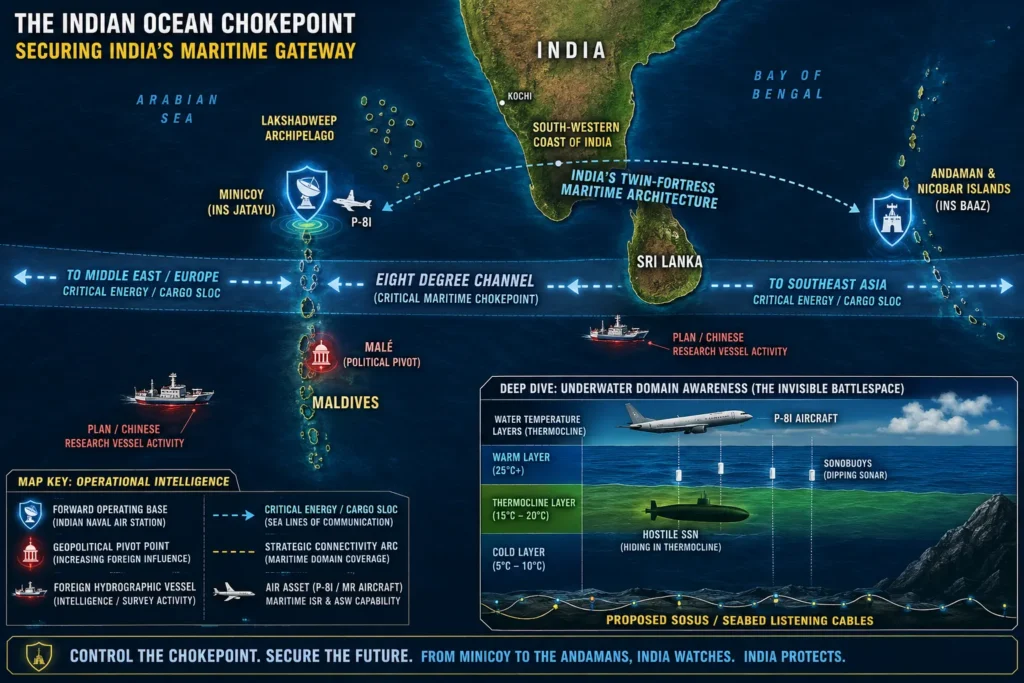
Minicoy is the southernmost atoll of the Lakshadweep archipelago. It sits immediately adjacent to the Eight Degree Channel, the maritime border that separates India from the Maldives.
This channel is not just a geographic marker. It is one of the world’s most heavily trafficked Sea Lines of Communication (SLOCs). A massive percentage of commercial cargo and energy supplies traveling between Southeast Asia, the Middle East, and Europe passes through this specific corridor. Whoever monitors the Eight Degree Channel effectively monitors the economic pulse of the Arabian Sea.
For years, Minicoy hosted a minor naval detachment. It functioned primarily as a coastal radar station manned by a handful of personnel. In early 2024, that posture fundamentally changed. The Indian Navy formally commissioned the facility as a full naval base, naming it INS Jatayu.
The upgrade from a detachment to a commissioned base triggers a structural shift in military infrastructure and operational funding. The Ministry of Defence is actively expanding the island’s capabilities. Current plans include the construction of a new dual-use airfield capable of supporting fighter aircraft and heavy military transport, alongside upgraded jetty facilities to harbor larger warships.
Modern naval maneuverability in the Eight Degree Channel relies heavily on bathymetry. The channel is deep enough for nuclear-powered attack submarines (SSNs) to operate securely. Submarine commanders routinely exploit thermocline layers—distinct bands of ocean water with varying temperatures. Surface-based sonar pulses reflect off these layers, creating acoustic blind spots where submarines can loiter undetected.
INS Jatayu counters this acoustic advantage. Boeing P-8I maritime patrol aircraft operating from the new Minicoy airfield can drop sonobuoys directly through the thermocline to detect the mechanical signatures of submerged hulls. Defense analysts also note the strategic viability of deploying seabed listening cables—similar to a Sound Surveillance System (SOSUS)—across the channel’s floor. This passive acoustic grid would continuously record subsurface movements without emitting any signals that might alert the target.
By building out INS Jatayu, the Indian Navy is establishing a hard western anchor for its maritime forces.
The strategy mirrors India’s posture on its eastern flank. In the Andaman and Nicobar Islands, INS Baaz provides domain awareness over the approaches to the Strait of Malacca. INS Jatayu replicates this capability in the west. Together, these island bases form a twin-fortress architecture, projecting power far beyond the Indian mainland.
The operational timing aligns directly with Beijing’s expanding footprint in the region. Chinese research vessels—often accused of conducting hydrographic surveys for submarine navigation—have increasingly frequented the waters around Sri Lanka and the Maldives. A pro-China administration in Malé heightens the risk of the People’s Liberation Army Navy (PLAN) gaining a logistical foothold just outside India’s exclusive economic zone.
A fully operational airbase on Minicoy neutralizes much of that advantage. The radar arrays intercept electronic communications and track ship transits long before they reach the Indian coast.
Relying on foreign governments for strategic depth is inherently unstable. Bilateral relations fluctuate with election cycles. By pivoting to Minicoy, India bypasses the diplomatic friction of dealing with neighboring capitals.
The commissioning of INS Jatayu is a calculated acknowledgment of the new security environment in the Arabian Sea. The diplomatic fallout with Malé accelerated a geographic necessity. The Eight Degree Channel remains firmly under New Delhi’s surveillance grid, and the western gate is now heavily guarded.