
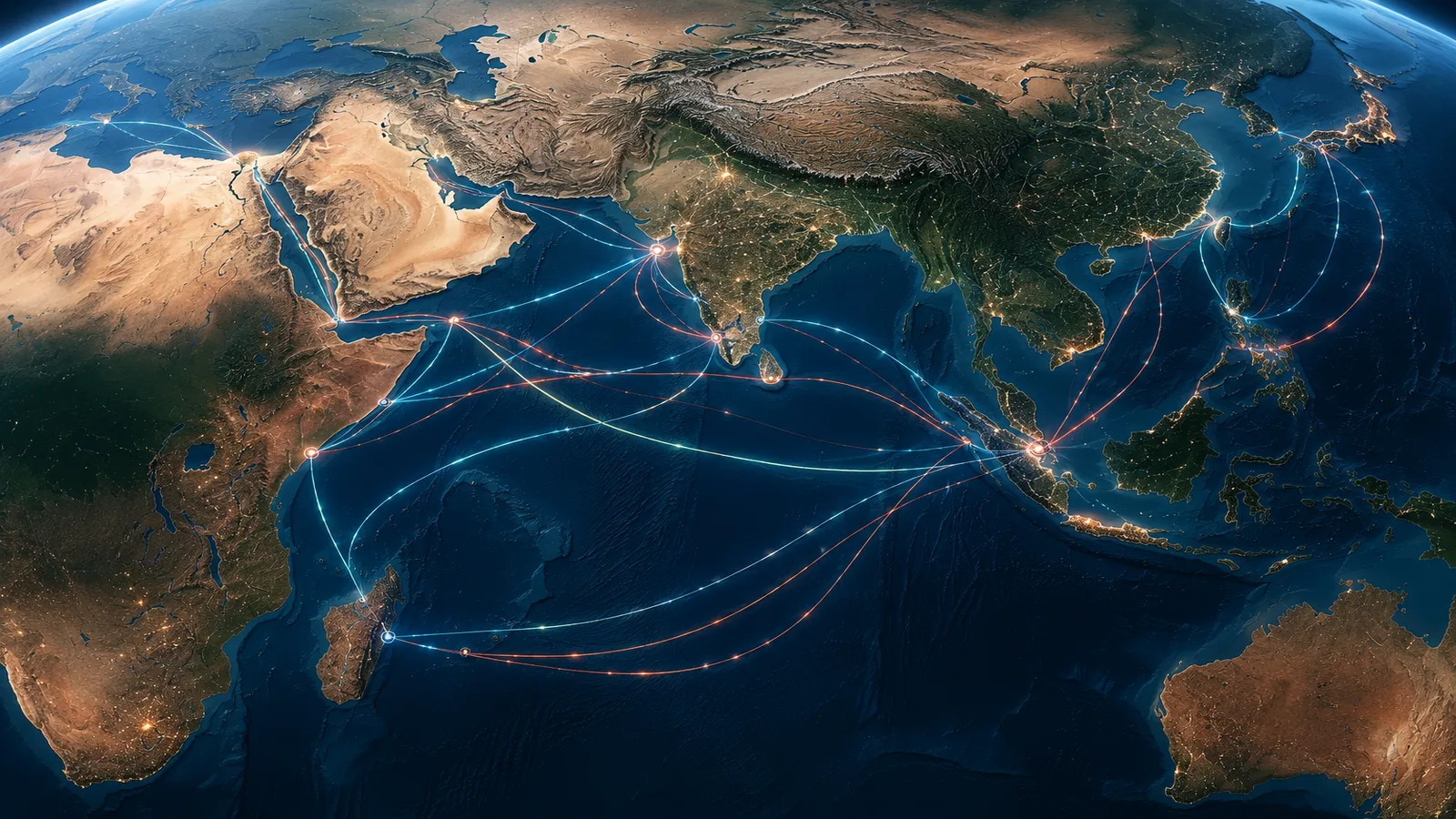
The Indian Ocean is no longer just a maritime trade corridor. It is becoming one of the world’s most important digital battlegrounds, where undersea cables now carry strategic value comparable to oil shipping lanes and naval chokepoints.
The Indian Ocean is usually discussed through the lens of naval competition, energy flows and maritime trade. But beneath those waters lies another layer of strategic infrastructure that has become central to twenty-first century power: subsea fiber-optic cables.
These undersea systems carry nearly all intercontinental internet traffic, linking financial markets, cloud computing networks, military communications and global commerce. As governments increasingly frame digital infrastructure as a national security issue, submarine cables have moved from technical utility to geopolitical asset.
The shift is especially visible across the Indo-Pacific, where India, China, the United States and European powers are competing to shape the next generation of digital routes.
Related TES analysis: Pax Silica and the Rise of a Western AI Infrastructure Bloc .
Why Subsea Cables Matter More Than Ever
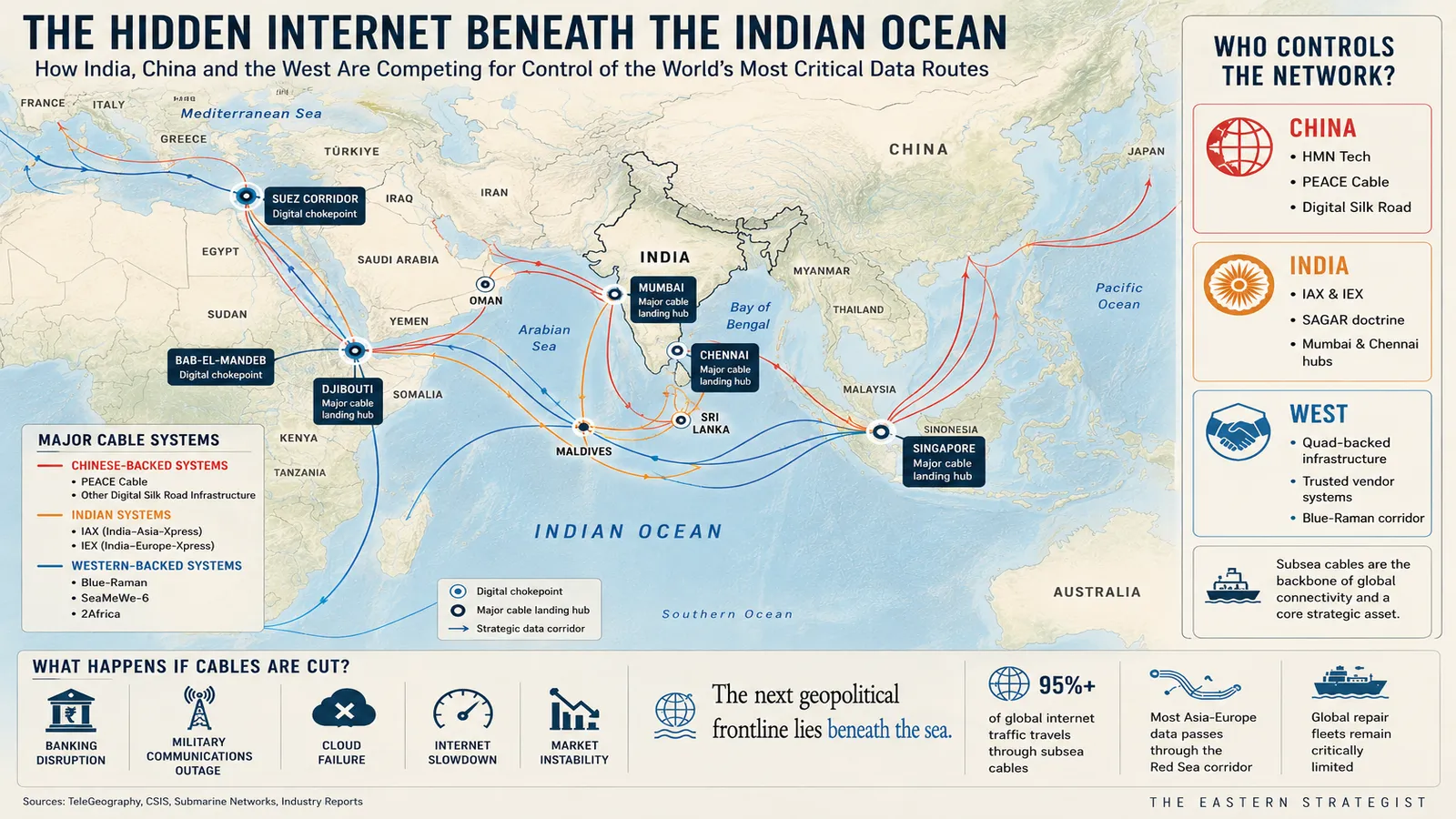
Glowing subsea cable routes across the Indian Ocean illustrate the growing geopolitical contest over global internet infrastructure between India, China and Western powers.
Submarine cables form the physical backbone of the global internet. While satellites dominate public imagination, they carry only a fraction of worldwide communications traffic. The overwhelming majority of global data still moves through seabed infrastructure stretching across oceans and chokepoints.
That dependence creates vulnerabilities. Cables are physically fragile, difficult to monitor and expensive to repair. A single disruption can affect banking systems, telecommunications networks and government connectivity across entire regions.
According to the Center for Strategic and International Studies (CSIS) , undersea cable resilience is increasingly being treated as part of Indo-Pacific security planning.
The infrastructure race is also changing because of hyperscalers — major technology firms such as Google, Meta, Amazon and Microsoft. These companies are no longer just purchasing bandwidth from telecom operators. They are directly financing and operating cable systems themselves.
That transition has geopolitical consequences. Companies now influence where digital hubs emerge, which routes receive investment and which regions become central to future data flows.
China’s Digital Silk Road Beneath the Sea
Beijing has treated subsea infrastructure as a strategic priority for years through its broader Digital Silk Road initiative.
At the center of that push is HMN Technologies, formerly Huawei Marine Networks. Western governments have repeatedly raised concerns over the security implications of Chinese-built cable infrastructure because of Beijing’s legal authority over domestic firms.
The issue is not simply espionage. It is network influence.
Countries that finance, build and maintain major cable systems gain leverage over routing, connectivity and infrastructure access. Analysts increasingly describe this as a contest over “network centrality” — the ability to sit at the center of global data circulation.
One of the most important examples is the PEACE cable system, linking Asia, East Africa and Europe.
More details on the project can be found via: Submarine Networks .
The cable strengthens China’s digital presence across the Indian Ocean while reducing dependence on older routes vulnerable to geopolitical disruption.
India’s Shift From Consumer to Digital Power
India has historically depended on foreign consortium-led cable systems for international connectivity. That posture is changing rapidly.
New Delhi increasingly views digital infrastructure as part of national strategy rather than merely commercial telecommunications policy.
Reliance Jio’s India-Europe-Xpress (IEX) and India-Asia-Xpress (IAX) systems represent a major step in that transition. The projects aim to strengthen India’s direct connectivity with Southeast Asia, the Middle East and Europe while reducing reliance on intermediary routing hubs.
The projects are also tied to India’s broader maritime doctrine under SAGAR — Security and Growth for All in the Region.
The Indian government has simultaneously moved to modernize cable landing regulations and improve infrastructure resilience around key nodes such as Mumbai, Chennai and the Andaman and Nicobar Islands.
Related TES coverage: The Software-Defined Battlefield and India’s AI Military Transition .
Why Djibouti and Egypt Have Become Critical Digital Gateways
The geography of the Indian Ocean gives enormous strategic importance to a handful of states sitting near narrow maritime corridors.
Djibouti has emerged as one of the world’s densest cable landing zones because of its location near the Bab-el-Mandeb Strait. Multiple international systems now converge there before connecting onward toward Europe and Africa.
Egypt remains equally indispensable.
Nearly every major cable linking Asia to Europe passes through the Egyptian corridor connecting the Red Sea to the Mediterranean. That makes Cairo one of the most important digital transit actors in the global economy.
Telecom Egypt’s subsea initiatives have expanded further with projects such as IEX.
More details are available through: SAMENA Council .
The Security Threat Is No Longer Theoretical
Most cable disruptions still result from accidental causes such as anchors or fishing activity. But governments are increasingly preparing for deliberate interference.
The sabotage of the Nord Stream pipelines in Europe intensified Western concerns about vulnerable undersea infrastructure.
Meanwhile, incidents involving Taiwan’s offshore cable networks demonstrated how connectivity disruptions can become tools of pressure without escalating into conventional military conflict.
That has pushed undersea cable protection into mainstream security planning across NATO, the Quad and Indo-Pacific maritime partnerships.
According to analysis from the Atlantic Council , future geopolitical competition may increasingly involve both physical and digital attacks against undersea systems.
Related TES reading: India’s NASM-SR and the Expansion of Maritime Precision Warfare .
The Repair Problem Few Governments Talk About
One of the least discussed vulnerabilities is repair capacity.
There are relatively few specialized cable-repair vessels worldwide, and many are aging. When disruptions occur, governments often face regulatory delays, permit bottlenecks and logistical complications before repairs can even begin.
In strategic terms, resilience is not only about building cables. It is about restoring them quickly after disruption.
That issue is becoming increasingly important as new projects multiply across the Indo-Pacific and Western Indian Ocean.
The Indian Ocean’s New Strategic Reality
The contest beneath the Indian Ocean is no longer simply about connectivity. It is about who controls the architecture of the digital economy itself.
China wants a larger role in building and routing global infrastructure through the Digital Silk Road. The United States and its allies are trying to build trusted alternatives. India is attempting to emerge as a central digital hub rather than a dependent market.
That competition will shape trade, cloud computing, financial systems, military communications and geopolitical influence for decades.
The internet may appear borderless to ordinary users. Its infrastructure is not.
And increasingly, the future of that infrastructure runs through the Indian Ocean.
Sources: CSIS, Atlantic Council, Telecom industry data, Submarine Networks, regional policy papers and infrastructure reports.