
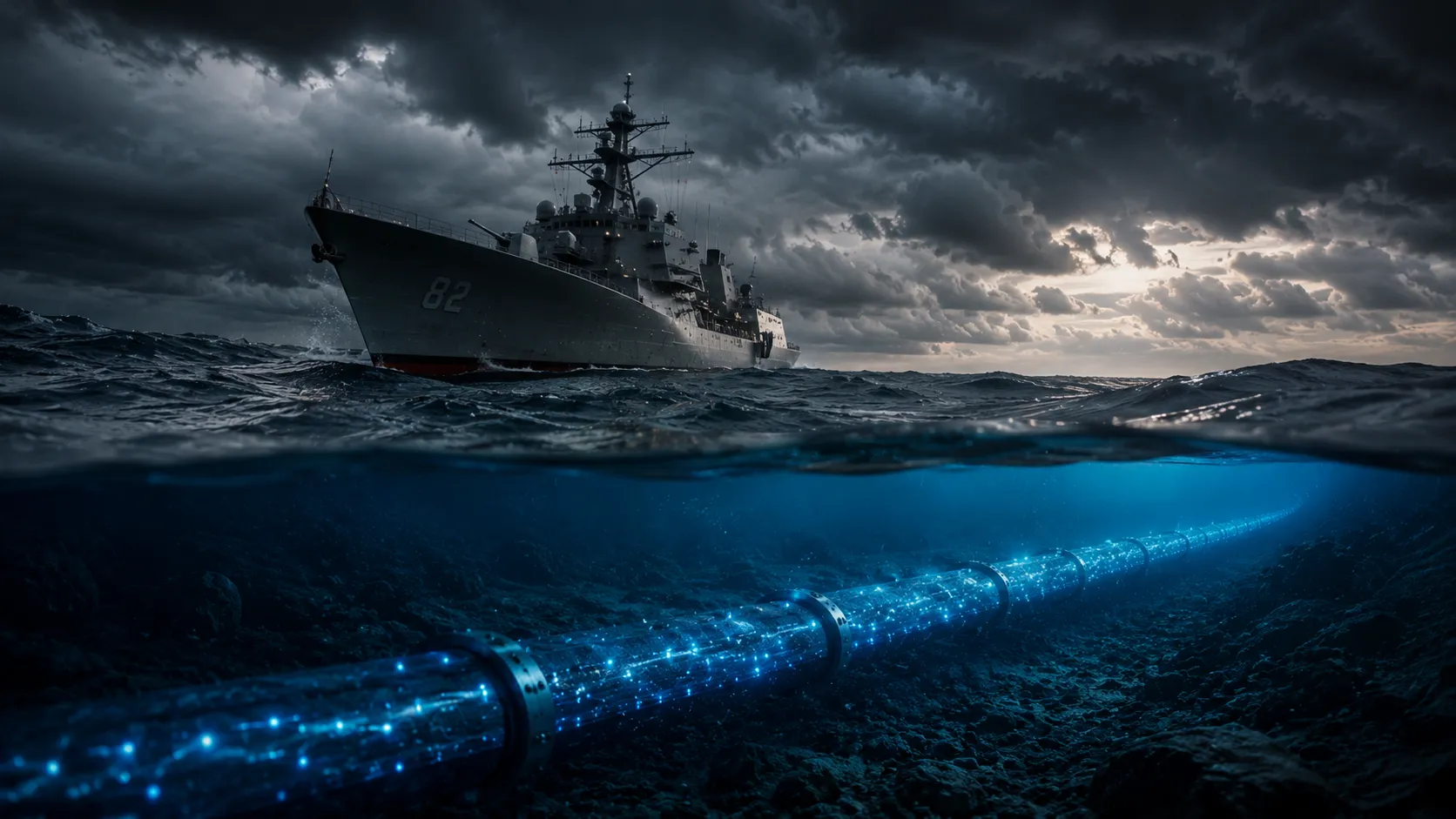
Submarine Cable Geopolitics: The Unseen Frontline
Introduction: The Battlefield Deep Underwater When we talk about security in the oceans, we usually think of aircraft carriers, submarines, or island disputes. But the real fight is happening deep underwater, quietly.
Think of undersea internet cables as the world’s most important highways. Almost 97% of the global internet—and trillions of dollars in daily bank transfers—travels through these cables. If these cables are cut, the internet stops, stock markets crash, and economies freeze.
What used to be just a telecom business has now become a silent war. The countries fighting to control these underwater data pipelines are mainly the US and China. Here is how this invisible war is shaping the future of the Indo-Pacific.
1. The US vs. China Battle for Data
For a long time, Western companies built most of the world’s underwater cables. But recently, Chinese companies started laying these cables much faster and cheaper. The US sees this as a huge national security risk. They worry that China could tap into these cables to spy on global data or cut them off during a crisis.
Because of this fear, the US is actively stopping Chinese companies from getting major cable contracts. For example, the SeaMeWe-6 cable project (which connects Asia to Europe) was almost given to a Chinese company. But after strong pressure from the US, the contract went to an American firm instead. This rivalry is slowly dividing the world’s internet into two separate camps.
2. The Danger Zones: Red Sea and Malacca Strait
Just like ships have to pass through narrow sea lanes, internet data also passes through narrow underwater areas. The Red Sea is one of the biggest “danger zones.” Right now, about 15 to 16 major cables run through the Red Sea, connecting Asia’s fast-growing internet to Europe.
Recent attacks by Houthi rebels in the Red Sea showed how risky this is. When some cables in the area were damaged, internet speeds dropped across several Asian and African countries. Other high-risk areas include the Malacca Strait (near the Andaman Sea) and the waters around Taiwan. If a war breaks out here, half of Asia could lose its internet connection in minutes.
3. The Threat of Cutting the Cables
Navies around the world are now preparing for “Seabed Warfare.” This means using special submarines or underwater drones to spy on or cut enemy cables. Russia and China both have advanced submarines designed specifically to operate deep underwater where these cables lie.
If a major conflict happens today—for example, a blockade of Taiwan—the first move won’t be dropping a bomb. The first move will be cutting these cables. Blinding the enemy by destroying their internet and military communications is the easiest way to win a modern war.
4. India’s Masterstroke: Building a Safe Data Hub
With the US and China fighting over cable routes, India is stepping up as a safe and reliable digital hub. India is building massive data centers in cities like Mumbai and Chennai, making sure that data passing from the Middle East to Southeast Asia stays secure.
Also, India’s move to connect the Andaman and Nicobar Islands with a high-speed fiber-optic cable is a game-changer. It doesn’t just give the islands fast internet; it gives the Indian Navy a highly secure communication line to keep a strict watch over Chinese ships entering the Malacca Strait.
The Bottom Line of Submarine Cable Geopoltics
For centuries, the rule of geopolitics was simple: the nation that controlled the oceans controlled the world. Today, that rule still applies, but the focus has shifted from the water’s surface to the dark seabed. Undersea cables are no longer just internet pipes; they are the absolute lifelines of a country’s economic and military survival.
In the coming years, the real superpower won’t just be the one with the biggest aircraft carriers or the most advanced stealth fighter jets. True power will belong to the country that can build, control, and protect the massive data highways flowing thousands of meters underwater. If a country cannot protect its data, its military radars will go blind, and its stock markets will crash in seconds.
As the US and China continue their tech Cold War, countries like India are in a unique position. By creating a secure digital fortress and partnering with trusted allies in the Indo-Pacific, India is ensuring that it doesn’t just remain a bystander in this invisible war. The recent cable disruptions in the Red Sea have already given the world a small, terrifying trailer of the global chaos that a severed cable can cause.
Looking ahead, defending the seabed is no longer just a telecommunications issue—it is the ultimate defense priority. We must realize that the next major global conflict might not start with a loud missile explosion in the sky. It will likely start with the silent snap of a glass fiber cable in the dark, freezing depths of the ocean. The invisible war has already begun, and the stakes have never been higher.