
Why China didn’t defend Iran during the 2026 Middle East conflict reveals the strategic limits of Beijing’s global partnership network.
The China Iran war question became one of the most debated geopolitical puzzles during the 2026 Middle East conflict. When the United States and Israel launched large-scale strikes against Iranian military infrastructure during Operation Epic Fury, many analysts expected Beijing—Tehran’s strategic partner—to respond more forcefully.
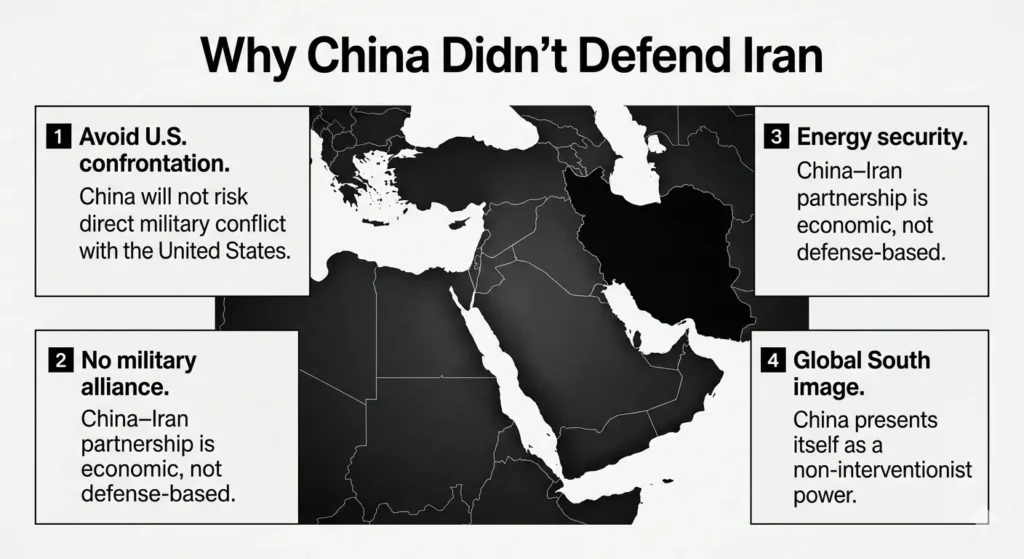
Instead, China remained largely absent from the battlefield. While Chinese officials condemned the strikes and called for restraint, Beijing avoided direct military involvement. This cautious approach revealed something fundamental about China’s global strategy: its partnerships are designed to expand economic and diplomatic influence, not to create military alliances.
Table of Contents
China’s Strategic Partnership Model
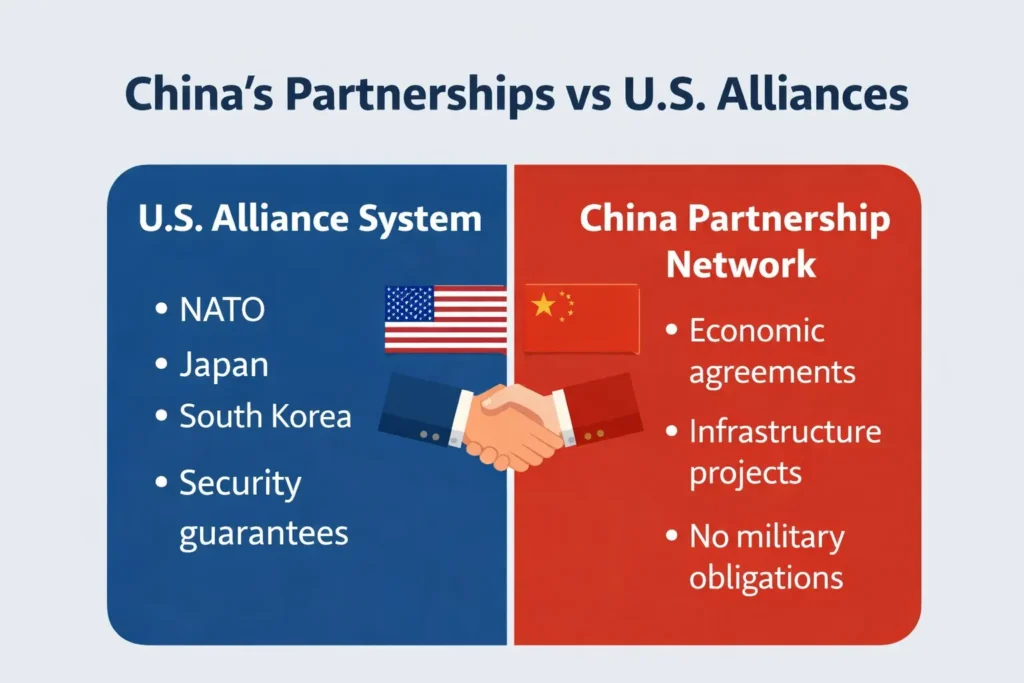
China’s relationship with Iran is often described as a strategic partnership rather than a military alliance. In 2021 the two countries signed a long-term cooperation agreement covering energy, infrastructure, and investment. However, the agreement does not include mutual defense obligations.
This reflects a broader feature of Chinese foreign policy. Beijing prefers flexible partnerships that expand trade, infrastructure development, and diplomatic influence without binding military commitments. Unlike the United States and its NATO allies, China rarely promises to defend partners in wartime.
As a result, when the Iran war escalated, Beijing’s response focused on diplomacy and economic stability rather than military intervention.
Limits of China’s Military Reach
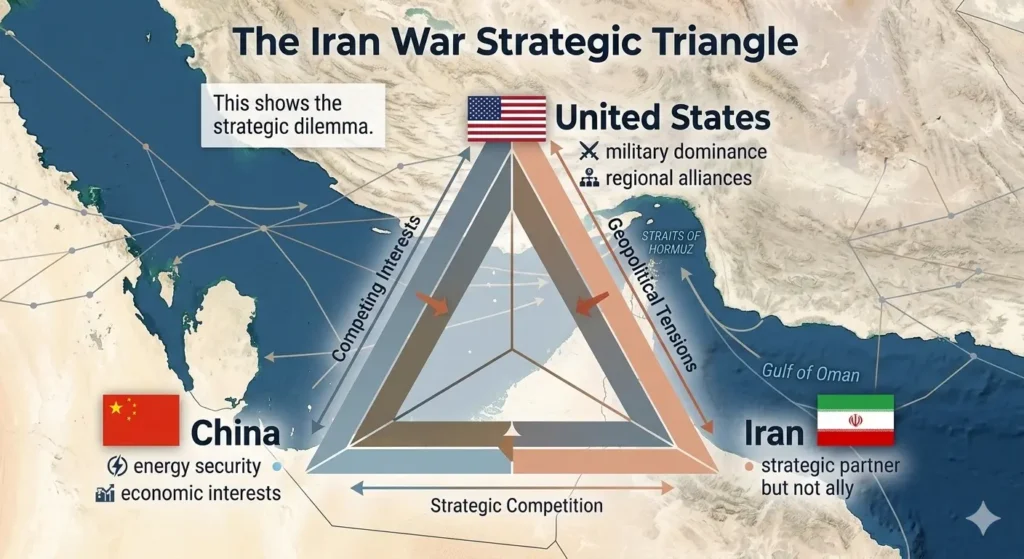
The China Iran war debate also highlights the limits of China’s global military reach. Although China possesses the world’s largest navy by ship numbers, its power projection capabilities remain concentrated in the Indo-Pacific region.
The Middle East remains a strategic theater dominated by U.S. military infrastructure, including major bases, naval deployments, and regional alliances. Direct intervention on Iran’s behalf would have risked confrontation with a far larger American military presence.
For Chinese leaders, entering such a conflict would offer limited strategic benefit while carrying enormous geopolitical risk.
Energy Security and Economic Interests
Energy security is another major factor shaping Beijing’s calculations. China is the world’s largest oil importer, and a significant portion of its energy supply flows through the Persian Gulf.
Escalation in the region—particularly any disruption of the Strait of Hormuz—could threaten global oil markets and China’s economic stability. From Beijing’s perspective, preserving regional stability matters more than defending a single partner.
By avoiding military involvement in the China Iran war scenario, Beijing aimed to protect its broader economic interests across the Middle East.
What the Iran War Reveals About China’s Strategy
The 2026 Iran war therefore offers an important lesson about China’s global strategy. Beijing’s growing network of strategic partnerships is not designed to replicate the U.S. alliance system. Instead, it functions as a flexible network focused on trade, infrastructure, and diplomatic influence.
This model allows China to expand its global presence while avoiding costly military commitments. However, the Iran conflict also reveals the limits of such an approach. When crises escalate into open warfare, economic partnerships alone may not translate into meaningful security guarantees.
In this sense, the China Iran war question illustrates a broader geopolitical reality: while China’s global influence is expanding rapidly, it still operates within a strategic framework that prioritizes economic power and stability over direct military intervention.
Related Analysis
- Why the Strait of Hormuz Matters in Global Energy Security
- How the Iran War Is Impacting Defence Markets
Source: Reuters, international policy analysis