
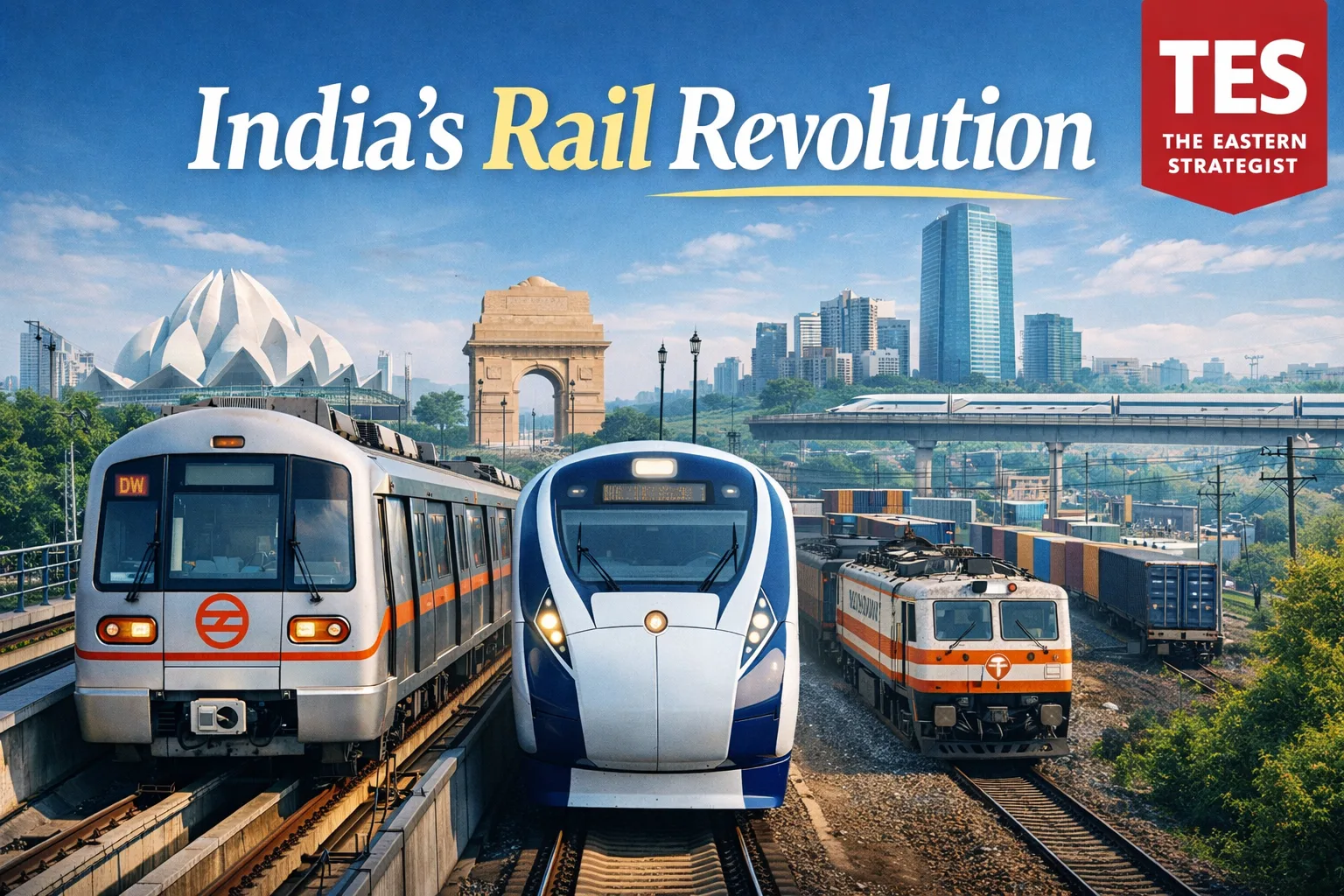
India’s Rail Revolution is transforming how the country moves people and goods. From the rapid expansion of the Delhi Metro to the rise of Vande Bharat trains and modern freight corridors, India is investing heavily in railway infrastructure to support economic growth and urban mobility.
For many years, Indian Railways was known mainly for crowded trains, slow freight movement, and old infrastructure. It carried millions of people every day, but few saw it as a symbol of modern technology or national transformation.
That picture is now changing fast.
In 2026, India’s railway system is going through one of the biggest modernization drives in its history. New metro networks, electrified rail lines, modern stations, faster trains, and freight corridors are changing how people travel and how goods move across the country.
At the center of this change stands one of India’s biggest public transport success stories: the Delhi Metro.
India’s rail story is no longer about catching up. It is now about building a faster, cleaner, and more connected economy.
Indian Railways remains one of the largest railway networks in the world. More information about infrastructure modernization and railway development can be found on the official Indian Railways website.
Delhi Metro: The Face of Modern Urban Mobility
The Delhi Metro is now one of the most important transport systems in urban India.
Since its launch in 2002, the network has expanded across Delhi and major nearby cities such as Noida, Gurugram, Ghaziabad, and Faridabad. It has become the backbone of daily mobility in the National Capital Region.
Every day, millions of people depend on it for work, education, business, and essential travel. But the impact of Delhi Metro goes far beyond convenience.
It has helped reduce road congestion, improved travel reliability, lowered pollution pressure, and made city movement more efficient. For businesses, faster commuting means better productivity. For families, it means safer and more predictable travel. For the city, it means a more modern transport culture.
The Delhi Metro has also created a model that other Indian cities are now following. Metro systems in cities such as Mumbai, Bengaluru, Hyderabad, Ahmedabad, and Pune are all part of this larger urban rail shift.
The success of the Delhi Metro has made it one of the most respected urban transport systems in the world. According to the official Delhi Metro Rail Corporation, the network continues to expand and serve millions of passengers across the National Capital Region every day.
Why Delhi Metro Matters
- Improves daily commuting speed
- Reduces traffic pressure on roads
- Supports cleaner urban transport
- Helps businesses through better connectivity
- Acts as a model for metro expansion across India
Why Rail Modernization Matters for the Economy
India’s rail transformation is not only about passengers. It is also about the economy.
For years, one major weakness in India’s growth story was the high cost of moving goods. Logistics costs in India have often remained around 13% to 14% of GDP, which is high compared with many advanced economies.
That matters because expensive transport makes almost everything cost more. It affects industry, exports, food prices, and supply chains.
To fix this, the government has pushed railways into the center of its economic strategy. The idea is simple: if goods move faster and cheaper, businesses become more competitive and the economy becomes more efficient.
Dedicated Freight Corridors Are Changing the Game
One of the biggest parts of this transformation is the development of Dedicated Freight Corridors.
These corridors are built mainly for cargo trains, which means freight can move with fewer delays and better speed. This reduces pressure on passenger routes and improves reliability for manufacturers, traders, and ports.
For businesses, the result is clear:
- Faster movement of goods
- Lower transport costs
- Better delivery timelines
- Stronger supply chain planning
This is especially important for a country that wants to expand manufacturing and improve export competitiveness.
Record Investment Is Driving the Change
The scale of investment behind India’s rail modernization is historic.
For the 2026–27 fiscal year, the Ministry of Railways received an allocation of about ₹2.78 lakh crore. Capital expenditure has risen to roughly ₹2.9 lakh crore, showing how strongly the government is backing long-term rail infrastructure.
This money is funding major projects across the country, including new rail lines, station redevelopment, modern signaling systems, electrification works, new train fleets, and freight and logistics corridors.
Unlike short-term spending, rail investment creates assets that support the economy for decades. It also creates demand in sectors such as steel, cement, engineering, and manufacturing.
India’s Green Rail Shift
Another major part of this rail revolution is electrification.
India has moved rapidly toward building one of the world’s largest electrified rail networks. With almost the entire broad-gauge system now electrified, Indian Railways is reducing dependence on diesel and cutting long-term fuel costs.
- Lowers operating costs
- Reduces dependence on imported fuel
- Supports India’s climate goals
- Makes rail transport cleaner and more efficient
In simple terms, a cleaner railway network is not just good for the environment. It is also good economics.
Vande Bharat and a New Passenger Experience
Passenger expectations are also changing.
The introduction of Vande Bharat trains has given many routes a more modern identity. These trains are faster, more efficient, and more comfortable than many older services. They also signal something important: Indian passengers are now expecting railway travel to feel modern.
At the same time, the Amrit Bharat Station Scheme is helping transform railway stations across the country. Stations are being upgraded with better design, cleaner surroundings, digital systems, and improved passenger facilities.
This changes the way people experience rail travel. Stations are no longer seen only as crowded waiting points. They are slowly becoming modern public spaces and multi-modal transport hubs.
A modern station is not just a stop on a route. It is a signal of how seriously a country takes mobility, dignity, and growth.
Connecting Regions That Were Left Behind
Rail expansion is also changing India’s economic geography.
For decades, many parts of India remained underconnected, especially remote regions, border zones, and smaller cities. That limited industrial growth and reduced mobility.
New railway projects are now extending connectivity into these areas. Better rail links can help move people, goods, and investment into regions that were previously left out of the development story.
This is important not only for economic inclusion, but also for national integration and strategic mobility.
Strategic Outlook: Why This Rail Shift Matters
India’s rail modernization should be seen as a national strategy, not just a transport upgrade.
A stronger railway system helps in multiple ways at once. It improves daily life in cities. It reduces logistics pressure on businesses. It supports cleaner transport. It strengthens industrial growth. And it prepares India for a future where infrastructure quality will decide economic competitiveness.
This is also where Delhi Metro becomes especially important. It shows that well-designed, disciplined, and modern rail systems can change not just mobility, but also urban behavior and economic productivity.
If India can combine the success of urban systems like Delhi Metro with national rail modernization, the result could be transformational. It would mean faster cities, stronger supply chains, better regional balance, and a transport network ready for a much larger economy.
Conclusion
India’s rail revolution is no longer a promise on paper. It is visible on the ground.
From Delhi Metro’s success in urban mobility to freight corridors, electrification, and station modernization, the country is building a railway system that is faster, cleaner, and more strategic than before.
Indian Railways is no longer just carrying passengers and cargo. It is helping shape the next phase of India’s growth story.
And if this momentum continues, railways may become one of the most important engines behind India’s long-term economic rise.
About the Author
Saket Shivam is an engineer associated with the Delhi Metro system and works in urban rail infrastructure and transport systems. His professional interests include metro expansion, railway modernization, railway electrification, and sustainable urban mobility in India. He contributes analysis on infrastructure development, transportation policy, and India’s evolving railway network.
The views expressed are personal and do not represent the official position of the Delhi Metro Rail Corporation.
India’s railway transformation is already reshaping the country’s economic landscape. From the rapid expansion of the Delhi Metro to freight corridors and electrified rail lines, the modernization of India’s transport infrastructure is gaining strong momentum. This shift is also closely connected with broader strategic developments in global trade and energy routes. For deeper analysis, read our coverage on how geopolitical tensions are influencing global markets and our report on recent strategic developments in the Middle East.