
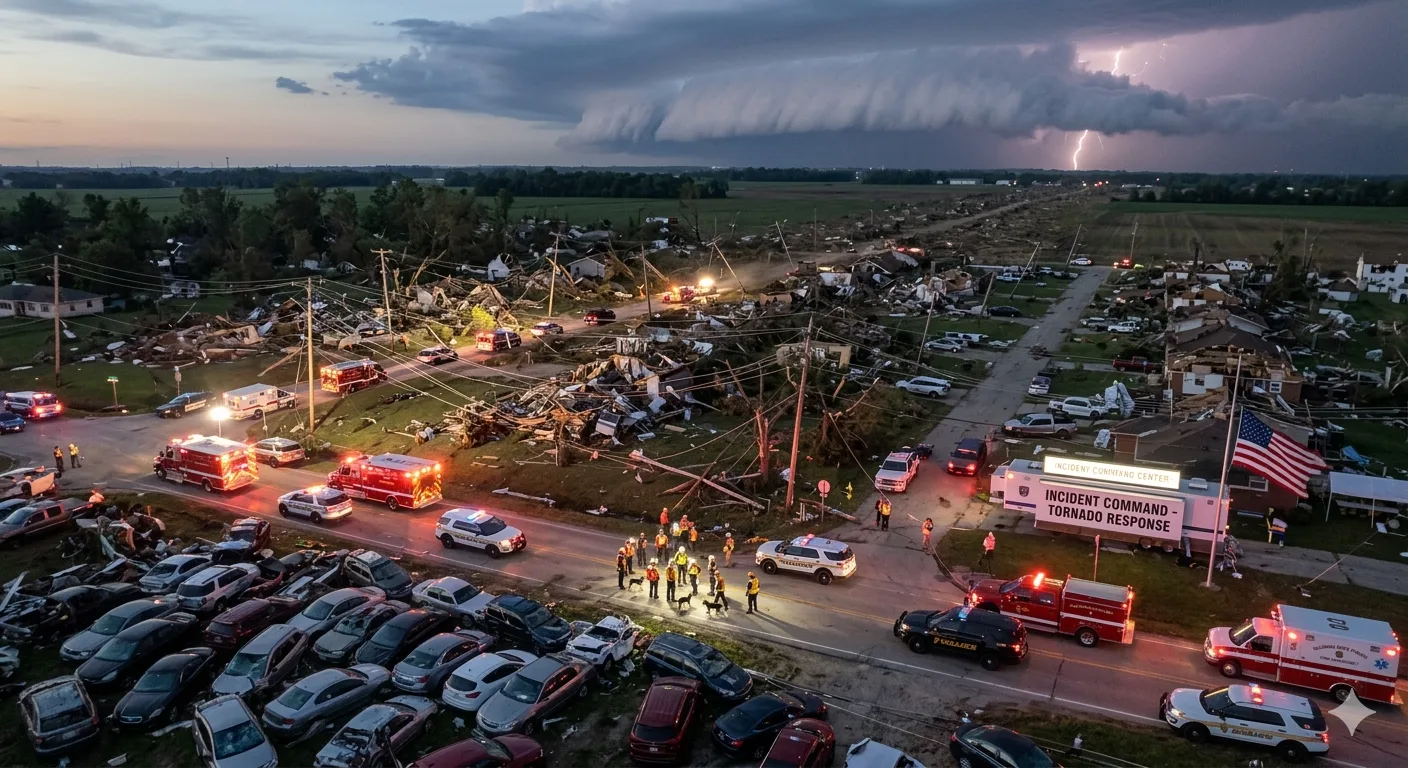
Midwest Tornado Outbreak:Two people died in Lake Village. On March 10, a massive supercell thunderstorm flattened entire neighborhoods in Newton County with extreme wind speeds.
Emergency responders spent the long night digging blindly through the scattered rubble of what used to be suburban homes. The death toll will climb.
Primary reports confirm the immediate destruction. The National Weather Service officially investigated a massive six-inch hailstone striking Kankakee on March 10.
Ground coverage from PBS NewsHour detailed two tragic fatalities within the heavily damaged Newton County disaster zone. And The Watchers tracked eight prior deaths.
The Illinois Impact and Record Hail
This is not an isolated event. Between March 5 and March 7, another violent frontal system spawned over 25 tornadoes across Michigan and Oklahoma.
That weekend weather outbreak killed eight people, including a young mother and daughter driving in Fairview, Oklahoma. The financial damage exceeds $450 million.
The markets are ignoring grid vulnerability. Over 70 utility poles snapped in a single Illinois county, leaving thousands of local residents freezing in the dark.
Regional energy monopolies like ComEd and NIPSCO have repeatedly deferred vital structural maintenance on aging transmission lines. Blackouts are a predictable feature.
Warm Gulf moisture met freezing air. This severe atmospheric temperature clash created immense energy across a massive 2,500-mile geographical corridor.
Violent instability allowed rapidly rotating updrafts to form giant supercells capable of dropping historic hail and tornadoes. The atmosphere simply boiled over.
The Eastward Expansion Threat
The storm threat is moving east. By March 11, the violent squall line shifted aggressively toward Pennsylvania, Ohio, and the heavily populated Mid-Atlantic states.
Cities from Washington D.C. down to the southern Gulf Coast are currently bracing for severe 60 mph wind gusts. Urban centers are entirely unprepared.
Insurance premiums will skyrocket again soon. Property and casualty insurers took a massive financial beating in the Midwest during the 2025 convective storm season.
Firms like State Farm and Allstate have already begun quietly restricting new homeowner policies in high-risk zones. The middle class pays the price.
The real play here is location. Meteorologists have tracked a distinct eastward migration of severe weather events away from the traditional Great Plains states.
Yet Illinois and Indiana are now absorbing the extreme kinetic energy that used to safely dissipate over open Kansas farmland. Suburban density amplifies the financial ruin.
The Mechanics of Nighttime Casualties
Lake Township officials confirmed the devastation. Spokesperson Lori Postma described the chaotic scene in Lake Village as the complete annihilation of homes following a direct hit.
Indiana Task Force One is currently conducting desperate search and rescue operations amid the dangerous twisted debris. Survival requires sheer dumb luck.
Texas and Missouri also suffered heavily. Cities across the Edwards Plateau faced dangerous flash flooding and falling hail larger than two inches on Tuesday afternoon.
The U.S. Storm Prediction Center had to issue immediate enhanced risk warnings for San Angelo and Kerrville. The damage footprint is vast.
Nighttime tornadoes act as silent killers. When extreme atmospheric instability persists after sunset, sleeping residents completely miss the critical warning sirens and alert messages.
The Lake Village and Kankakee twisters both struck in the dark, blinding trained spotters and delaying emergency response times. Blind chaos rules the night.
State governments are scrambling for funds. Illinois Governor JB Pritzker immediately activated state emergency management protocols to quickly coordinate the cleanup in Kankakee County.
Newton County Sheriff Shannon Cothran begged local civilians to stay out of the disaster zones to allow heavy machinery access. The bureaucracy always moves slowly.
Supply Chain and Infrastructure Reality
The physics of large hail terrifies. To support a heavy six-inch ice stone, atmospheric updrafts must sustain upward wind velocities of nearly 100 miles per hour.
This brutal mechanical process requires an immense amount of latent heat release within the towering cumulonimbus cloud structure. Gravity eventually wins the fight.
Roofs cannot withstand this kinetic bombardment. Basic physics dictates that a six-inch ice stone falling at 106 mph strikes exactly like a dropped concrete block.
Automotive dealerships in Kankakee reported hundreds of completely destroyed inventory vehicles by early Wednesday morning as the sun rose. The local economy is paralyzed.
The March 5 outbreak set precedents. That earlier storm system dropped a deadly tornado directly into Cass County, Michigan, killing a young 12-year-old boy.
Union City saw three tragic fatalities and 12 severe injuries when a funnel cloud tore across a frozen lake. The death toll compounds weekly.
Urban flooding adds another misery layer. As the current storm system pushes into Ohio and Pennsylvania, heavy downpours threaten to completely overwhelm outdated municipal drainage systems.
The National Weather Service has already issued active flood watches for the vital I-95 corridor from Baltimore to Washington. Water destroys what wind leaves behind.
Economic Fallout and Failing Grid Systems
Corporate media focuses strictly on wreckage. But the underlying supply chain disruptions will heavily ripple through the agricultural and manufacturing sectors for several hard months.
Disrupted regional rail lines and closed interstate highways in the Midwest delay shipments of fertilizer and heavy industrial parts. Inflation feeds on these delays.
Building codes remain disastrously inadequate nationwide. Wood-frame housing construction in the Midwest is simply not designed to withstand EF3 or EF4 rotational shear forces.
The glaring lack of mandatory safe rooms in new residential developments practically guarantees future mass casualty events across the region. Profit margins dictate the building standards.
Local 911 dispatch centers collapsed completely. When the violent wedge tornado crossed South Schuyler Avenue in Kankakee, the massive volume of emergency calls overloaded outdated telecommunications.
First responders were forced to operate totally blindly without accurate digital location data for hundreds of trapped civilians. The system is structurally broken.
Radar technology provides only minutes warning. Meteorologists heavily rely on dual-polarization data to detect deadly debris balls lofted high into the atmosphere by active tornadoes.
By the time that data reaches a civilian smartphone, the violent vortex is already tearing through their living room. Time is an absolute luxury.
The Failure of Proactive Readiness
Recovery operations will drag into summer. Heavy equipment operators are currently clearing massive uprooted trees from Aroma Park and Strasma South Drive block by block.
Utility crews must plant hundreds of new wooden poles before they can even begin restringing the local high-voltage lines. Life stops in the disaster zone.
The insurance industry dictates recovery timelines. Corporate adjusters will flood into Newton and Kankakee counties by Thursday to heavily lowball desperate homeowners holding destroyed policies.
Independent contractors will ruthlessly exploit the chaos by charging exorbitant premiums for basic roof tarping and rapid debris removal. Disaster capitalism thrives in the Midwest.
We witness a failure of readiness. The United States endures 1,200 tornadoes annually, yet emergency protocols still heavily rely on reactive charity rather than proactive hardening.
Relying on the American Red Cross to shelter displaced families in high school gymnasiums is not a serious long-term strategy. The storms will only intensify.
The Indiana deaths were entirely preventable. These victims resided in a highly vulnerable structure placed directly in the path of a highly predictable violent mesocyclone.
If Newton County possessed adequate community storm shelters, those two elderly residents would be eating their normal breakfast right now. We normalize completely preventable natural tragedies.
Market Mispricing and Future Vulnerability
Financial markets consistently misprice severe weather. Ignorant investors continue to pour capital into regional banks heavily exposed to residential mortgages in these newly expanded tornado corridors.
When a $500 million storm wipes out an entire zip code, the local tax base vanishes instantly overnight. The mortgage default rates will follow.
The Gulf of Mexico runs hot. Sea surface temperatures remain well above historical averages, pumping an endless supply of low-level moisture northward into the jet stream.
This thermal energy acts as high-octane fuel for any passing upper-level trough aggressively crossing the high Rocky Mountains. The engine never runs completely dry.
The federal government is dangerously overextended. FEMA is already burning through its limited congressional budget dealing with ongoing western wildfires and previous coastal hurricane damage.
Another billion-dollar disaster in the Midwest will severely strain the federal agency past its maximum operational breaking point. Washington will eventually write blank checks.
Look closely at the agricultural fallout. Kankakee County is a massive producer of corn, and this storm stripped topsoil and destroyed critical planting equipment yesterday.
The brutal six-inch hail pummeled commercial greenhouses and physically shattered million-dollar farm implements just weeks before the planting season. Food prices reflect this quiet devastation.
The eastward trajectory is highly concerning. As the aggressive cold front collides with the dense population centers of the Mid-Atlantic, the target shifts toward concrete grids.
A localized tornado in the crowded suburbs of Pittsburgh or Columbus causes exponentially more economic destruction and human death. Urban density equals massive physical vulnerability.
We must reevaluate our national risk. Continuing to build cheap infrastructure in regions experiencing a verifiable increase in extreme convective storms is a total fool’s errand.
Local zoning boards are completely complicit in this ongoing cycle of absolute destruction and taxpayer-funded rapid rebuilding. The math no longer works here.
The real play is commodity demand. Rebuilding Kankakee and Lake Village will rapidly require immense quantities of oriented strand board, roofing shingles, and raw copper wiring.
Regional suppliers in the Midwest will face immediate stock shortages as aggressive contractors furiously bid up the limited available inventory. Watch the regional building supply equities.
Strategic Bottom Line
A total insurance collapse is coming. Expect the rapid withdrawal of affordable property insurance across the vital I-80 corridor over the next twelve to eighteen months.
Legacy carriers will aggressively file for massive 30% rate hikes or abandon the Illinois and Indiana markets entirely to survive. Smart capital shorts regional insurance providers.
For more developing stories, read our
Iran war first week analysis
and our report on the
Iran war impact on India.
You can explore more geopolitical and strategic coverage across
The Eastern Strategist.