📌 The BLUF (Bottom Line Up Front): Why This Matters to US Business
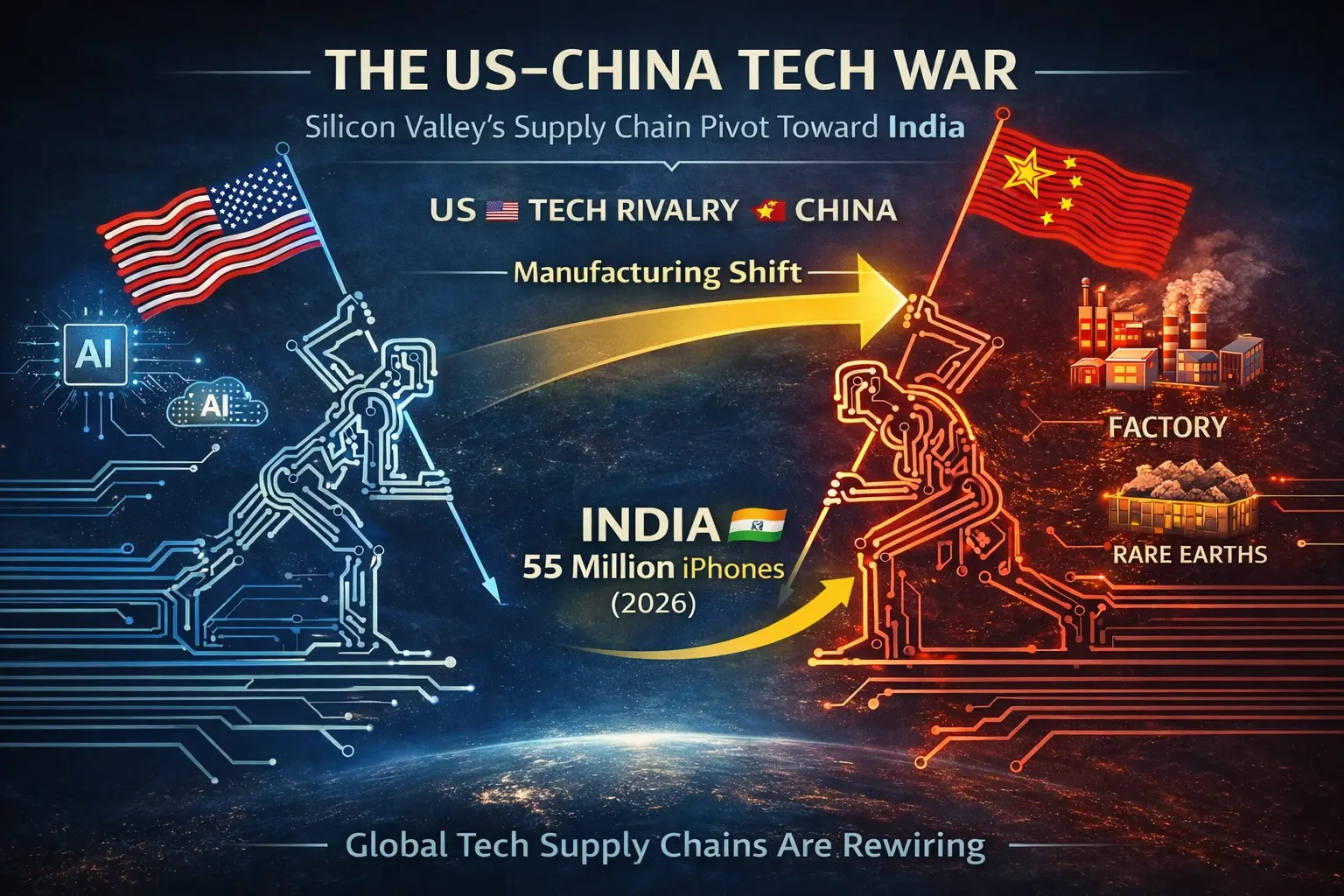
- The Hardware Exodus: Escaping punitive US tariffs and supply chain vulnerabilities, Silicon Valley is accelerating its departure from China. In a historic milestone, India officially overtook China as the top source of US-bound smartphones, with Apple manufacturing roughly 55 million iPhones in India (25% of its global output).
- The Paris Negotiations & The Rare Earth Crisis: As US Treasury Secretary Scott Bessent meets with Chinese officials in Paris this week to prep for the March 31 Trump-Xi summit, severe shortages of critical Chinese minerals like yttrium and scandium have forced North American aerospace suppliers to pause production, exposing fatal flaws in US tech supply chains.
- India’s Export Masterstroke: With India’s current tech manufacturing subsidies expiring this month, New Delhi is drafting an aggressive “Phase 2” incentive program for April 2026. This new policy directly targets the US-China rift by rewarding deep-tier local component sourcing, transforming India from a simple assembly hub into a foundational pillar of the global supply chain.
The US-China tech war has moved far beyond political rhetoric. In 2026, it is reshaping the physical geography of the global economy.
This week, the fragility of the global supply chain is on full display at the OECD headquarters in Paris. US Treasury Secretary Scott Bessent, US Trade Representative Jamieson Greer, and Chinese Vice Premier He Lifeng are locked in intense negotiations. Their goal is to hammer out “managed trade” deliverables ahead of President Donald Trump’s highly anticipated state visit to Beijing at the end of March.
While diplomats debate agricultural purchases and tariff truces behind closed doors, the underlying reality for American tech giants is stark: decoupling from China is no longer optional, but it requires a massive safety net. Triggered by Washington’s aggressive export controls on advanced technology and the shockwaves of Chinese AI advancements challenging Silicon Valley’s dominance, the tech industry is scrambling for stable ground.
Where do the multi-billion-dollar manufacturing lines, critical mineral processing, and AI supply chains go? From an Eastern strategic perspective, the answer is increasingly clear. Silicon Valley’s survival in the next phase of the tech war relies almost entirely on India’s next move.
1. The Apple Blueprint and India’s New Export Masterstroke
To understand the sheer scale of the shift, US business leaders only need to look at the world’s most valuable company.
Apple’s pivot to India is the bellwether for Silicon Valley. Driven by the constant threat of US import tariffs on Chinese goods, Apple orchestrated a historic supply chain migration. By early 2026, Apple produces 25% of its global iPhones in India, shipping around 55 million units—a staggering 53% surge from the previous year. The shift is so profound that in mid-2025, India officially overtook China as the largest source of smartphones shipped to the US.
But assembly is only the first phase. The true strategic shift is happening right now. India’s wildly successful Production-Linked Incentive (PLI) scheme for smartphones expires on March 31, 2026. In response to the widening US-China rift, New Delhi is actively finalizing a “Phase 2” policy.
Unlike the first program, which simply rewarded domestic output, the upcoming April 2026 framework explicitly ties massive government subsidies to export volumes and deep localization. Manufacturers will now receive tiered, maximum benefits only if they source complex sub-assemblies—like camera modules and display chips—from within India. By intentionally transitioning from import substitution to export dominance, India is actively engineering the exact geopolitical safe harbor that US manufacturers desperately need. The “China Plus One” strategy has essentially become the “India First” strategy.
2. The Rare Earth Squeeze and the Aerospace Crisis
The tech war is not just about consumer electronics; it is a battle for “innovation sovereignty” and the physical materials required to build the future. The Paris talks have highlighted a glaring US vulnerability: total reliance on Chinese heavy rare earth elements (HREEs).
China controls roughly 99% of the world’s yttrium and dominates scandium processing. Over the past few months, Beijing’s targeted export controls on these niche materials have created a silent crisis in the US industrial base. Yttrium prices have surged 60%, and the element is essential for the high-temperature coatings that keep aerospace engines from melting.
Because of these supply bottlenecks, at least two North American aerospace coating companies have been forced to temporarily pause production, threatening downstream supply chains for Boeing and US defense contractors. Simultaneously, US semiconductor makers are running dangerously low on scandium, which puts the production of next-generation 5G chips at immediate risk. The US currently has zero domestic scandium production and lacks fully operational alternatives outside of China.
This is the exact leverage Chinese negotiators are utilizing in Paris. For American CEOs, it proves that supply chains tethered to geopolitical rivals are fundamentally uninsurable.
3. “Pax Silica” and the Regulatory Walled Garden
To find stability away from these geopolitical choke points, Washington and Silicon Valley are working to build a walled garden of trusted partners. This culminated in India joining Pax Silica, a US-led international alliance aimed at reducing dependence on non-aligned nations for AI infrastructure, advanced semiconductors, and critical minerals.
This follows the newly minted TRUST framework (Transforming the Relationship Utilizing Strategic Technology) between Washington and New Delhi, alongside aggressive new investments from the US Defense Industrial Base Consortium. For Silicon Valley, these maneuvers mean the US government is officially underwriting and protecting tech investments made in the subcontinent.
American firms looking to diversify their chip packaging or secure mineral supply chains now have a green-lit, geopolitically secure alternative. We are already seeing the fruits of this: Apple is reportedly in talks with Indian firms like the Murugappa Group to begin semiconductor packaging in Gujarat, moving significantly up the value chain.
4. The End of “Just Software”
For decades, Wall Street and Silicon Valley viewed India primarily as the world’s back office—a limitless pool of software developers and IT support. The US-China tech war has violently disrupted that paradigm.
As the US pushes to re-industrialize, it lacks the sheer demographic scale, environmental leeway, and raw material processing power to replace China’s manufacturing output entirely domestically. The US CHIPS Act can subsidize mega-factories in Arizona or Texas, but the broader ecosystem of components, sub-assemblies, and rare earth refining requires a partner with massive scale.
India is stepping into this role, transitioning from a software exporter to a comprehensive hardware and deep-tech ecosystem. With heavy US investments pouring into Indian critical mineral processing and domestic semiconductor fabrication, the supply chain is deepening at an unprecedented rate.
The Strategic Takeaway for US Leaders
The US-China tech war is not a temporary trade dispute to be solved over a few days in Paris; it is a permanent bifurcation of the global technology ecosystem.
As the March 31 Trump-Xi summit approaches, the Eastern perspective reveals a critical vulnerability for American tech executives and investors: The US cannot successfully decouple from China without aggressively coupling with India. Whether it is navigating the chaotic export regulations of Washington, securing heavy rare earth minerals for jet engines, or finding a scalable alternative for consumer electronics manufacturing, Silicon Valley’s roadmap for the next decade runs directly through New Delhi. The companies that recognize this structural shift today will be the ones who survive the tech war tomorrow.