
Bangkok / New Delhi — Thailand’s revived Land Bridge proposal across the Kra Isthmus is, at first glance, a familiar kind of Southeast Asian infrastructure pitch: ambitious, expensive and described by its backers as a way to improve trade efficiency. But the project has drawn attention well beyond Thailand because it touches a far more sensitive issue — the degree to which Asia’s shipping system still depends on a single narrow route, the Strait of Malacca.
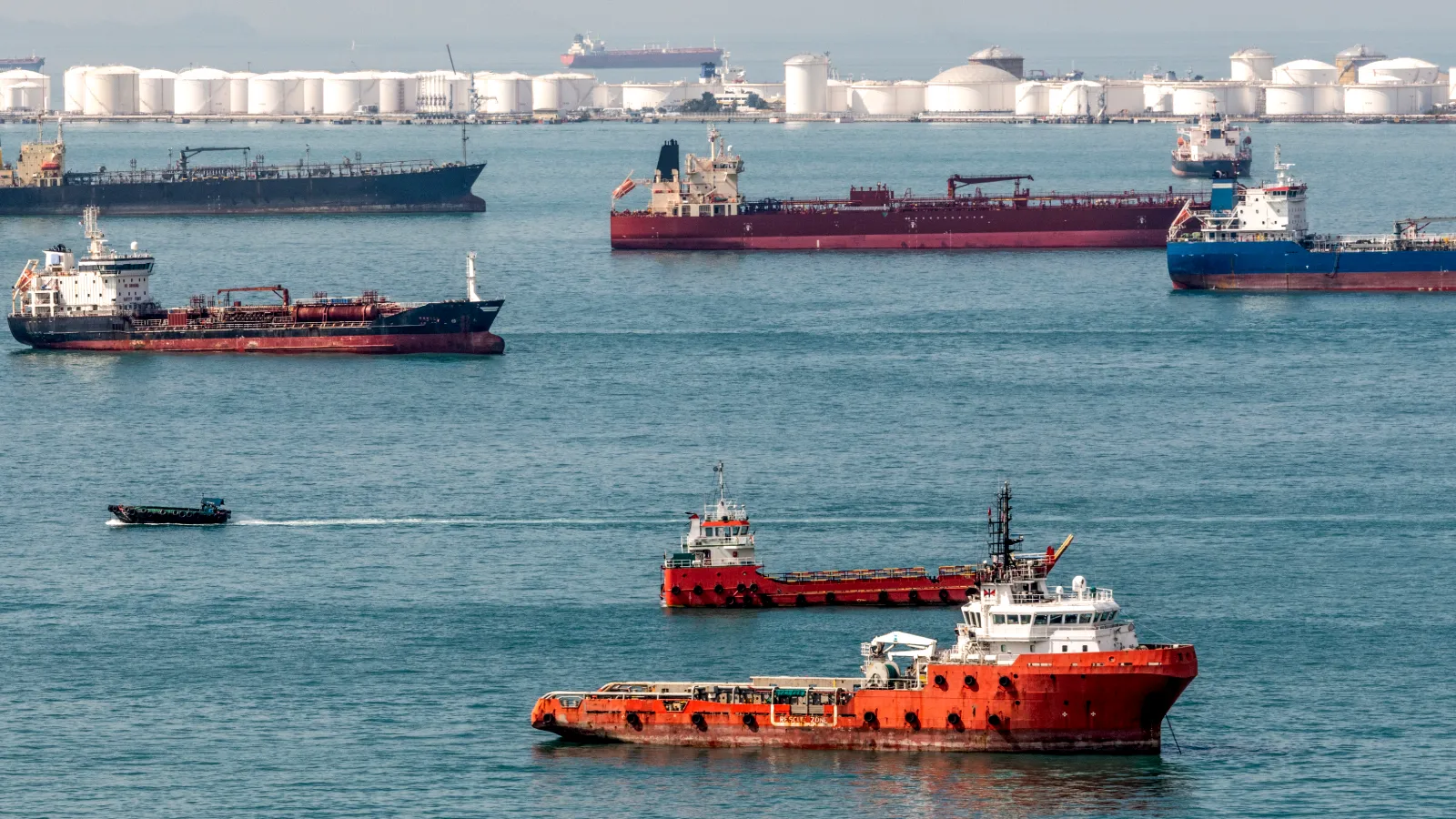
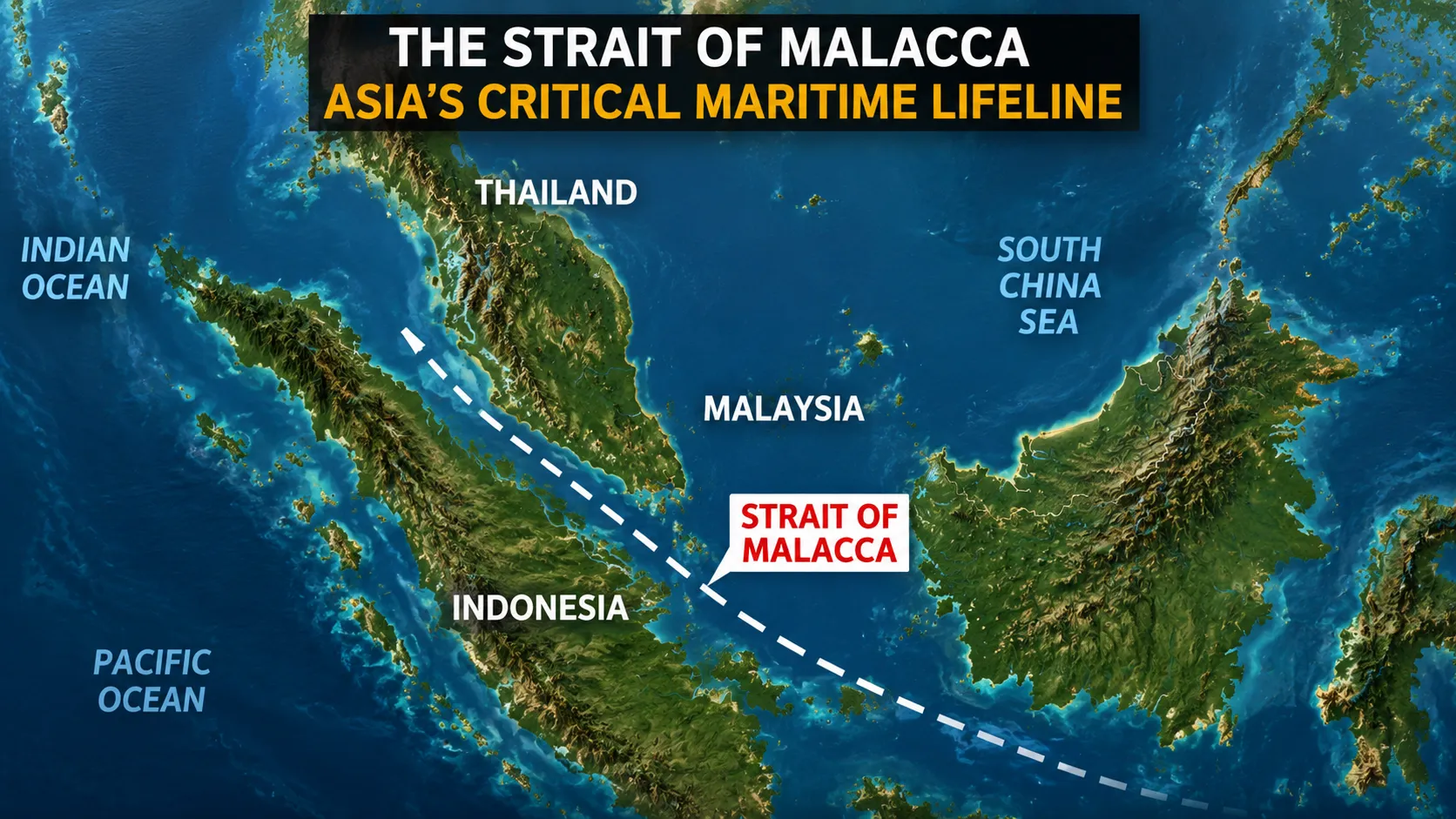
That dependence is not a theoretical problem. Reuters has reported that the Malacca Strait carried more than 102,500 ships in 2025, underscoring both its scale and its fragility. The route is vital for energy imports and container traffic moving between the Indian Ocean and East Asia. For China in particular, the strategic concern is long-standing: the bulk of its imported crude still travels through waters that Beijing does not control. Thailand’s proposal does not solve that problem. But it does raise a question that has become more urgent in recent years: whether Asia’s trade map can be made less dependent on one maritime bottleneck.
The old problem is still the same
The Strait of Malacca is not merely a busy shipping lane. It is a structural dependency. Energy cargoes bound for East Asia pass through a corridor narrow enough to make even modest disruptions consequential for freight rates, insurance costs and supply-chain planning. That is why the route remains central to strategic thinking in Beijing, New Delhi and several Southeast Asian capitals.
For China, the so-called “Malacca dilemma” has never been about a single point of failure in a narrow military sense. It is better understood as a persistent logistics constraint: a reminder that the world’s second-largest economy remains exposed to external pressure along a route it cannot reliably secure. The answer, from Beijing’s perspective, is not necessarily to replace Malacca outright, but to diversify away from exclusive dependence on it. A Thai land corridor would not end that vulnerability. It might, however, give policymakers and shippers another option. That alone is enough to make the project strategically relevant.
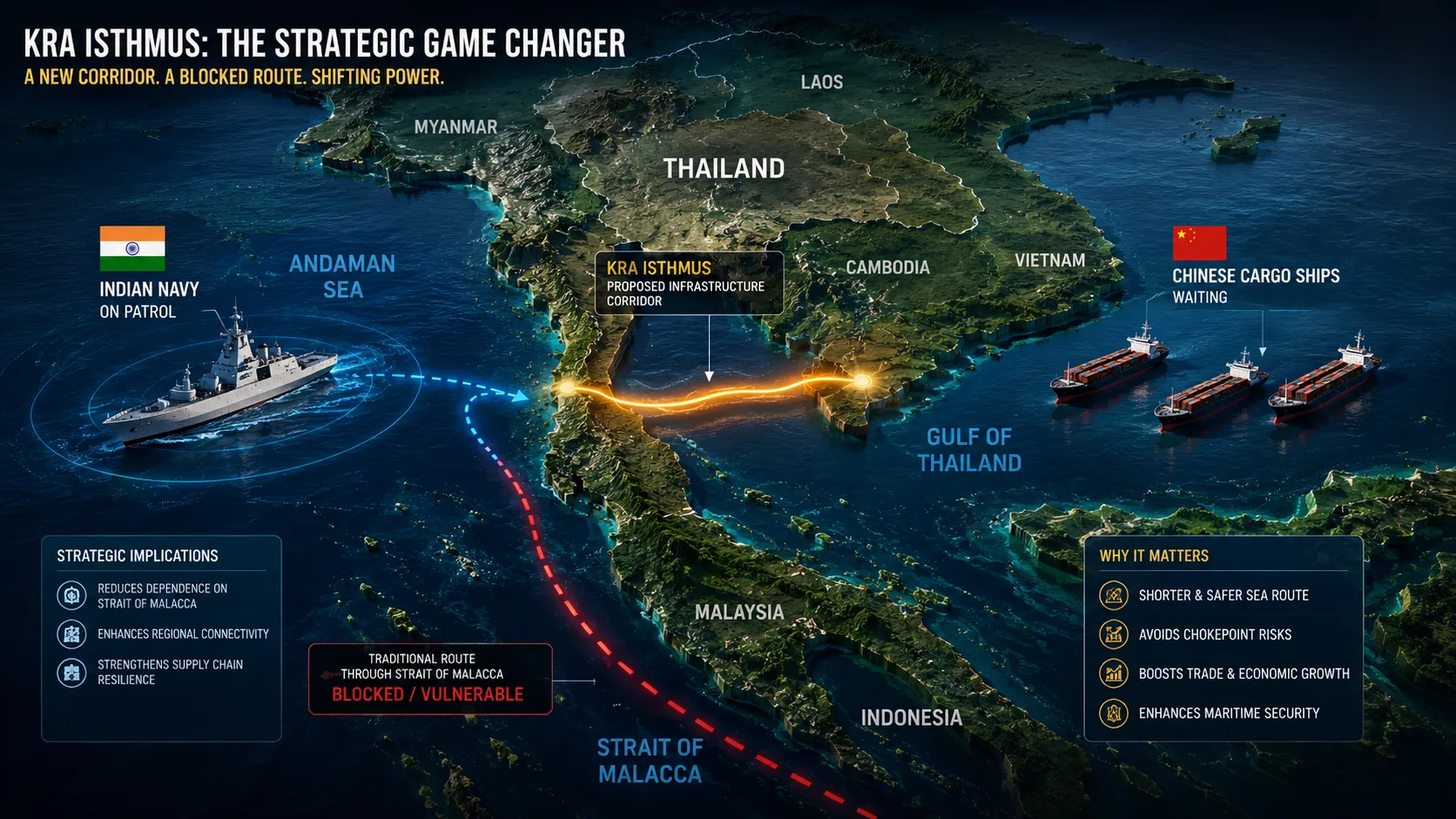
India sees the issue from the opposite side of the same geography. The Andaman and Nicobar Islands sit close to the western approaches to the Malacca Strait, giving New Delhi a useful vantage point over one of Asia’s most important maritime corridors. The Indian navy operates as part of the joint defence command in the islands, a reminder that the area is treated in New Delhi less as a remote archipelago than as a forward strategic position. Even so, India’s advantage is one of visibility, not control. The country can observe and complicate, but not dictate, the flow of trade through the strait.
Related background can be read in TES coverage of Indian Ocean subsea cable geopolitics, Pax Silica and strategic infrastructure networks, and the Hormuz crisis and global chokepoints.
What Thailand is actually proposing
The geography of the Kra Isthmus explains why the idea keeps resurfacing. Britannica describes the Isthmus of Kra as the narrow neck connecting the Malay Peninsula to the Asian mainland, separating the Andaman Sea from the Gulf of Thailand. At its narrowest point, it is only a few dozen kilometres wide. That makes a canal conceivable in theory, but also politically intrusive, environmentally contentious and economically difficult. Thailand has therefore returned, once again, to the more modest land bridge concept.
Reuters reported in April that Thailand was reviving a version of the project at a cost of about $31 billion, with two deep-sea ports — one at Ranong on the Andaman coast and one at Chumphon on the Gulf of Thailand — linked by roughly 90km of road, rail and pipeline infrastructure. Cargo would be transferred overland between the two coasts rather than sailing around the southern tip of the peninsula. The idea is simple enough to explain, which is one reason it keeps reappearing. But infrastructure of this sort has a habit of becoming more complicated the moment it moves from a presentation deck to a financing model.
Thailand’s political instinct is to frame the project as a commercial proposition rather than a geopolitical one. That is understandable. Large infrastructure schemes are easier to sell if they are described as logistics upgrades, not as moves in a regional contest. But the distinction can be overdrawn. Ports, rail corridors and pipeline links are commercial assets first, but in a strategic environment they also become instruments of leverage, connectivity and influence.
China’s interest is obvious, but not straightforward
China’s interest in the project would be obvious even if Chinese officials were not involved. Any corridor that reduces reliance on a single maritime chokepoint will appeal to a country whose energy imports and export routes remain heavily exposed to maritime disruption. Yet that does not mean the project should be read as a disguised military foothold. The more immediate issue is logistics resilience, not naval power.
Still, the line between commercial infrastructure and strategic utility is rarely clean in Asia. If Chinese firms participate in financing, construction or operations, the Land Bridge would sit within a broader pattern of Belt and Road-linked infrastructure development. That would not automatically make it a Chinese asset in the military sense. It would, however, increase Beijing’s practical exposure to the project and make the corridor part of China’s long-term supply-chain architecture. The project’s significance lies in this ambiguity. It could be commercially justified and strategically relevant at the same time.
The broader context matters too. Reuters has reported that the revival of the Thai proposal has come amid renewed concern about the vulnerability of major chokepoints, including the Strait of Hormuz. In that environment, governments and shippers are more alert to redundancy than they were a decade ago. A route that once looked speculative can suddenly become interesting simply because the world appears less stable.
India’s response is more about posture than counter-projects
India’s position is more nuanced. New Delhi does not need to “match” the Thai project one-for-one. Its advantage lies in preserving strategic visibility over the eastern Indian Ocean and in strengthening its own connectivity with Southeast Asia. The India-Myanmar-Thailand Trilateral Highway remains part of that broader effort, as do India’s port and maritime cooperation initiatives in the region.
But India should not overstate its own leverage. The Andaman and Nicobar Islands give it proximity, not ownership, of the key maritime terrain. That distinction matters. Geography offers India an important observation point and a useful degree of deterrence. It does not give New Delhi the power to shape commercial routing on its own. If the Kra Isthmus project advances, India’s response will probably need to be less about naval signalling and more about competing infrastructure, trade links and diplomacy.
That is why this story matters beyond the narrow question of whether Thailand will build the corridor. It speaks to a wider shift in Indo-Pacific competition: states are increasingly using transport networks, energy corridors and digital infrastructure to shape strategic outcomes. The route that moves cargo may also shape the route that moves power.
Environmental and political limits may decide the project’s fate
For all the strategic interest, the project is far from inevitable. Thailand has been here before. The old Kra Canal idea was repeatedly discussed and repeatedly stalled, in part because of cost, environmental concerns and political resistance in the south. Those objections have not disappeared simply because the new proposal uses a different engineering model.
Environmental scrutiny is likely to remain severe. Large-scale development across southern Thailand would affect fisheries, marine ecosystems and local land use, and any project touching such a sensitive area will need to clear more than financial hurdles. It will require political consent, regional confidence and a credible business case. Infrastructure in strategic geography is often discussed as though geopolitics alone can carry it forward. In practice, it usually fails or succeeds on more mundane questions: financing, local acceptance and delivery.
That is why the Land Bridge should be viewed as an important test rather than a foregone conclusion. If the project can attract international investors and survive environmental review, it could become a meaningful addition to Southeast Asia’s trade architecture. If not, it will join the long list of ambitious Asian corridors that looked more significant on paper than in practice.
A corridor worth watching, but not yet a revolution
The most reasonable reading is also the least dramatic. The Kra Isthmus Land Bridge would not replace the Strait of Malacca. It would not end China’s maritime exposure. It would not transform Thailand into a regional hub overnight. But it could create an alternative logistics option in a part of the world where alternatives are becoming more valuable by the year.
That is enough to make it strategically interesting. A second route, even if limited, reduces dependence on the first. It also forces governments, shipping firms and investors to think about Southeast Asia less as a fixed map and more as a system that can still be redesigned. The project’s value, in other words, is not that it resolves the Malacca problem. It is that it demonstrates how seriously that problem is now being taken.
For TES Intel: the Kra Isthmus Land Bridge is best understood as a signal of how infrastructure is becoming strategy in the Indo-Pacific. It is not a replacement for the Strait of Malacca. It is a reminder that the region’s trade geography is no longer settled.
Sources & References
This analysis is based on open-source intelligence (OSINT), strategic think-tank reports, and geographic data regarding Indo-Pacific maritime security.
- Observer Research Foundation (ORF): Strategic analysis on the ‘Malacca Dilemma’ and India’s maritime posture.
- Asia Times: Open-source reporting on Thailand’s Land Bridge proposal and regional geopolitics.
- CSIS (Asia Maritime Transparency Initiative): Institutional tracking of maritime trade routes and chokepoints in Southeast Asia.
Note: TES Intel analysis combines open-source reporting with independent geopolitical interpretation and does not represent official statements from any government or institution.

1 thought on “Thailand’s Kra Isthmus Land Bridge Could Redraw the Strait of Malacca Trade Corridor and Shift Indo-Pacific Logistics Strategy”