
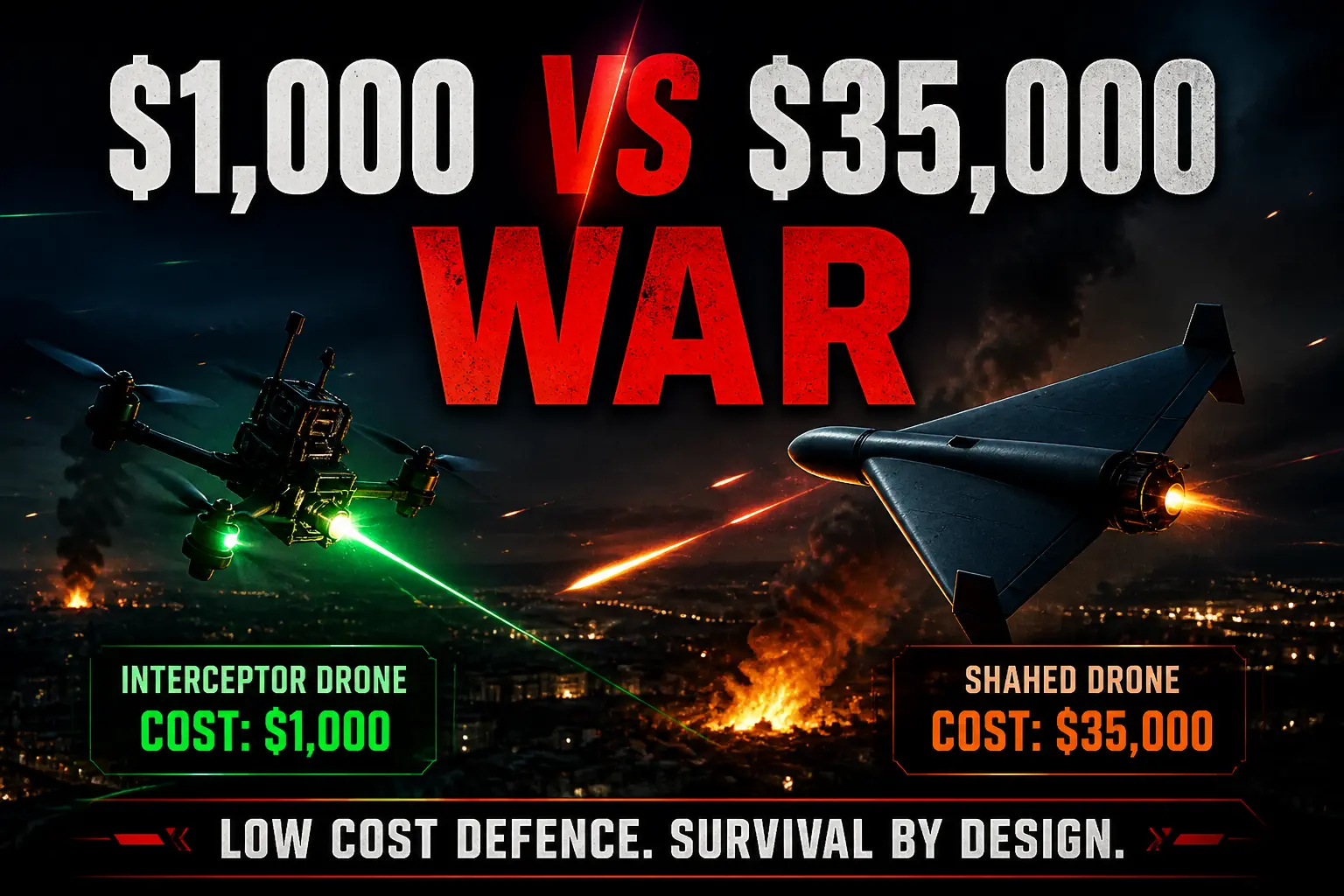
The Ukraine drone war is increasingly defined by cost. Kyiv is intercepting Russian Shahed attack drones with systems that cost as little as $1,000, according to Reuters reporting.
The shift highlights a growing imbalance in modern warfare: low-cost weapons forcing expensive defences into an unsustainable cycle.While a Shahed drone can cost up to $50,000, the missiles used to shoot them down can run into hundreds of thousands of dollars. Ukraine’s answer is simple—bring the cost of defence down, even if it means using multiple drones to stop one target.
The war is no longer just about who has better weapons. It is about who can afford to keep fighting.
A cost problem before a military one
The imbalance is straightforward. Firing a missile worth hundreds of thousands of dollars at a single incoming drone creates a losing equation over time. Even high interception rates become difficult to sustain financially.
This has pushed Ukraine toward a cost-imposition approach—reducing the price of defence faster than the attacker can reduce the price of attack.
Why Ukraine’s low-cost defence model is changing the economics of war
| System | Type | Estimated Cost |
|---|---|---|
| Shahed Drone | Attack (Russia/Iran) | $30,000 – $50,000 |
| Interceptor Drone | Defence (Ukraine) | $1,000 – $1,500 |
| Surface-to-Air Missile | Defence (Conventional) | $300,000 – $1M+ |
| Dark Eagle Hypersonic | Strategic Strike (U.S.) | Estimated tens of millions |
Estimates based on publicly reported ranges. Actual costs vary by configuration and deployment.
Small drone units, often operating in decentralized teams, are now tasked with intercepting incoming threats before they reach critical targets. The approach trades precision for scale.
What Ukraine is doing differently
The shift is not just technological—it is organisational.
Ukraine has expanded the number of drone operators and integrated them into air defence roles that were previously dominated by radar-guided systems and missiles. These teams rely on visual tracking, short-range interception and rapid deployment.
Interception is not always one-to-one. Multiple drones may be used to neutralise a single target. But at current price points, the exchange still favours defence.
An arms race in real time
Russia has adapted as well. Newer variants of the Shahed are faster and harder to intercept. Some reports point to jet-powered versions and improved navigation systems, reducing vulnerability in the final phase of flight.
Ukraine is responding by improving interceptor speed, automation and integration with electronic warfare systems. The cycle is iterative. Each side adjusts based on what works.
This shift is not limited to Ukraine. Similar cost pressures are shaping conflicts elsewhere.
The shift is not limited to Ukraine. In parallel conflicts, a different response is taking shape. In the Gulf, the United States has explored the potential deployment of its Long-Range Hypersonic Weapon, known as Dark Eagle, designed to strike heavily defended targets at extreme speed.
The contrast is clear. Ukraine is attempting to reduce the cost of defence through scalable drone interception. In the Middle East, escalation has leaned toward high-end strike capabilities and sustained pressure on infrastructure and supply chains.
As detailed in TES analysis of Operation Epic Fury and TES coverage of the Dark Eagle deployment debate , modern conflicts are diverging in method but converging in logic: cost, endurance and the ability to sustain pressure are becoming as important as battlefield precision.
Beyond Ukraine: a shift in air defence thinking
The model emerging in Ukraine is being closely watched. For decades, air defence has relied on expensive, centralized systems designed to counter aircraft and missiles. What is now visible is a distributed approach built around cheaper, scalable systems.
This has implications for countries facing similar threats, including India. The challenge is not just capability, but volume. Missile-heavy systems cannot easily scale to counter large drone swarms.
Lower-cost interceptors, produced domestically and in large numbers, may become a necessary layer alongside traditional defences.
Limits of the model
The approach is not a complete solution. Drone swarms can still overwhelm defences. Electronic warfare can disrupt both attackers and defenders. And production depends on supply chains that remain exposed to disruption.
Even with improvements, interception rates are unlikely to reach full coverage.
Conclusion
Ukraine’s approach is not perfect, and it does not stop every attack. But it is changing the equation. In long wars, the side that controls costs and adapts faster tends to endure.
That shift is already visible. And it is unlikely to remain limited to Ukraine.

1 thought on “$1,000 vs $35,000: How Ukraine Is Changing the Economics of War”