
Pax Silica: The next global alliance system may not be built around military treaties alone. It may be built around semiconductors, compute power and artificial intelligence infrastructure.
When Washington blocked China’s access to advanced AI chips, the move was framed publicly as a national-security decision. In Beijing, it was viewed differently — not as a trade dispute, but as the beginning of a technological containment strategy.
That distinction matters.
For years, artificial intelligence was treated as a commercial race dominated by Silicon Valley startups, venture capital and increasingly theatrical product launches. Governments watched closely, but mostly from the sidelines. That phase is ending.
AI is now moving into the center of geopolitical strategy.
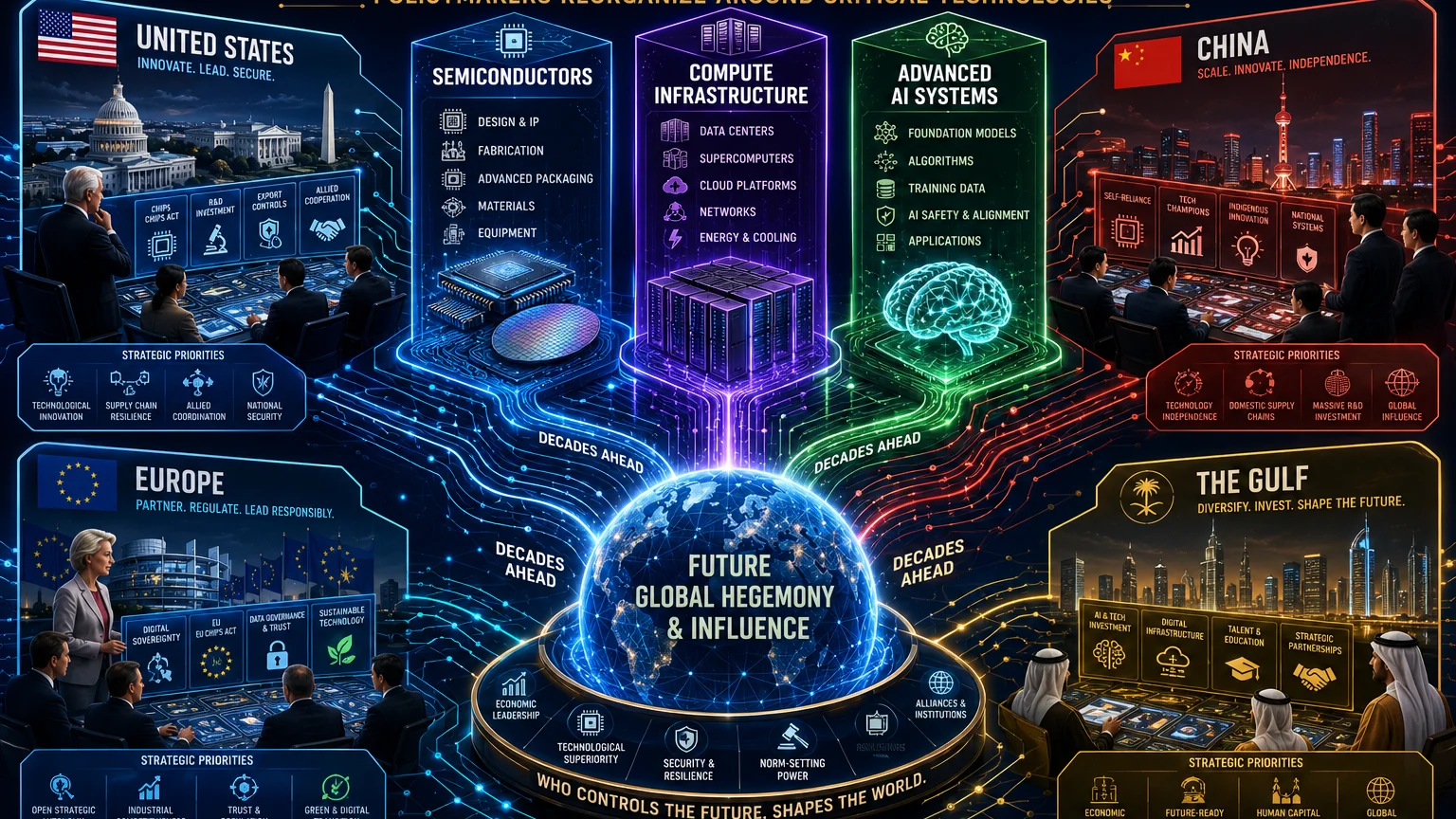
Illustration: The emerging geopolitical order of AI infrastructure, semiconductor alliances and competing compute ecosystems.
Across the United States, China, Europe and the Gulf, policymakers are reorganizing around a new assumption: the countries controlling semiconductors, compute infrastructure and advanced AI systems may shape the balance of global power in the decades ahead.
A quiet alliance structure is beginning to emerge around that reality.
Not a formal military alliance in the traditional sense. There are no treaty signings or NATO-style summits. But an ecosystem is taking shape nonetheless — built around trusted semiconductor supply chains, cloud infrastructure, AI partnerships and strategic technology access.
Call it Pax Silica.
The phrase describes an emerging geopolitical order where influence increasingly depends on control over silicon: advanced chips, hyperscale data centers, AI models and the infrastructure powering them.
Oil defined the industrial age. Compute may define the AI era.
And increasingly, countries are being pushed into competing technological spheres.
The New Geography of Power
The modern global economy was built on interconnected systems. For decades, globalization rewarded efficiency over resilience. Chips were designed in America, manufactured in Taiwan, assembled in Asia and shipped worldwide through deeply integrated supply chains.
AI is beginning to reverse that logic.
Training frontier AI models now requires extraordinary computational power. The infrastructure behind it is vast: advanced GPUs, semiconductor fabs, cloud campuses, cooling systems, power grids and enormous quantities of electricity.
This is not just software anymore. It is industrial capacity.
That shift is forcing governments to think differently about technology. Semiconductors are no longer being treated as ordinary commercial goods. They are increasingly viewed the same way previous generations viewed oil infrastructure, uranium enrichment or strategic naval chokepoints.
Washington moved first.
The United States imposed sweeping restrictions on advanced semiconductor exports to China, targeting both AI chips and the equipment needed to manufacture them. The policy also pulled allies into the effort, particularly the Netherlands and Japan, both deeply embedded in the semiconductor supply chain.
In recent months, U.S. lawmakers have pushed for tighter export controls targeting Chinese chipmaking access through restrictions involving Dutch semiconductor giant ASML and other allied suppliers. Reuters reported that Washington-backed proposals are increasingly focused on aligning export controls across allied countries to slow Beijing’s semiconductor ambitions. :contentReference[oaicite:0]{index=0}
The message was unmistakable: access to frontier compute would now be shaped by geopolitics.
The Partners of Pax Silica
The alliance taking shape around AI infrastructure is unusual because it is not entirely state-driven. Corporations sit at the center of it.
At the core is the United States, still dominant in advanced AI research, cloud infrastructure and chip design. Companies like NVIDIA, Microsoft and Google are no longer simply technology firms. They are increasingly strategic actors.
Then there is Taiwan.
Much of the global AI race runs through TSMC, the Taiwanese semiconductor giant manufacturing the world’s most advanced chips. The strategic importance of Taiwan was already obvious before the AI boom. Now it has become even more central.
Without Taiwan’s semiconductor capacity, much of the global AI industry slows dramatically.
The Netherlands occupies a similarly important role through ASML, the company producing the extreme ultraviolet lithography machines required for advanced chipmaking. There is effectively no substitute for ASML at scale.
Japan and South Korea remain critical through semiconductor materials, precision manufacturing and memory-chip production.
Together, these countries form something resembling a technological security ecosystem — one tied together less by ideology than by infrastructure dependence and supply-chain coordination.
This is the core of Pax Silica.
China’s Parallel System
Beijing has no intention of remaining outside that system permanently.
Chinese leaders spent years warning about dependence on Western technology. American export restrictions accelerated those concerns into national policy. China’s response has been aggressive: massive investment into domestic semiconductor production, sovereign AI systems and indigenous compute infrastructure.
Huawei’s re-emergence as a major AI-chip player reflects that shift. Chinese firms are increasingly designing systems optimized around domestic hardware rather than relying on Nvidia’s ecosystem.
Some analysts believe Washington’s restrictions may ultimately accelerate China’s drive toward semiconductor self-sufficiency rather than permanently constrain it. Reuters and industry reports increasingly point toward a deepening technological bifurcation between the U.S.-led and Chinese AI ecosystems. :contentReference[oaicite:1]{index=1}
The comparison to the Cold War is imperfect, but the direction is becoming difficult to ignore.
The Gulf’s Compute Ambitions
The Gulf states are another important part of this emerging landscape, though they are often overlooked in discussions about AI geopolitics.
For decades, countries like Saudi Arabia and the United Arab Emirates built influence through energy exports. Now they are trying to position themselves as infrastructure powers in the AI economy.
The strategy makes sense.
Large-scale AI systems consume extraordinary amounts of energy. Hyperscale data centers require stable electricity, cooling systems and long-term capital. The Gulf has all three.
Abu Dhabi and Riyadh are now investing heavily into sovereign AI initiatives, cloud infrastructure and compute partnerships.
The Gulf wants access to American AI ecosystems without becoming completely dependent on Washington. At the same time, it wants to preserve economic flexibility with China.
That balancing strategy could eventually make the region one of the most important neutral compute hubs in the world.
India’s Position in Pax Silica
For India, the emerging AI order presents both opportunity and risk.
India is unlikely to dominate frontier AI the way the United States currently does. It is also unlikely to replicate China’s manufacturing scale quickly. But that does not make India strategically irrelevant. In fact, it may make India more important.
Washington increasingly sees India as a long-term technological and geopolitical counterweight to China. That explains growing semiconductor cooperation, supply-chain diversification efforts and technology partnerships between the two countries.
India’s broader strategic positioning is already becoming more visible through expanding economic and technological engagement with Washington. TES recently examined how the evolving India-U.S. trade framework could reshape strategic cooperation beyond commerce alone.
Read also: India-U.S. Trade Deal in Final Stage
But India’s position is more complicated than simple alignment.
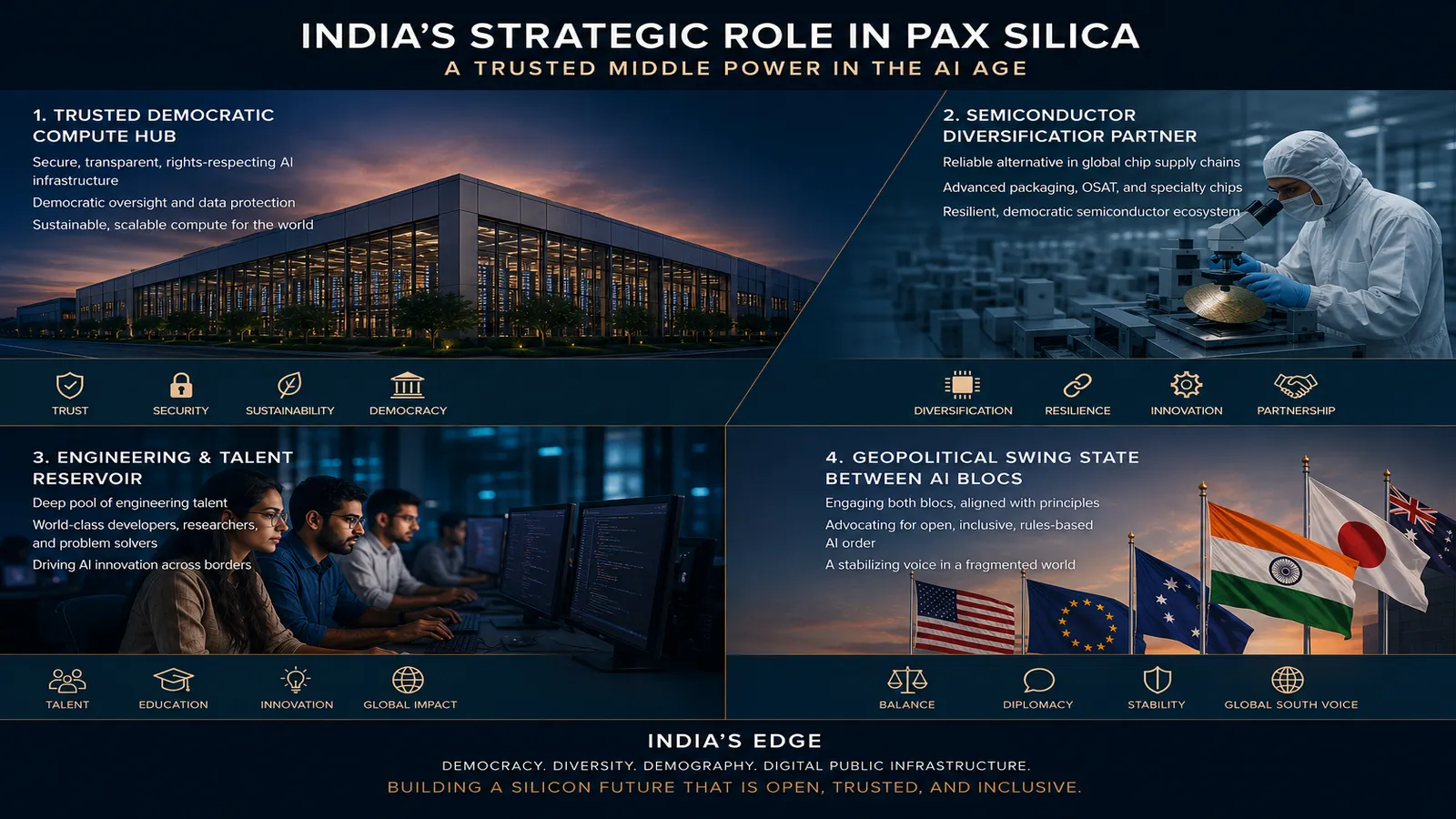
Illustration: India’s Role in Pax Silica .
New Delhi wants access to Western technology ecosystems without becoming technologically dependent on them. At the same time, India cannot realistically isolate itself from Chinese manufacturing networks overnight.
That creates a difficult balancing act.
India’s most realistic role in Pax Silica may not be as the dominant AI superpower, but as a strategic middle power:
- a trusted democratic compute hub,
- a semiconductor diversification partner,
- an engineering and talent reservoir,
- and a geopolitical swing state between competing AI blocs.
The bigger challenge is infrastructure.
India still lacks advanced semiconductor manufacturing at scale. Its compute infrastructure remains limited compared to the United States and China. If AI becomes the foundation of future economic and military power, those weaknesses could become strategic liabilities.
India’s ambitions to emerge as a developed economic power by 2047 will increasingly depend not just on GDP growth, but on technological sovereignty and compute capacity.
Read also: India’s $30 Trillion Economy Vision and Viksit Bharat 2047
There is also a deeper economic reality emerging behind the AI race. As American technology giants surge in value, the concentration of digital power itself is becoming geopolitical.
Read also: Google’s $4 Trillion Valuation vs India’s GDP
The Fragmentation of the Digital World
For years, the internet pushed the world toward integration. AI may push it toward fragmentation.
Countries increasingly want sovereign AI models, localized cloud systems and domestic control over strategic digital infrastructure. Governments are becoming more uncomfortable with critical systems being dependent on foreign-controlled technology stacks.
That trend is accelerating.
The result may not be a single universal AI ecosystem, but multiple competing digital spheres shaped by geopolitical alignment.
Future crises may involve restrictions on compute access, semiconductor exports or cloud infrastructure rather than traditional sanctions alone.
The struggle for global influence is no longer confined to military bases, shipping lanes or energy corridors.
Increasingly, it runs through semiconductor fabs, GPU clusters and data centers.
That is the logic behind Pax Silica.
And unlike previous geopolitical transitions, this one is unfolding quietly — hidden behind supply chains, server farms and export regulations while the world remains distracted by the consumer side of AI.
But beneath the surface, the infrastructure of a new global order is already being built.