
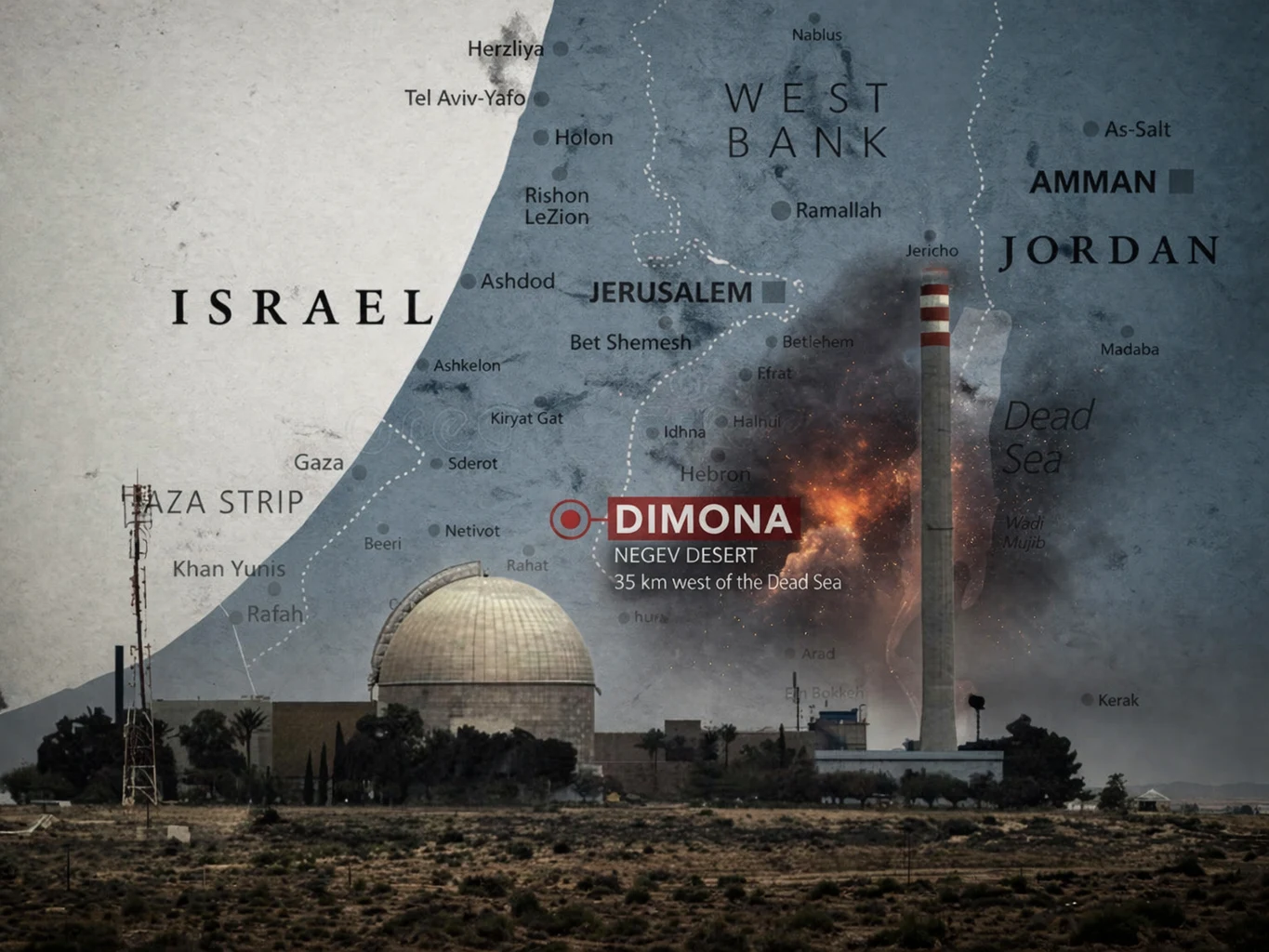
In the harsh stillness of Israel’s Negev desert, around 35 kilometers west of the Dead Sea, stands a city that feels almost improbable. In Dimona, Hebrew and Marathi can still be heard in the same neighborhoods. On some streets, the smell of homemade Indian food drifts through the desert air. This is Israel’s “Little India,” home to a large Bene Israel community whose story stretches across centuries, continents, and now, once again, conflict.
For decades, Dimona lived with a strange dual identity. It was a quiet desert town where families built ordinary lives, raised children, and carried old traditions into a new land. But it was also one of the most symbolically charged places in the Middle East. Behind the routines of daily life stood another reality: Dimona’s name was inseparable from Israel’s most sensitive strategic secrets.
On Saturday night, March 21, 2026, that fragile distance collapsed.
As Iranian missiles pierced parts of Israel’s air-defense shield and landed near Dimona, the illusion that this desert city could remain somehow insulated from the region’s wars suddenly gave way. For the Bene Israel families who had made their lives here, this was not just another episode in the long Israel-Iran confrontation. It was the moment the wider war arrived at their doorstep.
A journey that began on India’s western coast
To understand why Dimona carries such emotional and strategic weight, you have to look far beyond missile trajectories and military maps. You have to go back to India’s Konkan coast.
The Bene Israel are among the world’s oldest Jewish communities. Community tradition holds that their ancestors arrived on India’s western coast after a shipwreck many centuries ago. Whatever the precise origins, what followed is one of the most remarkable stories in the Jewish diaspora: for nearly two thousand years, they built a life in Maharashtra, spoke Marathi, adapted to local customs, and yet held firmly to their religious identity. They became deeply Indian without ceasing to be Jewish.
That is what gives their story its unusual power. In many parts of the world, minority identity is shaped through exclusion or persecution. In India, the Bene Israel experience took a different path. Over generations, they built a distinctly Indian Jewish life—rooted, adaptive, and remarkably durable. For readers who want background on the community’s long history, Britannica’s overview of the Bene Israel offers a useful starting point.
When many Bene Israel families migrated to Israel in the 1950s and after, they did not all settle in the country’s prosperous coastal centers. Many were directed toward frontier towns and development zones. Dimona became one of those places. It was dry, remote, and far from the romantic image of Mediterranean Israel. But it was where they were asked to build, and so they did.
Over time, Dimona became more than a settlement project. It became a cultural transplant. Indian melodies survived in prayer. Marathi lingered inside homes and across generations. Food proved the most stubborn archive of memory. The desert did not erase the Konkan. In some ways, it preserved it.
The town beside the secret
But Dimona was never just another town.
For decades, it existed in the shadow of one of the world’s worst-kept secrets: Israel’s nuclear complex. Officially, the policy was silence, ambiguity, opacity. Unofficially, everyone understood what Dimona represented. The site was central not just to Israel’s deterrence posture, but to the wider psychological balance of the region. It belonged to that small category of places whose importance extended far beyond what governments were willing to say aloud.
That is why the March 21 strike felt different.
This was not merely another exchange in a familiar cycle of regional retaliation. It pushed the conflict into the proximity of one of Israel’s most sensitive strategic zones. Even if the nuclear site itself remained intact, the symbolism was enormous. Iran had shown that Dimona could no longer be treated as untouchable in the public imagination. Public reporting after the incident also noted that the IAEA said it had no indication of damage to the nuclear facility itself.
That matters because, in the Middle East, symbolism is never separate from strategy. Sometimes it is strategy.
For years, the region lived with certain invisible boundaries—sites that could be invoked, threatened, and hinted at, but not too directly drawn into open confrontation without risking something far larger. Dimona belonged to that category. March 21 did not erase that boundary completely. But it made it look far thinner, far more fragile, and far less permanent than it once seemed.
The new arithmetic of war
There is another reason the strike near Dimona should unsettle military planners far beyond Israel.
It exposed, again, the brutal economics of modern warfare.
Air-defense systems are among the most advanced technologies any state can field. They are marvels of engineering. But they are also expensive, finite, and vulnerable to mass. A saturation attack does not need to prove that the defender is weak. It only needs to prove that even the best defender cannot intercept everything, every time, at acceptable cost.
That is the more important lesson.
For years, advanced air defense was treated as a near-magical answer to missile and drone threats. The new reality is harder and less flattering. Cheap drones, decoys, and ballistic pressure can force even elite systems into costly, unsustainable choices. Every interceptor fired carries a price. Every projectile that gets through carries consequences well beyond the physical damage it causes.
This is the weaponization of arithmetic. One side does not need perfect weapons. It needs enough affordable ones to create pressure faster than the other side can absorb it.
That equation is now being studied everywhere—from Tehran and Tel Aviv to Washington, New Delhi, and Beijing. For India, that conversation connects directly to the future of India’s defence stocks and the broader push to build resilient anti-drone and layered air-defence capabilities at home.
Why India should care
At first glance, a missile strike near Dimona may seem like a distant Middle Eastern episode with limited relevance for India. That would be a mistake.
The first reason is human. The Bene Israel of Dimona are not an abstract diaspora. They are part of India’s extended civilizational story. Their presence in the Negev is one of the clearest examples of how Indian identity can travel across continents without fully dissolving. When conflict reaches them, it resonates in India in a way that ordinary foreign headlines do not.
The second reason is strategic. India is entering an era in which drone warfare, electronic warfare, missile defense, and counter-swarm systems will matter more than ever. The strike near Dimona is a warning that future battlefields may not reward the state with the most advanced single platform. They may reward the side that can impose costs faster, cheaper, and in greater volume.
That has direct implications for Indian defense planning. It also has implications for Indian firms working in radar, electronic warfare, layered air defense, and anti-drone systems. The old prestige model of procurement—buying a handful of elite systems and assuming technological superiority will settle the question—is beginning to look outdated. Quantity, software, adaptability, and cost efficiency now matter almost as much as sophistication. That is also why the market keeps revisiting the link between Middle East escalation and Indian defence stocks during regional war shocks.
The third reason is energy. Any serious escalation involving Iran immediately raises the risk profile of the Strait of Hormuz. For India, that is not some distant geopolitical abstraction. It is a live economic artery. Oil shocks move fast. Freight shocks move fast. Insurance shocks move fast. According to the U.S. Energy Information Administration, around one-fifth of global petroleum liquids consumption moves through Hormuz, which is why even limited disruption can quickly hit sentiment and pricing across Asia. For investors, that also feeds into the wider story of the US-Iran war’s market impact on defence stocks.
When distance stops protecting you
What happened near Dimona on March 21 was not the beginning of nuclear war. In some ways, it was more revealing than that. It showed how fragile the old comfort zones have become.
For the Bene Israel families of Dimona, this was not about grand strategy written in sterile language. It was about the end of distance. The wars of the region were no longer something unfolding on television screens, along faraway frontiers, or inside intelligence briefings. They had entered a town where Indian food, Marathi memory, and Jewish history had learned to live together under the desert sun.
That is what gives this story its force.
Dimona is not only a strategic site. It is also a place where migration, faith, memory, and national security sit uneasily on top of one another. A place where an old Indian diaspora found shelter in a severe landscape, only to discover that in today’s Middle East, no place remains outside history for long.
For years, Dimona felt like a paradox that somehow held. After March 21, it feels more like a warning.